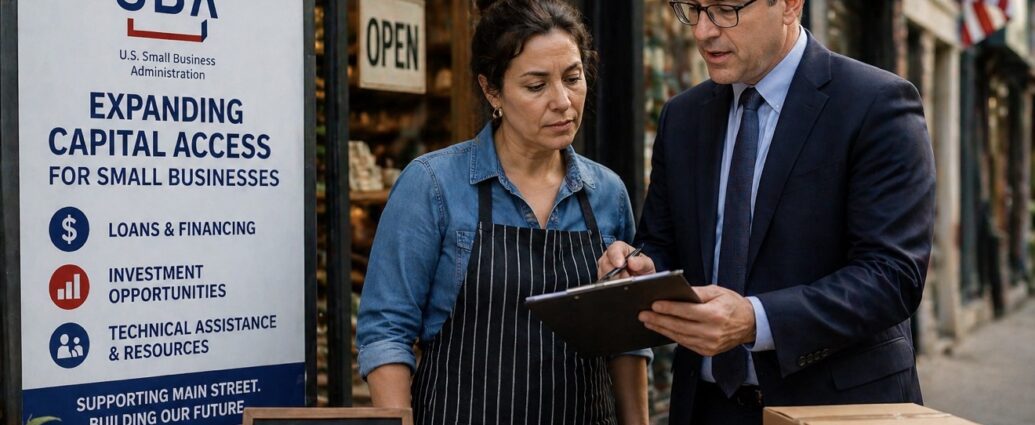
The U.S. Small Business Administration is rolling out its most aggressive capital access push in years — but the agency’s focus is squarely on manufacturers, food producers, and onshoring, not the kind of across-the-board relief that cost-squeezed retailers are hoping for.
On March 31, the SBA announced that small manufacturers across the country would soon be eligible for enhanced support through the agency’s International Trade Loan program, offering loans with a 90% federal guarantee to help manufacturers expand facilities, hire workers, and increase production. The SBA also expanded ITL eligibility to include small businesses across the food supply chain, including agriculture, production, and logistics. 
SBA Administrator Kelly Loeffler framed the initiative in explicitly industrial terms, stating the program would “give U.S. manufacturers additional financing to expand operations, modernize equipment, and supercharge domestic production,” adding that small businesses make up 98% of all manufacturers in America. 
The loan guarantee expansion builds on a broader suite of manufacturing-focused programs the agency has assembled over the past year. The SBA waived most upfront fees for small manufacturers in Fiscal Year 2026, with 7(a) manufacturing loans up to $950,000 carrying a 0% upfront fee, and all 504 manufacturing loans carrying a 0% upfront fee and 0% annual service fee through September 30, 2026.  The House of Representatives also passed the Made in America Manufacturing Finance Act on a bipartisan and unanimous vote, which would double the SBA’s loan limit for small manufacturers from $5 million to $10 million. 
For small retailers specifically — a sector now absorbing stacked shipping surcharges, elevated insurance premiums, and stubbornly high energy costs — the current SBA push offers limited direct relief. The agency’s capital programs are structured around production and onshoring, not the operational cost pressures that define the retail squeeze. The Trump administration’s FY2026 budget proposal called for ending 15 of the SBA‘s 16 entrepreneurial development programs and proposed a participation fee for business loan program lenders — a posture that narrows rather than expands the agency’s general small business support footprint. 
What the SBA is doing for the broader small business community centers on outreach and training. The agency announced its National Small Business Week 2026 Virtual Summit, a free two-day event running May 5–6, featuring sessions on access to capital, fraud protection, AI tools, hiring strategy, and federal contracting — co-sponsored by Visa, Google, Amazon, T-Mobile, Verizon, Paychex, Meta, and America’s SBDC. 
The capital gap for Main Street retailers, however, remains unaddressed by any current federal program. Comerica Bank Executive Vice President Larry Franco has described small business owners as stuck in “defensive mode rather than having the ability to focus on building and growing,” with inflation, labor availability, and economic uncertainty as the top drags on confidence heading into 2026.  The SBA‘s manufacturing-first posture reflects the administration’s broader industrial policy — but for the corner retailer absorbing a 42% rise in parcel shipping costs since 2022 and a labor market where nearly a third of openings go unfilled, the federal response remains largely out of reach.
Businesses seeking to access current SBA programs can visit sba.gov or use the SBA Lender Match portal to connect with participating lenders. National Small Business Week runs May 3–9, with the free virtual summit open to registration at sba.gov/NSBW.
JBizNews Desk
© JBizNews.com. All rights reserved. This article is original reporting by JBizNews Desk. Unauthorized reproduction or redistribution is strictly prohibited.