May 1, 2026
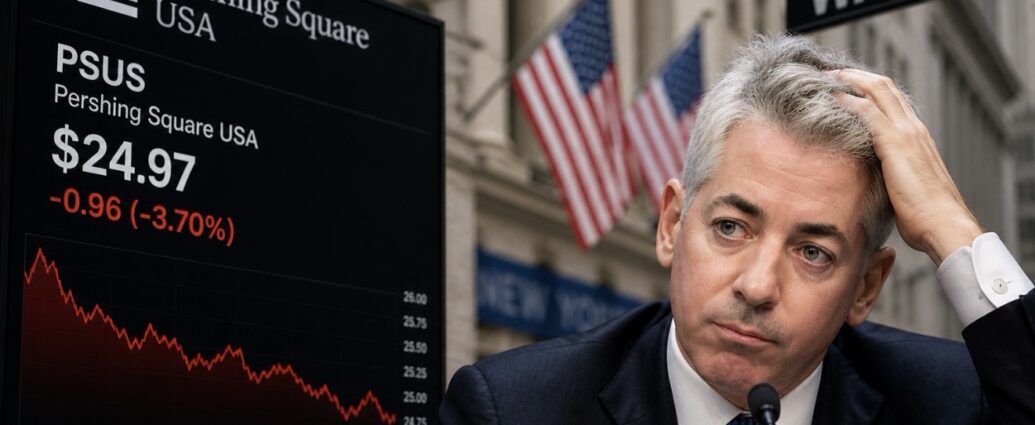
It was not the debut Bill Ackman had in mind. Pershing Square USA, the billionaire investor’s highly anticipated closed-end fund, fell sharply on its first day of trading Wednesday — erasing nearly a fifth of its value within hours of hitting the market.
Shares priced at $50 but traded as low as $40.33 in the minutes after the opening. By the close, PSUS settled at $40.90 — down 18.2% on the day. 
Pershing Square Inc., the asset management company that listed alongside the fund under the ticker PS, ended its first day at $24.20. 
An investor who bought five shares in the IPO — and received the bonus share of PS that came with the deal — was down roughly 9% on a combined basis by the close, according to calculations by Bloomberg. 
The offering marked the largest closed-end fund launch in U.S. history, but it came in at the low end of Ackman’s ambitions. He had originally targeted between $5 billion and $10 billion. The deal raised $5 billion, with about $2.8 billion already committed by large institutional investors before the IPO opened to the public. 
This was not Ackman’s first attempt at a U.S. public listing. He tried a similar launch in 2024 but pulled it after weak investor interest. 
This time, he structured the deal differently to bring in everyday investors. He lowered the minimum purchase from $5,000 to $250 and partnered with retail brokerages to reach their user bases.  The fund charges a 2% management fee with no performance fees — a departure from the typical hedge fund model that takes a cut of profits.
On the morning of the IPO, Ackman told CNBC: “Hedge funds are sort of known for managing money for rich people. And now we have the opportunity for someone with $50 to be a long-term shareholder. Usually, the retail gets cut massively back, the institutions are favored. We did the opposite.” 
The market, at least on day one, was not convinced. The sharp drop reflects a challenge that closed-end funds frequently face — shares often trade at a discount to the value of the underlying assets once the initial hype fades. Investors who buy in at the IPO price can quickly find themselves underwater even if the portfolio itself performs well.
By Thursday, Ackman moved to show confidence in the deal. He disclosed he had purchased 500,000 shares of PSUS and 800,000 shares of PS out of his own pocket on the first day of trading. Shares rebounded on the second day following the disclosure. 
Whether the bounce holds will depend on how Ackman performs as a public market investor and whether retail investors — the audience he specifically courted — stick with the fund through the early turbulence.
JBizNews Desk
© JBizNews.com. All rights reserved. This article is original reporting by JBizNews Desk. Unauthorized reproduction or redistribution is strictly prohibited.