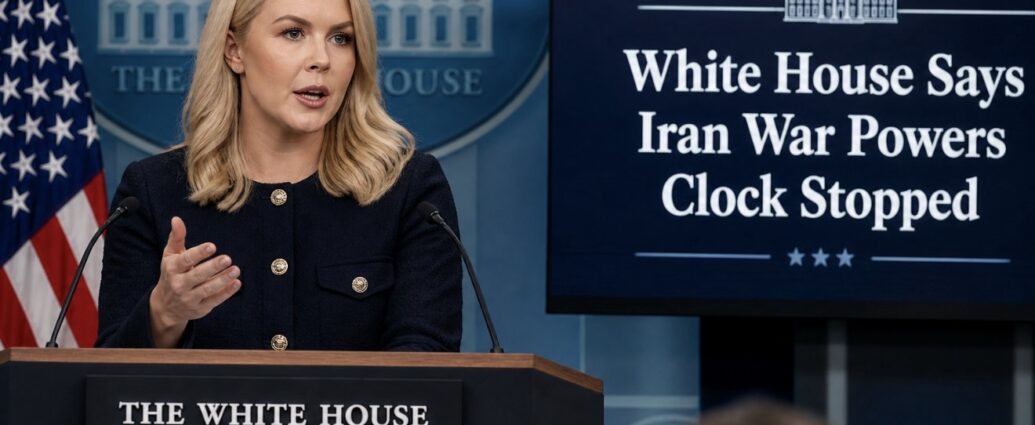
The White House is arguing that the U.S.-Iran conflict effectively ended for War Powers purposes when an April 7 cease-fire took hold, a position that could spare President Donald Trump from seeking fresh congressional authorization if hostilities stay frozen. A senior administration official told Associated Press that “for purposes of the 1973 War Powers law, the fighting has terminated,” framing the cease-fire as the legal dividing line even though U.S. forces remain deployed and tensions in the Gulf continue.
That interpretation immediately sharpened a constitutional fight in Washington because the War Powers Resolution generally requires a president to end military involvement within 60 days absent congressional approval. At a Senate Armed Services Committee hearing, Defense Secretary Pete Hegseth said the cease-fire “effectively pauses the war” and that “our understanding is that the clock stops while the parties observe the cease-fire,” according to reporting from Bloomberg. His comments signaled the administration intends to treat the lull not simply as a tactical pause but as a legal reset.
Lawmakers in both parties quickly pushed back, saying a cease-fire does not erase Congress’s role in authorizing force. Republican Senator Susan Collins of Maine said the deadline “is not a suggestion; it is a requirement,” according to Reuters, adding that “further military steps must have a clear mission, achievable goals, and a defined strategy for bringing the conflict to a close.” Her remarks matter because they show skepticism inside the president’s own party at a moment when the administration needs political cover as the 60-day timeframe draws scrutiny.
Democratic Senator Tim Kaine, one of Congress’s most persistent advocates of war-powers limits, called the administration’s theory legally unsupported. He said Hegseth “advanced a very novel argument that I’ve never heard before” and that it “certainly has no legal support,” according to AP. Kaine has urged the administration to submit any continued military campaign against Iran for formal authorization, arguing that a cease-fire cannot substitute for a vote by Congress if U.S. operations resume or remain active in substance.
Outside legal experts echoed that criticism and said the administration’s reading could stretch executive authority well beyond prior precedent. Katherine Yon Ebright, counsel at the Brennan Center for Justice’s Liberty and National Security Program, said “to be very, very clear and unambiguous, nothing in the text or design of the War Powers Resolution suggests that the 60-day clock can be paused or terminated,” according to remarks cited by CNBC. She described the cease-fire rationale as “a sizeable extension of previous legal gamesmanship,” underscoring the risk that a temporary halt in fighting could become a template for avoiding congressional checks in future conflicts.
The legal dispute is unfolding against a fragile military backdrop in the Persian Gulf, where the cease-fire has held but strategic pressure remains high. The waterway at the center of the confrontation, the Strait of Hormuz, still carries a large share of the world’s seaborne crude, and a U.S. Navy spokesperson told the Financial Times that American forces remain “positioned to ensure freedom of navigation while monitoring any escalation.” That statement suggests the administration’s claim that hostilities terminated does not mean the operational risk has disappeared for energy markets, shipping companies or regional allies.
Market participants are already reading the legal debate through the lens of oil and geopolitical risk. Analysts at Barclays said the White House stance could shape investor perceptions of whether the conflict truly cooled or simply entered a politically convenient pause, according to Dow Jones. Senior commodities strategist Laura Chen said, “Investors are watching how the administration navigates the legal hurdle; any perceived weakness could reignite price volatility,” a reminder that constitutional arguments in Washington can quickly feed into freight costs, insurance premiums and crude pricing.
Some national security hawks, while not disputing the need to protect shipping lanes, are already discussing ways to reframe the mission if the legal challenge intensifies. Richard Goldberg, a former National Security Council counter-proliferation official now at the Foundation for Defense of Democracies, said in comments cited by MarketWatch that the administration could recast the operation as a self-defense effort focused on reopening the strait. “That mission would be self-defense focused on reopening the strait while reserving the right to offensive action in support of restoring freedom of navigation,” he said, effectively outlining a narrower legal theory if the cease-fire argument fails to persuade Congress or the courts.
What comes next now matters as much as the legal theory itself. Congressional leaders are weighing whether to force a vote on a joint resolution either authorizing continued action or directing its end, and several lawmakers have said privately to major U.S. outlets that the administration’s position could become a defining test of executive war-making power. If the cease-fire holds, the White House may avoid an immediate showdown; if firing resumes, the claim that the conflict already ended could unravel quickly, raising the odds of a direct constitutional clash with consequences for U.S. policy, oil flows and military credibility across the Middle East.
JBizNews Middle East Desk