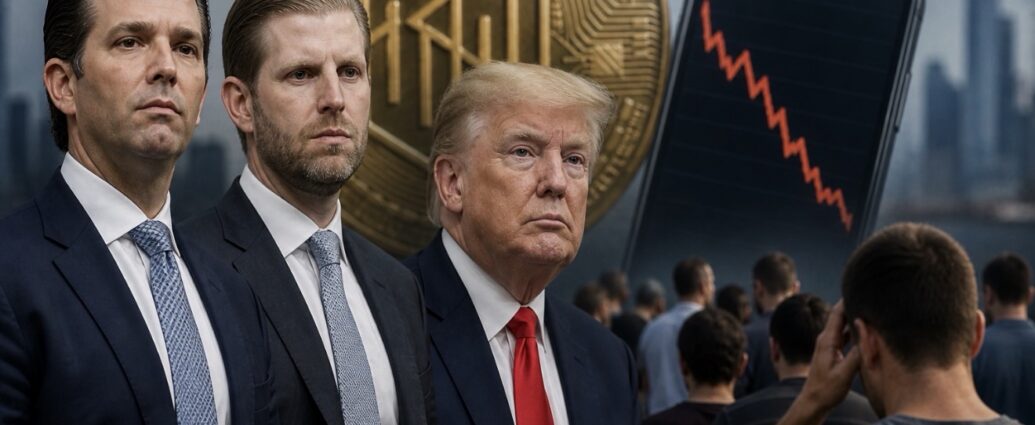
What was pitched as a chance to back the most powerful family in American politics at the peak of their influence has turned into one of the messiest stories in crypto this year. World Liberty Financial, the cryptocurrency venture co-founded by President Donald Trump and his sons, raised over half a billion dollars from investors — and now those same investors are finding they cannot get out.
The Setup
The pitch was straightforward: invest in the cryptocurrency venture of Donald Trump and his family, back the industry’s most powerful ally at the peak of their influence, and share the spoils. Investors said yes, putting in more than $550 million across two fundraising rounds. 
The project — built around a governance token called WLFI and a dollar-pegged stablecoin called USD1 — drew in institutional money, foreign governments, and high-profile crypto figures. For a moment, it looked like a success story. It has not played out that way for most investors.
Tokens Frozen, Price Collapsed
WLFI was trading at around $0.08 — roughly an 82% drop from its all-time high of $0.46 last September.  For investors who bought in near the top, there is no easy exit. World Liberty Financial proposed that tokens owned by some early investors remain unavailable for trading indefinitely — or at least until President Trump leaves office. Those who do not agree to the new terms would see their tokens locked “indefinitely,” according to the proposal. 
The structure of the project has also drawn scrutiny. The WLFI token is not backed by any assets, does not convey ownership in the company, and public token buyers hold only about a third of all tokens. The rest are held by the Trump family and other insiders, meaning outside investors would have a hard time outvoting them. 
The Family’s Take
While outside investors have watched their holdings lose most of their value, the Trump family has done considerably better. By December 2025, the Trumps had profited roughly $1 billion in proceeds from WLFI token sales while holding another $3 billion in unsold tokens.  The Trump family’s LLC is entitled to 75% of WLFI token sale proceeds after deductions. 
The Lawsuit
The most dramatic flashpoint came from Justin Sun, the billionaire founder of Tron and the largest known outside investor in the project. Sun filed a lawsuit in California federal court against World Liberty Financial, accusing the company of wrongful token freeze, fraudulent misrepresentation, defamation, and running an illegal scheme to seize his property through smart-contract changes. 
Sun alleged that World Liberty Financial secretly embedded a backdoor blacklisting function that gave insiders unilateral power to freeze any token holder’s wallet without notice, vote, or clear cause — a power he says was never disclosed to investors.  His frozen position reportedly fell from over $100 million in value to under $43 million as the token price collapsed, leaving him unable to sell or hedge. 
World Liberty Financial fired back, accusing Sun of misconduct and saying the freeze was triggered by transfers that violated his investor agreement.
Insider Loans Add to the Fire
WLFI‘s token price tumbled nearly 15% after CoinDesk reported that Corey Caplan, the project’s chief technology officer, used the project’s reserve of WLFI tokens to make loans on a third-party crypto platform he co-founded — a platform called Dolomite, ranked only the 13th-largest crypto lending platform in the market. 
Roughly 5% of WLFI’s entire token supply was pledged as collateral on Dolomite, raising concerns that a significant price drop could trigger a liquidation that would force World Liberty to sell tokens into an already weak market — pushing the price down further for everyone still holding. 
What It Means
For everyday investors who put money into World Liberty Financial based on the promise of backing a president’s crypto vision, the reality has been a token worth a fraction of what they paid, no clear path to exit, and a project whose insiders appear to have fared far better than those on the outside. The legal battles, governance disputes, and frozen wallets are still unfolding — and for most token holders, so is the wait.
JBizNews Desk
© JBizNews.com. All rights reserved. This article is original reporting by JBizNews Desk. Unauthorized reproduction or redistribution is strictly prohibited.