JBizNews Desk | New York |Monday, May 4, 2026
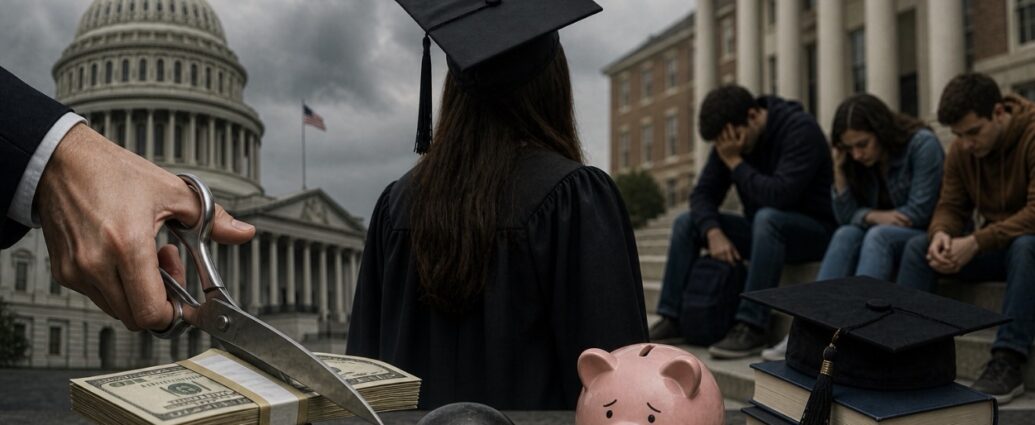
The U.S. Department of Education is moving to strip federal loan access from college programs whose graduates do not earn enough to justify the debt, a policy shift that could reshape how universities price, market and even keep certain degrees. In a proposed rule published in the Federal Register on April 17 and formally released April 20, Nicholas Kent, the department’s under secretary, said the administration wants to stop taxpayers from backing programs that leave students financially worse off, saying in a department release that the framework would “drive meaningful change in postsecondary education” and end “years of regulatory whiplash.”
Under the proposal, undergraduate programs would need to show that former students earn at least as much as a typical high-school graduate, while graduate programs would need to clear the earnings level of a typical bachelor’s-degree holder, according to the department’s rulemaking documents. The administration also said institutions with failing programs would need to warn current and prospective students about “low-earning outcomes,” with earnings data tied to tax records, according to the Department of Education. Kent said the approach aims to bring accountability and transparency to program-level outcomes, a notable expansion beyond earlier federal accountability efforts. The public comment period closes May 20, 2026, after which the department will review submissions before issuing a final rule expected to take effect July 1, 2026.
The proposal lands at a sensitive moment for higher education finance, with the federal student-loan portfolio still hovering around $1.7 trillion, according to Federal Student Aid data. Preston Cooper, a senior fellow at the American Enterprise Institute and the designated representative of taxpayer interests on the accountability rulemaking committee, said during the rulemaking sessions that “some people go to college and take out loans for programs that really just don’t have a whole lot of economic value,” arguing that federal lending cannot keep supporting pathways that leave borrowers with debt they struggle to repay. His analysis of department data found that roughly $1.2 billion in Pell Grant funds annually flows to programs likely to fail the proposed earnings test. The broader implication is that public universities, private nonprofit colleges and vocational schools could all face pressure to cut weak-performing offerings, redesign curricula or steer students toward fields with stronger wage outcomes.
Not everyone agrees that earnings should carry that much weight in judging a degree’s value. Daniela Amodei, president of Anthropic, told ABC News in a February interview that “studying the humanities is going to be more important than ever,” arguing that judgment, communication and cultural understanding remain essential even as artificial intelligence changes the labor market. That tension sits at the center of the policy debate: the administration frames the rule as consumer protection, while critics warn that a narrow wage test could squeeze disciplines that produce social or civic value without generating high early-career pay.
Even some advocates of stronger accountability say the issue is not simply whether a program leads to the highest salary. Steve Taylor, policy director at the Stand Together Trust, said that “college can have civic, personal, and cultural value beyond wages,” but added that “when students are taking on federal debt, it’s fair to ask whether a program gives them a reasonable path to repay what they borrowed.” That framing could resonate with policymakers in both parties, particularly as families question tuition costs and as colleges confront a shrinking pool of traditional-age students.
The administration built in a long runway before penalties take effect. According to the proposal, schools would lose loan eligibility only if a program fails the earnings test in two out of three years. Cooper said the structure is “corrective rather than punitive,” suggesting many colleges may try to revise low-performing programs, improve job placement or close offerings that no longer make economic sense. The first earnings calculations under the new framework are expected to be published by July 1, 2027, using earnings data from students who completed programs in 2025.
The earnings rule also fits into a broader effort to tighten graduate borrowing. The administration said it is phasing out the Grad PLUS loan program beginning July 1, 2026, while capping annual borrowing at $50,000 for professional students and $20,500 for other graduate study, with aggregate lifetime limits of $200,000 and $100,000 respectively, according to the same Department of Education rulemaking documents. Kent said those limits would “protect borrowers from excessive debt while ensuring that federal resources are directed toward programs that lead to sustainable careers,” linking the undergraduate and graduate changes into a single accountability push.
For colleges, lenders and employers, the next key milestone is the close of the public-comment period on May 20 and the department’s final rulemaking, which will determine how aggressively Washington ties aid to labor-market outcomes. Education leaders and investors will watch whether schools accelerate industry partnerships, apprenticeships and program redesigns to preserve access to federal aid. If the rule survives the political and legal scrutiny that often follows major education policy changes, it could become one of the most consequential federal interventions in higher education economics in years, forcing institutions to prove not only what they teach, but what that education delivers in the job market.
JBizNews Desk
© JBizNews.com. All rights reserved. This article is original reporting by JBizNews Desk. Unauthorized reproduction or redistribution is strictly prohibited.