JBizNews Desk | New York | Sunday, May 3, 2026
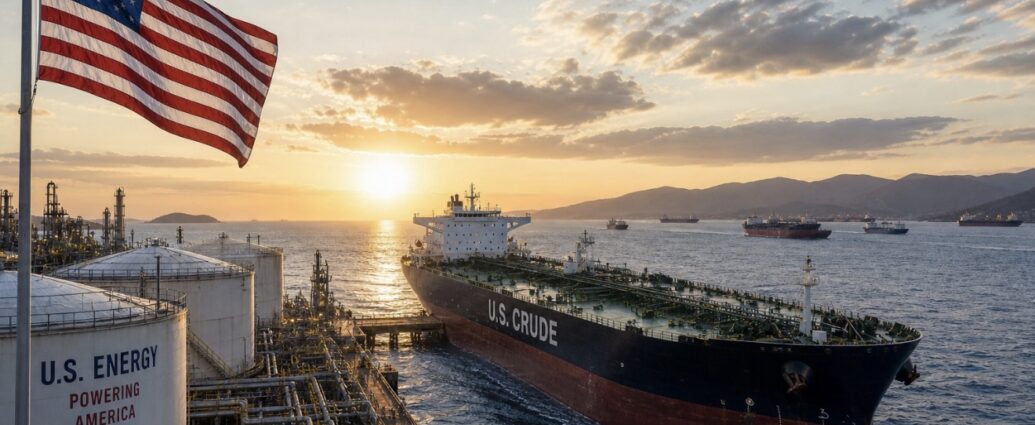
Tankers are loading up in Alaska and along the U.S. Gulf Coast and sailing to Japan, Thailand and Australia in unprecedented numbers. Nine weeks into the effective closure of the Strait of Hormuz, the United States has surpassed Saudi Arabia as the world’s top crude exporter and become the energy supplier global markets cannot function without — but energy executives and analysts warned this week that America’s supply cushion is running out faster than the world realizes.
Over the past nine weeks, more than 250 million barrels of crude from American oil wells and storage facilities have been shipped overseas, according to Bloomberg reporting published Sunday, May 3. That volume has made the U.S. once again the world’s number one crude exporter. But domestic oil and fuel stockpiles have drawn down for four consecutive weeks, falling below historical averages, raising serious questions about how long record exports can be sustained.
President Donald Trump told reporters Friday, May 2: “This has been amazing. The amount of oil and gas that we’re selling now is at a level that nobody’s ever seen.” He added: “We have more oil production right now than any time in history. And if you take a look at the ships, they’re all coming up to Texas, Louisiana, Alaska.”
Chevron chief executive Mike Wirth offered a starkly different assessment Friday, May 2, saying the global energy system is under “extreme stress.” The day before, Thursday, May 1, ConocoPhillips warned that “critical shortages” of oil are imminent. In anonymous survey comments published in late April by the Federal Reserve Bank of Dallas, energy executives said: “The unpredictable nature of the current administration makes business modeling near impossible.”
The Largest Supply Disruption in History
International Energy Agency Executive Director Fatih Birol has left no room for ambiguity about the scale of what has happened. Speaking on the podcast “In Good Company” hosted by Norges Bank Investment Management chief executive Nicolai Tangen on April 1, Birol said the energy crisis sparked by the war was “the worst in history” — worse even than the 1973 and 1979 oil shocks. “In both of them we lost each about 5 million barrels per day of oil. These oil crises led to global recession in many countries,” Birol said. “Today, we lost 12 million barrels per day — more than two of these oil crises put together.”
Crude and oil product flows through the Strait of Hormuz plunged from 20 million barrels per day before the war to just over 2 million barrels per day in March, according to the IEA’s April 14 monthly Oil Market Report. In early April, loadings through the Strait averaged just 3.8 million barrels per day, compared with more than 20 million barrels per day in February before the crisis, the IEA reported. Gulf producers including Iraq, Saudi Arabia, Kuwait, the UAE, Qatar and Bahrain collectively shut in an estimated 9.1 million barrels per day of crude production in April as onshore storage filled with oil that had nowhere to go.
Brent crude surged more than 60 percent over the course of March alone — the biggest monthly price gain since records began in the 1980s — before reaching a peak near $150 per barrel in physical markets, according to the IEA’s April Oil Market Report. JP Morgan warned that inventories are reaching minimum operational levels, with the actual shortage potentially doubling from 4 million barrels per day to as much as 8 million barrels per day as stockpiles and oil at sea are exhausted, according to analysis cited by Economics Help on May 2.
Birol told CNBC on April 1 that the IEA’s emergency reserve release of 400 million barrels — the agency’s largest ever, unanimously agreed by member countries on March 11 — was not a solution. “This is only helping to reduce the pain, it will not be a cure,” he said. “The cure is opening up the Strait of Hormuz.”
Rory Johnston, founder of Commodity Context, said April 21 that any reopening of the Strait would likely trigger an immediate drop of $10 to $20 in crude prices due to speculative positioning — but warned supply chain bottlenecks, infrastructure damage and production outages would keep the market tight, likely anchoring Brent in the $80 to $90 range even after a reopening. “This is still the largest oil supply shock in the history of the oil market,” Johnston said. “Without a sustained restoration of flows, prices may need to rise further to curb demand.”
Tony Sycamore, market analyst at IG, said in a note published April 30: “Prospects for any near-term resolution to the Iran conflict or a reopening of the Strait of Hormuz remain dim.”
Vitol chief executive Russell Hardy said April 21 that one billion barrels of oil production will be lost because of the war, with the current running total already between 600 and 700 million barrels. Naif Aldandeni, energy strategist, told Al Jazeera on March 15 that the IEA’s reserve release was “a small bandage on a large wound,” adding that the release would produce “only a temporary stabilising effect.”
What It Means at the Pump
For ordinary Americans, the consequences are direct. Retail gasoline prices have climbed to an average of $4.40 per gallon, according to Bloomberg. The U.S. Energy Information Administration reported March 30 that average retail gasoline stood at $3.99 per gallon and diesel at $5.40 per gallon — the highest levels in real terms in over two years. Gas prices have risen $1.16 per gallon since the start of the war, with prices expected to hit $5.00 per gallon if the Strait remains closed, according to the 2026 Iran War Fuel Crisis entry on Wikipedia. Jet fuel has spiked 95 percent since the war began, causing multiple airlines to raise baggage fees. Energy Secretary Chris Wright has repeatedly cited the $5-per-gallon threshold as the key political benchmark heading into November’s midterm elections.
U.S. domestic oil production has actually fallen roughly 100,000 barrels per day since the war began as drillers remain hesitant to invest amid deep uncertainty, according to Bloomberg. Exxon Mobil and Chevron are also managing disruptions to their Middle East operations, adding further constraints.
LNG and Fertilizer: The Hidden Crisis
The disruption extends well beyond crude oil. LNG supplies from Qatar and the UAE through the Strait of Hormuz have been cut by more than 300 million cubic metres per day since March 1, according to the IEA — reducing global LNG supply by roughly 20 percent. QatarEnergy declared force majeure on all export contracts after its Ras Laffan facility — the world’s largest LNG liquefaction plant — was struck on March 2 and went offline. The company warned repairs could take up to five years. Steven Wilson, a partner in the global energy practice at law firm Mayer Brown, said in late March that LNG suppliers were becoming more selective in negotiating long-term contracts because spot market pricing had become far more lucrative — squeezing buyers and driving prices higher.
Over 30 percent of global urea and significant volumes of ammonia and phosphate transit the Strait of Hormuz. Morningstar analyst Seth Goldstein projected that nitrogen fertilizer prices could roughly double from 2024 levels. The UN World Food Programme warned the disruptions are driving long-term increases in global food prices, threatening a scenario similar to the 2022 food crisis.
How Long Can Iran Hold Out?
Muyu Xu, senior crude oil analyst at Kpler, told Al Jazeera in late April that the U.S. naval blockade was already slowing Iranian oil loadings and exports, pressuring onshore inventories. “We expect any production reduction to be gradual over the coming week, with a higher likelihood of acceleration into May,” Xu said.
Kenneth Katzman, former Iran analyst at the Congressional Research Service in Washington, told Al Jazeera that Iran had between 160 million and 170 million barrels of oil “afloat” on tankers around the world — cargo that transited the Strait before the U.S. blockade began — potentially giving Tehran revenue flows through August. “Does President Trump have until August? Probably not,” Katzman said. “He’s probably going to have to look at kinetic escalation if he wants to bring this to the conclusion he wants, or he’s going to have to accept less than the deal he ideally wants.”
The question now facing energy markets, policymakers and businesses worldwide is whether diplomacy can reopen the Strait before the supply shock forces demand destruction on a scale not seen since the 1970s energy crisis — an outcome none of the parties to the conflict has yet fully prepared the world for.
JBizNews Desk
© JBizNews.com. All rights reserved. This article is original reporting by JBizNews Desk. Unauthorized reproduction or redistribution is strictly prohibited.