In the crowded canon of books about how to change the world, few loom as large as Saul Alinsky’s “Rules for Radicals.” Published in 1971, the manual distilled decades of organizing wisdom into what Alinsky, a seasoned organizer on behalf of better housing, jobs, and schools, called “a pragmatic primer for realist radicals.”
Although Alinsky, who was raised in an Orthodox Jewish home before leaving religious observance behind, rarely foregrounded his Jewishness, the book begins with an epigraph from the Talmudic sage Hillel: “Where there are no men, be thou a man.”
“Rules for Radicals” was written during a time of epic social upheaval in the United States and was read avidly by Vietnam War protesters, feminists, civil rights activists, and warriors against poverty. More than half a century later, a new mini-genre of “how-to” books about dissent and activism has emerged, drawing lessons from past protests for the era of “No Kings” rallies, Black Lives Matter marches, and the campus pro-Palestinian encampments.
Coincidentally but intriguingly, three of these books were written by Jewish authors who, explicitly or implicitly, offer advice on resistance, drawing on Jewish wisdom, role models, and historical precedents.
Combating protest fatigue and political polarization
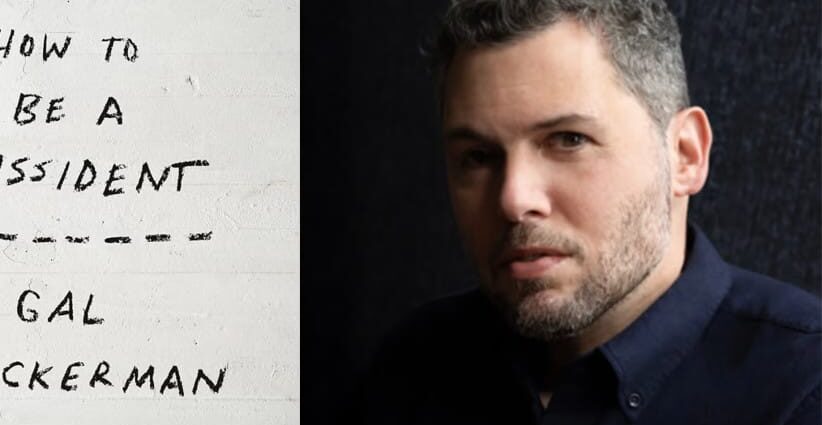
The three books, “How to Be a Dissident” by Gal Beckerman; the forthcoming “On Courage” by Julia Angwin and Ami Fields-Meyer; and “Be a Refusenik!” by Izabella Tabarovsky, arrive at a moment of protest fatigue and political polarization.
Only Tabarovsky’s book is aimed squarely at a Jewish audience, offering advice for Jewish students on how to fight back against a wave of anti-Zionism and antisemitism. The other two books are mainly about pro-democracy and anti-authoritarian movements. But taken together, the three reflect something like a Jewish conversation about identity, dissent, community, and the uneasy work of standing apart.
If Alinsky offered a field manual, Beckerman is after something more elusive: the inner life of dissent.
“I’m not someone who is comfortable at protests or looking to rush to the front of the barricades,” he said in an interview. Instead, “How to Be a Dissident” grew out of what he calls a long-running curiosity about how people arrive at moral decisions, “what happens in someone’s gut” when they decide to act. His previous book, “The Quiet Before,” was about how radical ideas become public social movements.
That curiosity, he suggests, is not incidental. The 49-year-old Beckerman, whose four grandparents survived the Holocaust, described growing up with a sense of how quickly societies can turn. “They seemed to be existing in environments where they felt fairly comfortable,” he said of his grandparents’ prewar lives, “and the notion that that could change so quickly was a kind of mystery.”
Beckerman explores those ruptures in a book that moves from the 17th-century Jewish philosopher Baruch Spinoza to Soviet Jewish refuseniks to Russian dissidents like Alexei Navalny. The book’s chapter titles distill their example and thought into directives: “Be Rational,” for example, describes how Spinoza applied the rigorous power of logical thinking to dispel superstition and annoy just about everybody.
The Soviet Jews who tried to hijack a plane in 1970, and who played a large role in Beckerman’s first book, “When They Come for Us, We’ll Be Gone,” a history of the Soviet Jewry movement, are featured in the chapter “Be Loyal.” It’s about the strong ties of friendship and common cause that can turn a bitch session into a movement.
“I’m not sure if any one of them, individually, would have done something so reckless as hijack a plane and try to fly to Israel from the Soviet Union,” said Beckerman. “What they discovered was that they shared this feeling, their friendship, and their loyalty to one another. This was part of what allowed them to gel as a group.”
Angwin and Fields-Meuyer offer a similar lesson in a chapter titled “Make a Minyan.” Drawing on the idea of the traditional Jewish prayer quorum, they suggest that the most important acts happen “among a group of people, in the context of community.”
Angwin said the idea of a “minyan” of activists emerged in the dozens of interviews she and Fields-Meyer conducted for the book, and stood in contrast to the “hero narrative,” which puts a single brave man or woman at the center of a movement. She also credits Fields-Meyer, whose mother was the rabbi at the Jewish day school he attended in Los Angeles, with the distinctive Jewish framing.
Angwin, a Pulitzer Prize-winning journalist who writes about business and tech, and Fields-Meyer, a senior adviser in the Biden White House, didn’t set out to write a “Jewish” book. But at the end of a Zoom conversation with a reporter who raised the idea, Angwin, 55, said she and her co-author “were surprised how often we found that we were writing about Jewish activists and how, especially for me, who’s not particularly practicing, it was a reminder of a strong Jewish tradition of activism and protest and fighting for rights. It was a nice bonus.”
Fields-Meyer, 31, said his role models include Sharon Brous, the activist rabbi of L.A.’s Ikar community, and David Myers, a professor of Jewish history at UCLA and the former board president of the left-wing New Israel Fund. “I come from that tradition of bringing that sort of Jewish spiritual depth to universalist politics,” he said.
Their book, he added, asks “how do we bring our values, whether explicitly Jewish or otherwise, into a moment where that’s going to get harder and harder under an authoritarian drift.”
“On Courage” touches on the Israeli-Palestinian conflict, each time in examples of critics of the Israeli government, its treatment of the Palestinians, and the war in Gaza. They profile Niveen Mosleh, a Palestinian woman from Gaza whose embroidery collective uses a traditional art form as a subtle form of resistance; Mikhael Manekin, the founder of the Smol Emuni movement of religious Jews who oppose the occupation; and Rumeysa Ozturk, a student from Turkey who was targeted by ICE after an anonymous Jewish “name and shame” group, Canary Mission, flagged an op-ed she co-wrote for the Tufts University student newspaper, urging the administration to join the anti-Israel boycott.
Their sympathetic portraits of these activists stand in sharp contrast to Tabarovsky’s project, which is to help “young American Jews who refuse to submit to an increasingly totalizing campus culture that demands they erase critical parts of their identity, particularly Zionism and their connection to Israel.”
Tabarovsky, who has studied antisemitism as a fellow of the Woodrow Wilson Institute and is a senior fellow at the Z3 Institute for Jewish Priorities, argues that there is a direct line from the anti-Zionist propaganda promulgated by the Soviet Union to today’s pro-Palestinian protests, including the anti-Zionist Jews who join them.
Her book draws directly on the Soviet Jewry movement, offering refuseniks, the Soviet Jews, and other dissidents who were denied permission to emigrate in the 1970s and 1980s, as a model for contemporary Jewish students navigating what she sees as a hostile ideological climate on campuses shaped by pro-Palestinian activism. (Natan Sharansky, the best-known refusenik, wrote the foreword.)
“Part of my motivation was to show American Jews what happens when anti-Zionism takes over your life, or when anti-Zionism becomes widespread,” Tabarovsky, 56, who emigrated to the United States from the USSR in 1989, said in an interview. “Because what you see in the examples of the refuseniks is precisely that and the Jewish response.”
The heroes in Tabarovsky’s book are figures like Elisha Baker, who, with other Jewish students at Columbia University, organized an open letter in May 2024 defending their support of Israel while condemning the harassment they said they experienced in connection with the school’s pro-Palestinian encampment.
“A lot of my book is about an attitude shift that I think really needs to happen,” she said. “So they tell you to condemn Zionism? You reclaim it. They tell you to condemn Israel? You reclaim it. Because once you start giving in, there will be nothing left.”
For Beckerman, who is also steeped in the history of Soviet antisemitism, the lessons he draws are less emphatic. In his epilogue, he writes about both his horror at the Oct. 7 attack on Israel and, in its “gruesome” response, an Israeli government that is “violating so many of the values that matter to me.”
“I picked that example deliberately because that has been a real moral quandary for me,” said Beckerman. “I am somebody who believes in Jewish self-determination and cares about Israel as a place where I have family, which was a refuge for my family. But I’m also deeply morally troubled by what has taken place over the last year, and by this government and the inhumane way that it acts when waging war.”
Beckerman even admits he was “jealous” of those, on either side, for whom the issues are clear-cut. He resisted joining peace protests where a fellow marcher might be calling for the end of Israel. Over time, however, he came to see that inaction was itself a choice. He now finds himself drawn to Israelis who continue to protest their own government, even amid war, and whose “anguish and persistence” he recognizes as his own.
Writing the book helped him realize how everyday citizens become activists. Becoming a dissident, he writes, is “the substance from which a meaningful life is made.”
Angwin and Fields-Meyer also describe the anguish of activists who are wary of joining in coalitions with protesters who may embrace values counter to their own. They conclude that not every alliance is worth making; some, they suggest, may undermine the very values a movement seeks to advance.
Ultimately, all three books are offering what many people feel may be in short supply: hope. In “Rules for Radicals,” Alinsky wrote that his personal philosophy is “anchored in optimism.”
“It must be,” he continued, “for optimism brings with it hope, a future with a purpose, and therefore, a will to fight for a better world. Without this optimism, there is no reason to carry on.”
Similarly, the new handbooks, arriving in an era of vicious polarization, environmental catastrophe, and the return of ideologies and political demons once thought vanquished, are meant as antidotes to despair.
“The Soviet refuseniks proved that even under the most repressive conditions, Jews could win,” writes Tabarovsky.
Beckerman said he found hope in the anti-ICE protests in Minneapolis, where citizens took part in what his colleague at the Atlantic, Adam Serwer, called “neighborism.” These were the defiant actions of people who may not have considered themselves dissidents, such as the elderly couple who walked their neighbor’s daughter to school because her immigrant parents were scared to let her walk on her own.
“These actions tapped into something essentially human,” Beckerman said. “It was really hopeful to see that we’re capable of that, and do it for people who aren’t our own tribe, but are just our neighbors, who share our community.”
Fields-Meyer said he found hope in realizing that dissidents have come forward and overcome challenges under conditions much more daunting than the ones being faced by most Americans.
“Even the despair that democracy-minded, liberal-minded Americans feel about this moment has taken on the particular character of American exceptionalism, which is like, ‘woe is me.’
“Which, by the way, is also very Jewish.”
The views and opinions expressed in this article are those of the author and do not necessarily reflect the views of JTA or its parent company, 70 Faces Media.