By JBizNews Desk | Monday, May 4, 2026
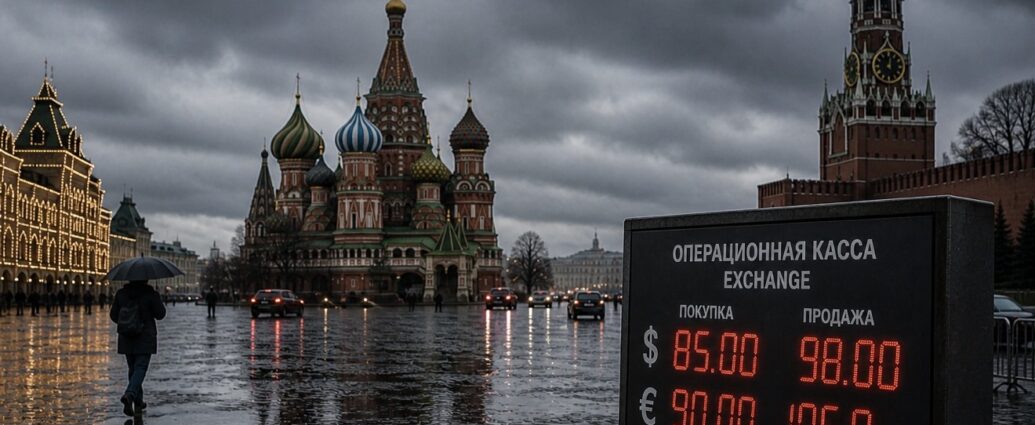
Russia’s wartime economic boom is over. The surge in military spending that briefly supercharged growth in 2023 and 2024 has given way to stagnation, a cratering oil revenue base and a population increasingly forced to pay for a war through higher taxes and rising prices. Four years into the invasion of Ukraine, analysts and international institutions are now asking not whether Russia’s economy is slowing — but how hard the landing will be.
After two years of expansion exceeding 4% annually, Russia’s GDP growth slowed to around 1% in 2025 and is expected to hold near that level in 2026, with any meaningful recovery unlikely before 2027. The International Monetary Fund forecasts growth of just 1.0% this year.  The Bank of Finland puts the picture more bluntly, warning that Russia has hit the limits on economic growth imposed by the war, constrained to annual growth rates near its long-term potential of around 1%, with recession now a very real possibility. 
Oil Money Has Collapsed
Energy revenues have been the financial backbone of Russia’s war effort — and they are crumbling. In January 2026, Russia’s state revenues from taxing the oil and gas industries fell to 393 billion rubles — down from 587 billion rubles in December and from 1.12 trillion rubles in January 2025, the lowest level since the COVID-19 pandemic, according to Janis Kluge, an expert on the Russian economy at the German Institute for International and Security Affairs. 
In February 2026, Russia’s oil export revenues collapsed a further $1.5 billion month-on-month to $9.5 billion — the lowest level since the invasion began — driven by a 9.2% drop in seaborne export volumes, according to the Kyiv School of Economics KSE Institute. Urals crude averaged just $42.8 per barrel that month, still trading below the European Union’s revised price cap. 
For the first time since the pandemic, Russia collected less budget revenue in 2025 than originally planned. Revenues projected at 40.3 trillion rubles came in closer to 36.6 trillion rubles — a shortfall driven by weaker oil prices and Western sanctions that have forced Moscow to offer steep discounts on its crude. 
Taxing Ordinary Russians to Fill the Gap
With oil income falling short, the Kremlin has turned to its own citizens. Russia raised its VAT rate from 20% to 22% starting January 1, 2026, while pulling far more small businesses into the tax net by lowering the annual revenue threshold for mandatory payments from 60 million rubles to 10 million rubles. New levies on finished electronic goods including laptops and smartphones are also planned. 
The impact on everyday Russians has been immediate. Food prices rose 21% in early 2026, services climbed 14%, and fuel prices increased 11% following refinery disruptions. In 2025, Russian revenues fell 24% to $111 billion, leaving a large hole in government finances filled by increasing taxes on consumers. 
Russia’s 2026 federal budget dedicates 16.8 trillion rubles to defense and national security, 7.1 trillion rubles to social policy, and 3.9 trillion rubles to debt servicing — a combined 27.8 trillion rubles out of total planned expenditures of 44.1 trillion rubles. That leaves just 16.3 trillion rubles for the entire civilian economy, including healthcare, education and infrastructure. 
The Central Bank Is Caught in the Middle
The Bank of Russia has been cutting rates aggressively to try to stimulate a slowing economy, but remains deeply constrained. On April 24, 2026, the Bank of Russia cut its key rate by 50 basis points to 14.50% — its eighth consecutive cut since departing from a record high of 21%. The bank maintained its 2026 GDP growth forecast at just 0.5% to 1.5%, noting the economy slowed in the first quarter of 2026 partly due to the shock of the new tax changes. 
Bank of Russia Governor Elvira Nabiullina warned that Russia is facing a labor shortage for the first time in its modern history, with unemployment at a historic low of 2%. The lack of available workers has forced employers to raise wages to compete for staff, driving up production costs and adding to inflationary pressure. “This is a new reality for the government and for business alike,” Nabiullina said. 
Corporate bankruptcies in Russia have jumped 20% this year as soaring interest rates and liquidity shortages push firms closer to financial ruin. 
Sweden’s Intelligence Warning
The strain is severe enough to have drawn a rare public assessment from a Western intelligence agency. Sweden’s Military Intelligence and Security Service said Russia has been manipulating its economic data to hide the real state of its economy, and is likely suffering from higher inflation and a larger budget deficit than it is communicating. Thomas Nilsson, head of MUST, warned that “the Russian economy can only go on one of two scenarios: long-term recession or shock. In either case, it will continue on a downward trajectory towards financial disaster.” 
What Comes Next
Kluge of the German Institute for International and Security Affairs said the Kremlin is clearly worried about the overall budget balance because the economic downturn is coinciding with war costs that are not decreasing. “Give it six months or a year, and it could also affect their thinking about the war,” he said. “I don’t think they will seek a peace deal because of this, but they might want to lower the intensity of the fighting.” 
For now, the Strait of Hormuz crisis has handed Moscow an unexpected lifeline — higher global oil prices are temporarily easing budget pressure. But analysts are unanimous that this does nothing to fix the deeper structural rot underneath.
— JBizNews Desk
© JBizNews.com. All rights reserved. This article is original reporting by JBizNews Desk. Unauthorized reproduction or redistribution is strictly prohibited.