By JBizNews Desk | Monday, May 4, 2026
Iran has spent decades preparing for economic warfare. It has survived crippling sanctions, the U.S. withdrawal from the nuclear deal, and multiple cycles of production shutdowns and restarts. But the combination of a U.S. naval blockade now in its fourth week, rapidly filling storage tanks, and a war that shows no sign of ending quickly is pushing Tehran’s oil industry toward a breaking point it may not be able to manage its way out of.
Even as Iran squeezes global energy supplies by keeping the Strait of Hormuz effectively closed, its own oil sector is under mounting pressure from the other direction — a pincer that is forcing production cuts, straining export infrastructure, and threatening long-term damage to aging oil fields that may prove very difficult to reverse.
The Blockade Is Working — Slowly
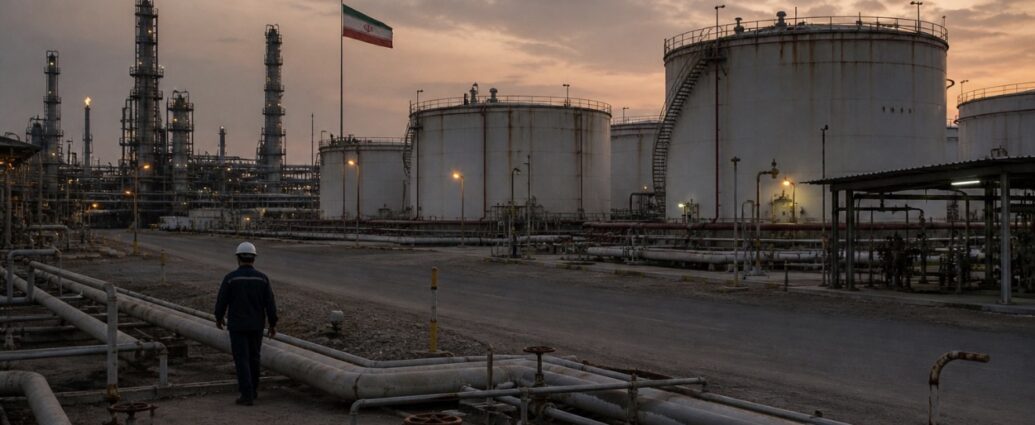
Iran had been producing over 3 million barrels of crude oil per day before the war, with slightly more than half going toward its domestic market. Since the U.S. naval blockade began on April 13, ships at Iranian ports have been filling with oil that cannot leave. Oil and condensate loadings at Iranian ports have collapsed from 2.1 million barrels per day before the blockade to just 567,000 barrels per day after, according to ship-tracking firm Kpler. Tehran is losing $500 million per day as a result, a White House official told CNBC. 
Antoine Halff, co-founder and chief analyst at Kayrros, an environmental intelligence firm that tracks emissions and energy supply chains, said there has been a significant slowdown in production, pointing to signs that storage at Kharg Island — Iran’s main oil export terminal in the Persian Gulf — is not filling as fast as would be expected if Iran were still pumping at full capacity. That suggests Tehran has already begun dialing back output proactively to avert a more chaotic shutdown. 
How Much Time Does Iran Have?
The storage math is tightening. Kpler estimates Iran has roughly 20 days of onshore storage capacity remaining at current production rates, with any production reduction expected to be gradual in the near term but accelerating into May. Wood Mackenzie analyst Alexandre Araman puts the runway at about three weeks before storage runs out entirely. “If the blockade persists, cuts become inevitable,” Araman wrote, adding that shutdowns of more than a month “risk long-term damage” to Iran’s oil reservoirs, with recovering older fields described as “uncertain.”
Iran also retains significant floating storage capacity — roughly 65 to 75 million barrels tied up in tankers both inside and outside the blockade zone, according to Vortexa. A senior Iranian official confirmed the country has already begun proactively cutting crude output to stay ahead of storage limits rather than waiting for tanks to fill completely. Engineers have learned how to idle wells without lasting damage and restart them quickly, officials said, after years of sanctions pushed the industry through repeated cycles of disruption. 
The Long-Term Risk
The real danger for Iran is not a short-term storage crunch — it is what a prolonged shutdown does to fields that are already aging. Halting oil production risks damaging underground reservoirs by reducing reservoir pressure, allowing water or gas to intrude into producing layers and disrupting oil flow patterns. This can make some oil harder or more expensive to recover later — damage that may be permanent for Iran’s older wells. 
Iran‘s state television — run by hardliners — aired a segment in which journalists openly discussed the possibility of an oil storage crisis. One said that if empty tankers are blocked from returning to Iran, “we won’t be able to export.” Oil Minister Mohsen Paknejad praised oil terminal staff for their “continuous perseverance,” a phrase analysts read as an indirect acknowledgment of growing strain. 
Iran’s Resilience Should Not Be Underestimated
Hamid Hosseini, a spokesman for the Iranian Oil, Gas and Petrochemical Products Exporters’ Association, pushed back on the alarm. “We have enough expertise and experience,” he said. “We’re not worried.” The country drew on hard lessons from the first Trump administration’s 2018 withdrawal from the nuclear deal, which forced Tehran to slash production sharply and develop techniques for managing extended shutdowns with minimal field damage. 
Fernando Ferreira, head of geopolitical risk at Rapidan Energy, framed the standoff plainly: “The question for me is who has a longer runway — Trump or Iran.” He estimated Iran has prepared for months of blockade, having studied what happened to Venezuela under sustained U.S. sanctions. “They prepared for a blockade,” Ferreira said. “They thought it through.” 
For now, both sides are playing a waiting game — Iran managing its storage and production to buy time, and the U.S. tightening the vice through the blockade and escalating Treasury sanctions on Iranian oil shipments already at sea. The question is not whether the blockade is hurting Iran. It clearly is. The question is whether the pain arrives fast enough — and cuts deep enough — to force Tehran to the negotiating table before the damage to its oil industry becomes a decade-long problem.
— JBizNews Desk
© JBizNews.com. All rights reserved. This article is original reporting by JBizNews Desk. Unauthorized reproduction or redistribution is strictly prohibited.