There is a particular clarity that comes to a leader who governs at the edge of an abyss. In Beirut, that clarity has arrived—slowly, reluctantly, and at an almost unbearable cost.
President Joseph Aoun and Prime Minister Nawaf Salam are not pursuing direct negotiations with Israel because they wish to. They are pursuing them because they understand, with a sense of real politics and unsentimental precision, what the alternative looks like – the end of Lebanon as a unified country.
In a nationally televised address, Aoun declared that Lebanon is “no longer a card in anyone’s pocket, nor a field for anyone’s wars,” adding that his government had “reclaimed Lebanon and Lebanon’s decision-making power for the first time” in nearly half a century.
These were not mere diplomatic flourishes. They were the words of a man who has looked squarely at the structural realities of his country and concluded that Lebanon as presently constituted — perpetually instrumentalized by regional powers, hollowed by militia sovereignty, and cleaved by confessional allegiances — might not survive another cycle of destruction.
The “phantom state” problem
Understanding why requires grappling with what one might call the “phantom state” problem: a government that occupies the offices of power but finds the levers functionally disconnected.
Consider the basic test of sovereignty — the monopoly on the use of force. In Lebanon, an Iranian-backed militia controls an arsenal larger than that of the national army, operates a parallel welfare state in the south, and until recently held an effective veto over cabinet decisions. A state that cannot disarm a non-state actor within its own borders is a state in name only.
The political fabric of Lebanon was historically woven through a series of fragile compromises. The National Pact of 1943 created a precedent for a grand coalition in which the president would always be a Maronite Christian, the prime minister always a Sunni Muslim, and the speaker of the parliament always a Shi’ite Muslim.
The Taif Agreement of 1989, born from the ashes of civil war, was meant to update this architecture. In practice, however, it reaffirmed and even consolidated political sectarianism, and what the Lebanese should consider is that theirs is a country of permanent precariousness, of endless instability, a country perpetually on the brink. What were designed as power-sharing mechanisms have morphed, over decades, into power-blocking instruments. Hezbollah, from 2008 to 2019, held about third of all ministerial positions, granting it an effective veto in the Lebanese cabinet — not a share of governance, but a stranglehold over it.
This is the political context in which Aoun and Salam operate. Lebanon’s current government came to power in early 2025 on a reformist platform that included disarming non-state actors. Officials were angered by Hezbollah’s decision to enter a new war. The government moved to criminalize the terrorist group’s military activities, declared Iran’s ambassador persona non grata, and banned the Iranian Islamic Revolutionary Guard Corps. These acts of sovereign self-assertion are historically significant, but they also carry a profound internal risk – one rooted not in geopolitics but in social structure.
Lebanon is not simply politically divided, but also socially fragmented at the level of lived experience. The felt, daily reality of belonging to this state of the Lebanese citizens have diverged almost completely along communal lines.
A resident of the southern suburbs of Beirut inhabits a reality defined by the Resistance narrative and ideological alignment with Tehran. A citizen in the Maronite heartlands or Sunni urban centers inhabits a reality oriented toward Western-style liberalism and economic integration.
These communities are not disagreeing on public policy issues. They are, in a meaningful sociological sense, living in different spheres of consciousness and distinct moral universes.
Within each sect, the bonds of solidarity are dense and durable. Between the sects, the social fabric has collapsed almost entirely. To its many critics, the confessional system has paralyzed the state and fueled corruption by cementing the power of sectarian former warlords and party barons from a handful of powerful families. When intra-communal ties outweigh national ones, the state ceases to serve its purpose.
In 2025, I argued for a disentangling of nation-states and the emergence of smaller, sovereign entities that reflect the region’s diverse communal and sectarian identities. I proposed this model for Lebanon and found it of equal, if not greater, relevance for Syria. This was a diagnosis of a process—albeit one less vivid to many—that is already underway. The question is not whether Lebanon might end up fractured, but whether its political leadership can forestall that fracture through diplomacy.
The most fragile element in Lebanon’s remaining unity is the Lebanese Armed Forces (LAF). The army is the sole genuinely multi-confessional institution that commands some cross-sectarian respect. Aoun has pledged that the LAF “will play a fundamental role after the withdrawal of Israeli forces,” deploying to the southern border and ensuring that “there will be no armed forces other than the army and the legitimate security forces.” But that commitment depends largely, some would argue entirely, on a successful peace framework.
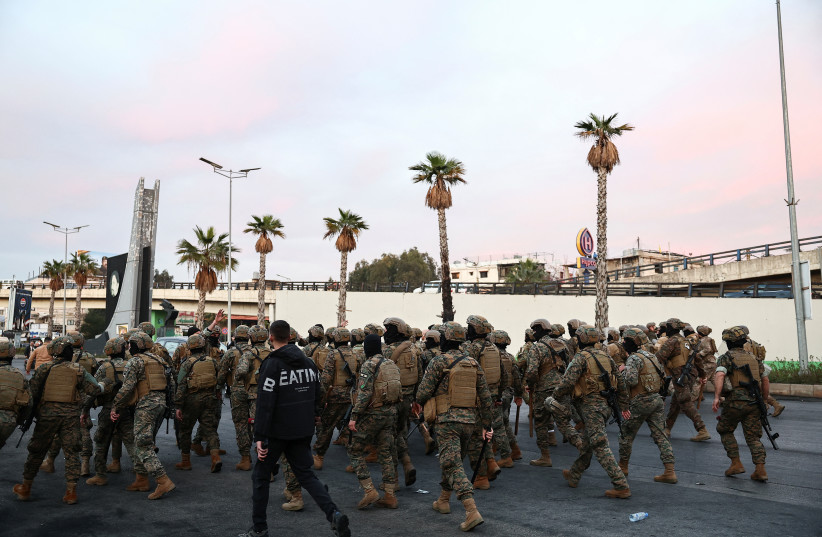
Absent the deployment of the LAF to the south, Hezbollah retains its spurious claim that only it can guarantee the security of Shi’ite communities in Lebanon’s border regions. Should Lebanon be drawn into another full-scale conflict without a prior peace settlement, the LAF could fragment, its soldiers deserting their posts to “defend” their villages and sects rather than a state that has ceased to function. The moment the military begins to tear along sectarian lines, the dismantlement of Lebanon would cease to be a theoretical possibility. It would become a humanitarian fait accompli.
Prime Minister Salam has already rejected Iran’s proposal to negotiate on Lebanon’s behalf, a decisive signal that this government is determined to exercise genuine rather than nominal sovereignty. President Aoun offered direct negotiations with Israel — the first in decades — in exchange for a cessation of hostilities, leading to a meeting between Israeli and Lebanese ambassadors in Washington. That window will not remain open indefinitely.
The hard truth, which Aoun and Salam appear to grasp even if they cannot say it plainly, is that Lebanon’s communal fabric is too strained, its economic foundations too depleted, and its security void too vast to absorb another decade of armed limbo. Lebanon already carries one of the world’s highest ratios of debt to gross domestic product and one of the largest refugee populations per capita, hosting over 1.5 million refugees, more than 800,000 of them Syrian. Economic collapse and demographic strain have only intensified sectarian identities. As one could argue, when the state fails to deliver, the sect substitutes.
A negotiated peace with Israel is neither a concession nor, as Aoun has insisted, the “forfeiture of any right” or “abandonment of any principle.” It is the only mechanism available that can reconstitute a credible Lebanese state anchored in a legitimate monopoly on the use of force.
When I discussed the formalization of smaller sovereign entities, I offered an analytical prognosis that describes a future that is already arriving. Yet for Aoun, Salam, and many Lebanese citizens, dissolution remains a destiny to be avoided at all costs.
The difference between a viable Lebanon and its dismantlement ultimately depends on whether its political leaders grasp a simple truth: negotiating and concluding a peace agreement may be the only viable path forward. Aoun and Salam appear to understand this. Others do not.
The writer is a professor of strategy and management at Tel Aviv University and is the Lilly and Alejandro Saltiel Chair in Corporate Leadership and Social Responsibility.