By JBizNews Desk | May 4, 2026
Wall Street reversed sharply Monday, as a sudden escalation in the U.S.-Iran conflict wiped out recent gains and sent investors fleeing risk assets, with surging oil prices and rising bond yields amplifying fears that inflation pressures could return just as markets had begun stabilizing.
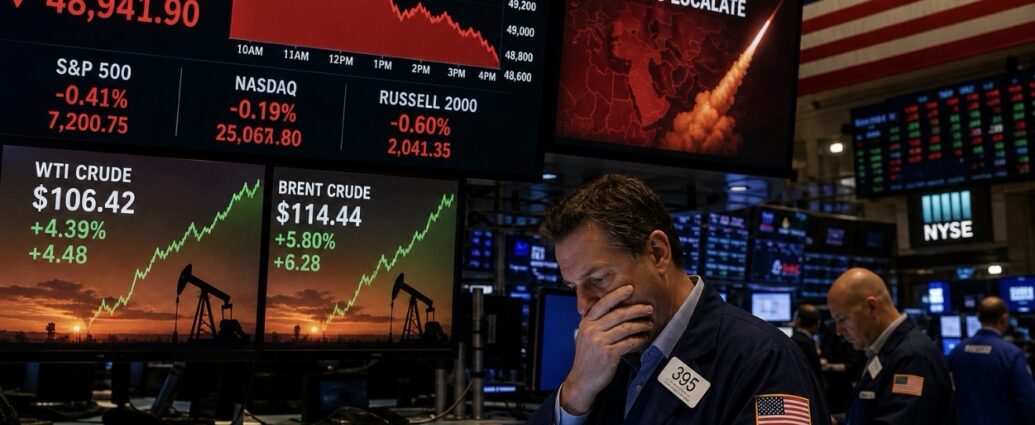
The Dow Jones Industrial Average dropped 557 points, or 1.13%, closing at 48,941.90. The S&P 500 fell 0.41% to 7,200.75, while the Nasdaq Composite slipped 0.19% to 25,067.80, showing relative resilience as mega-cap technology names helped limit deeper losses. The Russell 2000 declined 0.60%, reflecting heightened pressure on smaller, rate-sensitive companies. Meanwhile, the 10-year Treasury yield climbed to 4.438%, underscoring a renewed selloff in bonds as investors recalibrated expectations around inflation and Federal Reserve policy.
The market’s turn came after officials in the United Arab Emirates confirmed that Iranian missiles had been intercepted — the first such incident since last month’s ceasefire. The development immediately reignited concerns that the conflict could broaden across the region, particularly around critical energy infrastructure and shipping routes.
Investors reacted swiftly. Risk assets sold off across the board, while commodities — particularly oil — surged on fears of supply disruptions. The possibility of instability in the Strait of Hormuz, which handles roughly 20% of global oil flows, became the central focus of trading desks.
Energy stocks surged in response, making the sector the clear outperformer of the day. West Texas Intermediate crude rose 4.39% to $106.42 per barrel, while Brent crude jumped 5.8% to $114.44. The move lifted major energy names, with APA Corporation gaining nearly 4%, Diamondback Energy rising close to 3%, and Marathon Petroleum advancing about 2% as investors rotated into companies directly benefiting from higher oil prices.
Across the broader market, however, selling was widespread. Only Energy and Technology sectors managed to close in positive territory, while economically sensitive sectors bore the brunt of the decline. Materials fell 1.62% and Industrials dropped 1.02%, reflecting growing concern that rising input costs and supply chain disruptions could weigh on corporate margins if the conflict persists.
Within the Dow, losses were led by consumer and industrial names. Home Depot fell 3.50%, Nike dropped 2.95%, and Boeing declined 2.64%, as investors priced in the potential impact of higher fuel costs and slowing global demand. By the end of the session, just seven of the Dow’s 30 components finished in positive territory, highlighting the breadth of the selloff.
Corporate developments added another layer to Monday’s volatility. Norwegian Cruise Line Holdings fell 6.5% after issuing weaker-than-expected forward guidance, citing higher fuel costs and disruptions tied to Middle East tensions. Travel and leisure stocks, which are particularly sensitive to geopolitical instability and energy prices, were among the hardest hit.
At the same time, pockets of strength emerged in earnings-driven names. Palantir Technologies rose 2.3% ahead of its earnings release, with analysts projecting significant growth driven by artificial intelligence demand and government contracts. Berkshire Hathaway edged higher after reporting strong results, with its cash reserves climbing to nearly $397 billion, reinforcing Warren Buffett’s cautious but opportunistic stance in an uncertain environment.
After the close, Pinterest delivered a standout performance, reporting revenue of $1.01 billion — well above expectations — and sending shares surging more than 17% in after-hours trading. Meanwhile, biotech firm Rallybio Corporation jumped 47.4% during the session after announcing a $50 million payment, marking one of the day’s most significant individual stock gains.
The impact of the geopolitical shock extended beyond equities and into the broader economy. Mortgage rates climbed back above 6.5%, tracking the rise in Treasury yields and tightening financial conditions for American households. The move underscores how quickly global events can feed into domestic borrowing costs, particularly in interest rate-sensitive sectors like housing.
Despite the sharp selloff, underlying corporate performance has remained strong. With roughly 63% of S&P 500 companies having reported earnings, blended growth stands at 27.1%, providing a solid фундамент for equities. However, Monday’s session highlighted a critical reality: even robust earnings may not be enough to offset the impact of escalating geopolitical risk, particularly when it intersects with energy markets.
Looking ahead, markets face a series of key tests. Earnings from Palantir, Advanced Micro Devices, Arm Holdings, and Paramount Skydance are expected in the coming days, while Friday’s U.S. jobs report will provide insight into whether economic momentum is holding up amid rising uncertainty.
For now, the message from Wall Street is clear. As long as tensions in the Middle East continue to escalate and oil remains volatile, markets are likely to remain on edge — with energy stocks standing as the market’s only consistent refuge in an otherwise fragile environment.
© JBizNews.com. All rights reserved. This article is original reporting by JBizNews Desk. Unauthorized reproduction or redistribution is strictly prohibited.