By JBizNews Desk | May 7, 2026
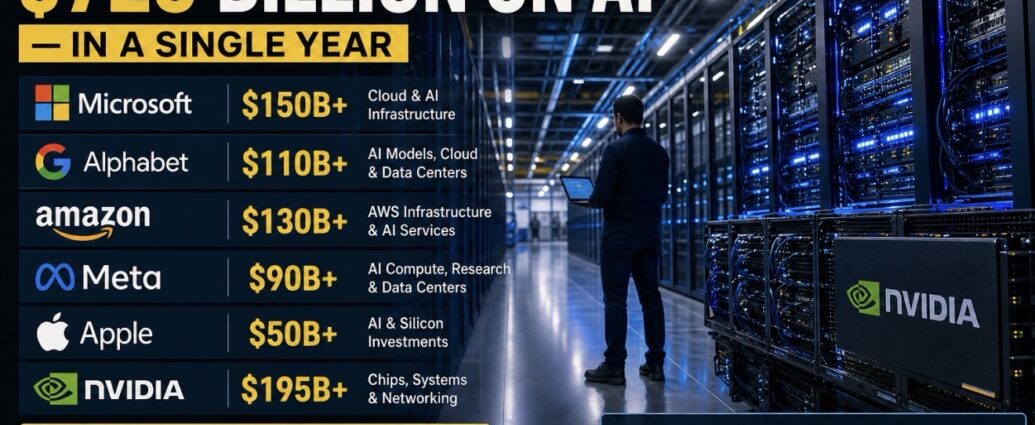
The world’s largest technology companies are on the verge of unleashing an unprecedented wave of capital spending, with combined investments in artificial intelligence infrastructure projected to reach $725 billion in a single year — a scale that is reshaping the global economy and redefining the future of competition across industries.
The spending surge is being led by a handful of dominant players — Microsoft, Alphabet, Amazon, Meta Platforms, Apple, and Nvidia — each racing to build out massive data centers, secure semiconductor supply, and deploy next-generation AI systems that executives say will underpin the next decade of economic growth.
“This is the largest technology investment cycle we’ve ever seen,” said Satya Nadella, CEO of Microsoft, who has repeatedly emphasized that AI is becoming the “defining platform shift of our time.” Microsoft alone is expected to spend tens of billions this year expanding its AI cloud infrastructure, including its partnership with OpenAI and global Azure data center buildouts.
At the center of the spending boom is a simple but costly reality: AI requires enormous computing power. Training and deploying advanced models demands vast networks of specialized chips, primarily graphics processing units (GPUs), which has turned Nvidia, led by CEO Jensen Huang, into one of the most critical — and valuable — companies in the global economy.
“AI factories are the infrastructure of the future,” Huang said at a recent industry conference, describing a world where companies operate massive computing hubs to generate intelligence in the same way traditional factories produce goods.
The ripple effects of this spending are being felt far beyond Silicon Valley. Construction firms are racing to build new data centers, utilities are preparing for surging electricity demand, and governments are increasingly focused on securing domestic supply chains for semiconductors and critical technologies.
Andy Jassy, CEO of Amazon, said the company’s AI investments — particularly within Amazon Web Services — are “meaningfully higher” than previous infrastructure cycles, reflecting what he described as “once-in-a-generation demand” from businesses seeking to integrate AI into their operations.
Alphabet is following a similar path. Sundar Pichai, CEO of Google, has positioned AI as central to the company’s future, from search and advertising to enterprise services, with spending accelerating across its cloud and hardware divisions.
Even companies traditionally known for consumer hardware are shifting aggressively. Tim Cook, CEO of Apple, has signaled increased investment in AI capabilities embedded across its ecosystem, while Mark Zuckerberg, CEO of Meta, has committed billions toward building AI-driven platforms, including virtual environments and advanced recommendation systems.
The scale of the spending is not without risk. Investors are beginning to question whether returns will match the enormous capital outlays, particularly as competition intensifies and pricing pressure could emerge in cloud and AI services.
“There’s no historical comparison for this level of investment,” said Brad Gerstner, CEO of Altimeter Capital, who has warned that while AI represents a transformative opportunity, “not every dollar spent will generate a return.”
Still, early signs suggest that demand is real and accelerating. Businesses across sectors — from healthcare and finance to manufacturing and retail — are rapidly adopting AI tools to improve efficiency, reduce costs, and create new revenue streams.
The broader economic implications are profound. AI investment is driving job creation in some areas, particularly in engineering and infrastructure, while raising concerns about displacement in others. Policymakers are increasingly focused on how to balance innovation with workforce stability.
At the same time, geopolitical competition is intensifying. The United States and China are both investing heavily in AI capabilities, viewing the technology as critical to national security and economic leadership. Export controls, subsidies, and industrial policy are all playing a role in shaping the competitive landscape.
“AI is not just a business race — it’s a strategic race,” said Gina Raimondo, U.S. Secretary of Commerce, who has emphasized the importance of maintaining American leadership in advanced technologies.
For markets, the spending boom presents both opportunity and uncertainty. On one hand, it is fueling growth for companies across the supply chain, from chipmakers to construction firms. On the other, it raises questions about capital efficiency and long-term profitability.
Investors will be watching closely as earnings reports continue, looking for evidence that AI investments are translating into real revenue and margin expansion. Early adopters have reported gains, but the full impact may take years to materialize.
Looking ahead, the trajectory of this $725 billion spending wave will likely define the next phase of the global economy. If successful, it could unlock new levels of productivity and innovation. If not, it risks becoming one of the most expensive bets in corporate history.
For now, one thing is clear: the AI race is no longer theoretical — it is being built in real time, at a scale the world has never seen before.
© JBizNews.com. All rights reserved. This article is original reporting by JBizNews Desk. Unauthorized reproduction or redistribution is strictly prohibited.