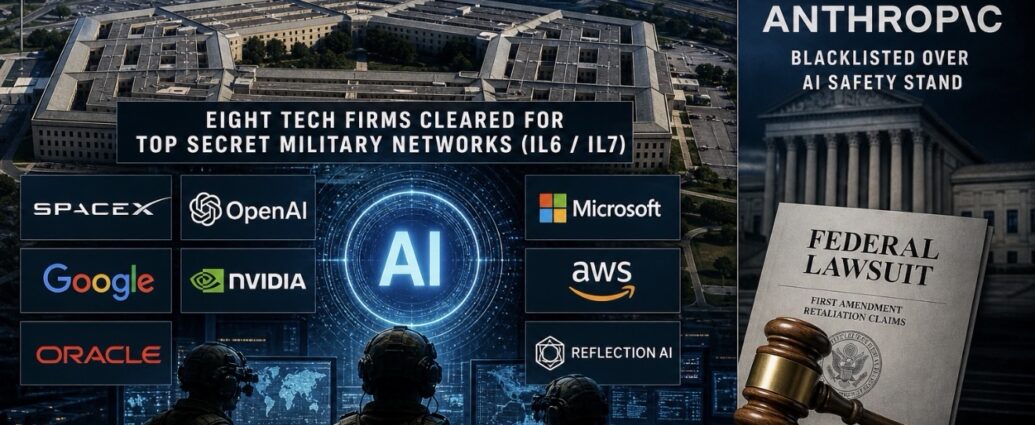
SpaceX, OpenAI, Google, Nvidia, Microsoft, Amazon, Oracle and Reflection AI Cleared for Secret Military Networks as Dispute Over Safety Guardrails Escalates Into Federal Court
By JBizNews Desk | Washington — May 5, 2026
The Pentagon has cleared eight of the country’s leading technology companies to deploy artificial intelligence directly onto its most sensitive classified networks, formalizing a sweeping shift in how the U.S. military intends to fight wars — and delivering a pointed rebuke to Anthropic, the San Francisco-based AI developer now locked in active litigation with the Trump administration over the limits of AI in warfare.
The Department of Defense announced the agreements on Friday, May 1, naming Amazon Web Services, Google, Microsoft, Nvidia, OpenAI, SpaceX, and startup Reflection AI, with Oracle added hours later in an updated release. The agreements authorize those companies to deploy AI capabilities on the Pentagon’s classified IL6 and IL7 networks — systems reserved for secret and highly sensitive national security operations. Defense officials described the move as enabling advanced data synthesis, situational awareness, and faster warfighter decision-making.
Emil Michael, the Pentagon’s technology chief, said the initiative is designed to give U.S. forces a decisive advantage. “The goal is to ensure decision superiority across all domains,” he said, framing AI as central to the next generation of military operations.
Anthropic was conspicuously absent — not by accident, but by designation.
The roots of the exclusion trace back to February, when Defense Secretary Pete Hegseth issued an ultimatum to Anthropic CEO Dario Amodei: allow unrestricted Pentagon use of the company’s Claude AI models for all lawful military applications or face consequences. Anthropic declined, citing concerns over autonomous weapons and potential domestic surveillance. Within days, President Donald Trump directed federal agencies to cease using Anthropic products, and the Pentagon formally labeled the firm a “supply-chain risk” — a designation typically applied to foreign adversaries, not U.S. companies.
The consequences of that label have been far-reaching. It not only blocks direct procurement but also forces defense contractors to certify they are not using Anthropic systems in any Pentagon-related work. The effect has rippled across the defense ecosystem, with companies like Palantir removing Claude from military-linked platforms following the designation.
Anthropic responded in March with two federal lawsuits, arguing the government retaliated against the company for its stance on AI safety, violating its constitutional rights. Judge Rita Lin issued a preliminary injunction on March 26 blocking parts of the government’s restrictions, finding the actions likely unlawful. However, an appellate panel later allowed the supply-chain risk designation to remain in place as litigation continues.
Despite the legal standoff, talks have quietly resumed. Dario Amodei met with White House Chief of Staff Susie Wiles in recent weeks, and President Donald Trump said afterward that “a deal is possible,” even as the Pentagon moved forward with the May 1 contracts.
Among the selected firms, roles are already taking shape. Microsoft, Amazon, and Oracle are providing secure cloud infrastructure alongside AI models, allowing the Pentagon to deploy capabilities without building entirely new classified systems. Google and OpenAI are expected to contribute advanced models tailored to intelligence and operational use cases.
Nvidia, led by CEO Jensen Huang, is supplying its Nemotron models, which enable autonomous AI agents capable of executing complex tasks. Huang has argued that open-source models can enhance national security by allowing full inspection and adaptation of AI systems.
SpaceX, following its merger with xAI, brings the Grok family of models into the defense ecosystem, while Reflection AI, a startup backed by Nvidia and founded by former DeepMind researchers, is developing next-generation systems tailored specifically for military needs. The company is reportedly seeking funding at a valuation of roughly $25 billion, underscoring investor demand for defense-linked AI.
The Pentagon’s AI expansion is already underway. More than 1.3 million Defense Department personnel have used the unclassified GenAI.mil platform, generating tens of millions of prompts and deploying hundreds of thousands of AI agents in just five months. Moving those capabilities into classified systems marks a far more consequential phase.
The financial stakes are substantial. The administration is seeking a $961.6 billion defense budget for 2026, including $33.7 billion earmarked for science, technology, and autonomous systems. That funding has triggered intense competition among tech giants, positioning AI as one of the most strategically valuable sectors tied to national defense.
For the broader market, the message is clear: alignment with Pentagon priorities is quickly becoming a prerequisite for access to the largest government contracts. Companies that resist those terms risk exclusion not only from direct deals but from the wider defense supply chain.
Whether Anthropic can resolve its legal battle and return to that ecosystem remains uncertain. For now, the classified networks of the U.S. military will run on AI from eight companies — and not the one that chose to draw a line.
JBizNews Desk
© JBizNews.com. All rights reserved.