The Budget Carrier’s Shutdown Doesn’t Just Hurt Its Own Passengers — It Removes the Competitive Force That Kept Every Airline Honest on Price
By JBizNews Desk | New York — May 5, 2026
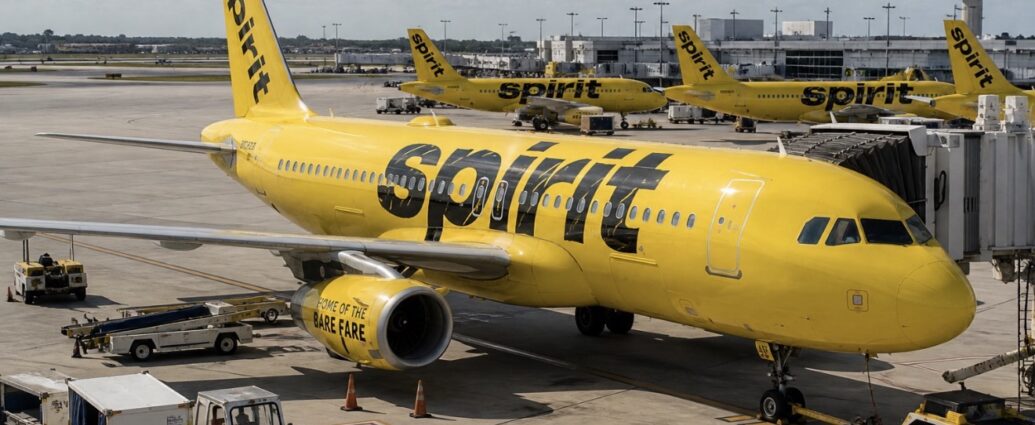
When Spirit Airlines went dark before dawn on Saturday, May 2, the impact extended far beyond the airline’s own passengers. What disappeared overnight was one of the most important — and least understood — forces keeping airfare prices in check across the United States.
Spirit began an orderly wind-down of operations, canceling all flights immediately and leaving roughly 17,000 workers without jobs, including about 14,000 direct employees and thousands of contractors. The shutdown followed a failed last-minute effort to secure up to $500 million in government-backed support after bondholders declined to move forward. Commerce Secretary Howard Lutnick personally informed CEO Dave Davis that no agreement would be reached.
But the real story isn’t just about stranded passengers or job losses. It’s about pricing power — and what happens when a key source of competition disappears.
The economic role of ultra-low-cost carriers like Spirit has always extended beyond their own customer base. William McGee, a senior fellow at the American Economic Liberties Project, explained it bluntly: “You do not have to fly a small carrier in order to benefit from its presence, because they will bring down the big guys’ fares.” Without that pressure, he warned, “everyone will be paying more.”
That effect is already being modeled by industry analysts. Katy Nastro of Going.com said Spirit’s roughly 5% share of the domestic market had an outsized influence on pricing, particularly in leisure-heavy routes. “We may be in for specific areas to see upwards of 15 to 20 percent more expensive fares due to the fact that we don’t have that low-cost option,” she said.
The impact will not be evenly distributed. Markets where Spirit had a strong footprint — including Orlando, Las Vegas, and Fort Lauderdale — are expected to feel the most immediate pressure. In those cities, Spirit acted as a constant check on pricing, forcing competitors to match or respond to its ultra-low fares.
That dynamic shaped the entire airline industry.
Spirit’s model — charging a low base fare while monetizing add-ons — forced legacy carriers to introduce their own stripped-down “basic economy” offerings. Airlines like Delta, United, and American didn’t adopt those models out of preference; they adopted them because Spirit forced their hand. Now, with that pressure gone, the incentive to maintain those lowest price tiers weakens.
Brandon Oglenski, an airline analyst at Barclays, noted that while Spirit’s direct capacity accounted for just about 1.5% of domestic seats this summer, the broader pricing impact could be far greater. “Beyond direct revenue capture from Spirit’s prior network, we also suspect industry pricing could benefit significantly for nearly all airlines,” he wrote in a note to clients.
History supports that view. When AirTran was absorbed by Southwest in 2011 — and earlier when carriers like ATA Airlines and Independence Air exited the market — fares in key routes rose as competitive pressure declined. The pattern is familiar: fewer low-cost options translate into higher average prices.
Spirit’s collapse was not caused by a single event. It was the culmination of multiple pressures hitting at once.
The airline faced intensifying competition from larger carriers, rising labor and operational costs, and the collapse of its planned merger with JetBlue — a deal blocked in court by federal regulators. At the same time, engine issues grounded portions of its fleet, further constraining revenue.
More recently, macroeconomic forces delivered the final blow. The surge in jet fuel prices tied to the ongoing U.S.-Iran conflict and disruptions in the Strait of Hormuz significantly increased operating costs. For a carrier built on razor-thin margins, that spike proved unsustainable.
Spirit had already filed for bankruptcy protection for the second time in under a year in August 2025. Analysts say the company failed to make deep enough structural changes during its earlier restructuring, leaving it vulnerable when conditions worsened.
Transportation Secretary Sean Duffy placed some of the blame on the blocked JetBlue merger, arguing that regulatory intervention removed a potential lifeline. Critics counter that the merger would have reduced competition anyway by absorbing Spirit into a higher-cost structure — effectively eliminating its low-fare pressure through consolidation rather than collapse.
In the immediate aftermath, major airlines moved quickly to stabilize the situation. United capped one-way “rescue fares” at $199 for most routes and $299 for longer distances, rebooking approximately 14,000 stranded Spirit passengers within hours. Delta, American, and Southwest implemented similar temporary measures.
But those caps are temporary by design.
Once the short-term response ends, pricing will reset — and without Spirit in the system, that reset is likely to trend higher.
Looking ahead, the industry faces a new phase. Fewer seats and fewer competitors could accelerate consolidation, particularly among smaller carriers trying to avoid the same fate. Alternatively, the gap could attract new entrants backed by private capital — though building a national airline network from scratch is neither quick nor easy.
John Kwoka, an economist at Northeastern University, framed the long-term challenge clearly: “What one really wants is that it be easier for another ultra-low-cost carrier to replace Spirit. But policy does not get to make those choices.”
For millions of Americans, the implications will show up in the simplest place — the final price before checkout.
Spirit Airlines was never designed to be luxurious. It was designed to be cheap — and, more importantly, to force everyone else to be cheaper. That role made it one of the most influential players in the industry, regardless of its size.
Now that it’s gone, the effect will be felt not just in empty gates — but in higher fares across the country.
JBizNews Desk
© JBizNews.com. All rights reserved.