Multiple Research Studies Find That Stricter Enforcement Has Slowed Hiring, Depressed Wages in Key Sectors, and Left Many American Workers Worse Off — Not Better
By JBizNews Desk | Washington — May 6, 2026
The promise was straightforward: crack down on immigration, and jobs would open up for American workers. More than a year into the Trump administration’s sweeping enforcement campaign, the data from multiple independent research institutions tells a more complicated story — one in which the workers the policy was designed to help have in many cases been left behind.
A body of research from sources spanning the political spectrum, including the Federal Reserve, Goldman Sachs, and policy groups on both the left and right, has found that the rapid reduction of immigrant workers in the U.S. economy has not produced a meaningful surge in employment or wages for native-born Americans. Instead, it appears to have removed workers from industries that depend on them, reduced consumer spending, slowed residential construction, and contributed to one of the weakest years of job growth in recent memory.
What the Numbers Show
The U.S. economy added only 181,000 jobs in 2025 — a fraction of the 1.459 million added in 2024, the final full year of the prior administration.
A policy brief from the National Foundation for American Policy found that from February 2025 to February 2026, labor force participation for U.S.-born workers age 16 and older fell from 61.4% to 61%, based on Bureau of Labor Statistics data. Over the same period, the number of foreign-born workers in the U.S. declined by more than one million from its March 2025 peak.
The wage picture has also lagged expectations. A Wall Street Journal analysis of Labor Department figures found that hourly earnings in 41 immigrant-reliant industries rose just 3.5% year over year in February 2026 — below the 3.8% increase recorded across all workers and slower than pre-enforcement trends. Economists note that removing immigrant workers also removes consumer demand, offsetting the expected upward pressure on wages.
The Federal Reserve’s Findings
Among the most closely watched research came from the Federal Reserve Bank of San Francisco, where economists Daniel Wilson and Xiaoqing Zhou examined the relationship between unauthorized immigrant worker flows and employment levels.
Their findings point to a near one-for-one relationship. As immigrant worker flows increased through 2021 to early 2024, employment levels rose alongside them. As those flows declined beginning in March 2024, employment followed the same downward pattern.
The effect has been most visible in construction, manufacturing, and service industries.
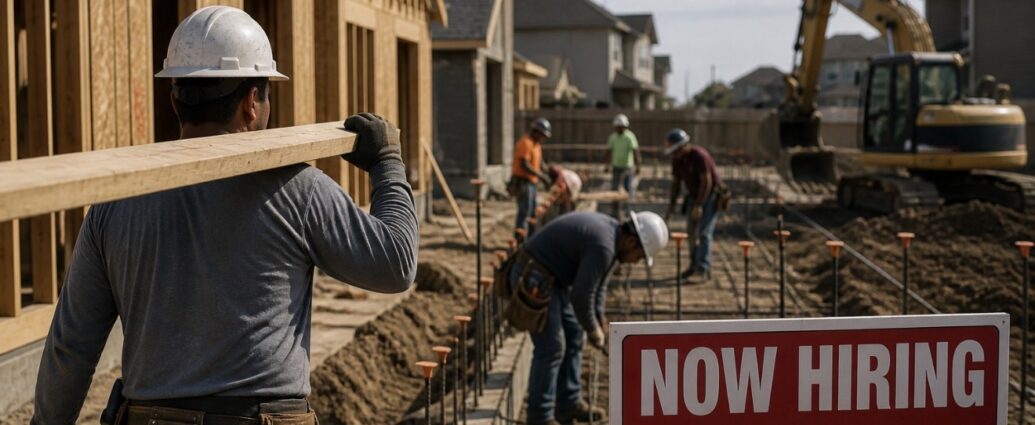
In construction, the researchers found that declining immigrant labor is slowing residential building activity — a shift that is already affecting housing supply and affordability. The authors concluded that overall U.S. employment growth is likely to remain under pressure as long as those labor flows remain constrained.
Goldman Sachs and the Labor Math
Goldman Sachs economists, led by David Mericle, found that the immigration crackdown resulted in roughly an 80% drop in net immigration.
Annual net migration, which averaged about one million people per year in the 2010s, fell to 500,000 in 2025 and is projected to decline further to just 200,000 in 2026.
That shift has changed how economists interpret job growth. With fewer workers entering the labor force, fewer jobs are needed each month to maintain stable unemployment levels. Goldman estimates that the monthly threshold has fallen from 70,000 to about 50,000 by the end of 2026.
In practical terms, job growth that would have been considered weak in prior years now appears stable — masking underlying softness in the labor market.
Why American Workers Aren’t Filling the Gap
One of the central assumptions behind stricter enforcement was that removing immigrant workers would create openings for American workers. Economists say the labor market does not function that simply.
Joe Brusuelas, chief economist at RSM US, noted that many immigrant workers fill roles that native-born workers are often unwilling to take. As recently as 2023, nearly one-quarter of U.S. farm workers were unauthorized.
Economist Stan Veuger pointed to a second effect: immigrants are also consumers. “As net migration goes down and as deportations from the interior go up, you’re not just losing workers — you’re also losing people on the demand side,” he said.
Zeke Hernandez, a professor at the University of Pennsylvania’s Wharton School, added that immigrants contribute to economic activity beyond labor alone — including tax revenue, spending, and local business support.
What Bipartisan Research Confirms
The Brookings Institution estimated that the United States experienced negative net migration in 2025 for the first time in roughly half a century — meaning more people left the country than entered it.
Analysts at both the center-right American Enterprise Institute and the center-left Brookings Institution have pointed to similar conclusions about the scale of the shift and its economic implications.
Sara Estep, an economist at the Center for American Progress, wrote that immigration has long been a key driver of labor force growth, and that the current slowdown risks weakening long-term economic expansion.
The White House has pushed back on these conclusions, citing data showing that one million new jobs went to native-born workers during the first year of enforcement while foreign-born employment declined. Officials say the administration remains focused on strengthening opportunities for American workers.
But across independent research — from the Federal Reserve, Goldman Sachs, the Congressional Budget Office, and policy institutes — the findings converge on a consistent theme: in a deeply interconnected labor market, removing one segment of workers does not automatically benefit another.
More often, it reduces overall economic activity.
For workers and businesses on the ground, the effects are tangible. Construction projects are slowing, employers in service industries are struggling to hire, and housing supply constraints are keeping prices elevated.
The gap between policy expectations and economic outcomes is no longer theoretical — it is playing out in real time across the U.S. economy.
JBizNews Desk
© JBizNews.com. All rights reserved.