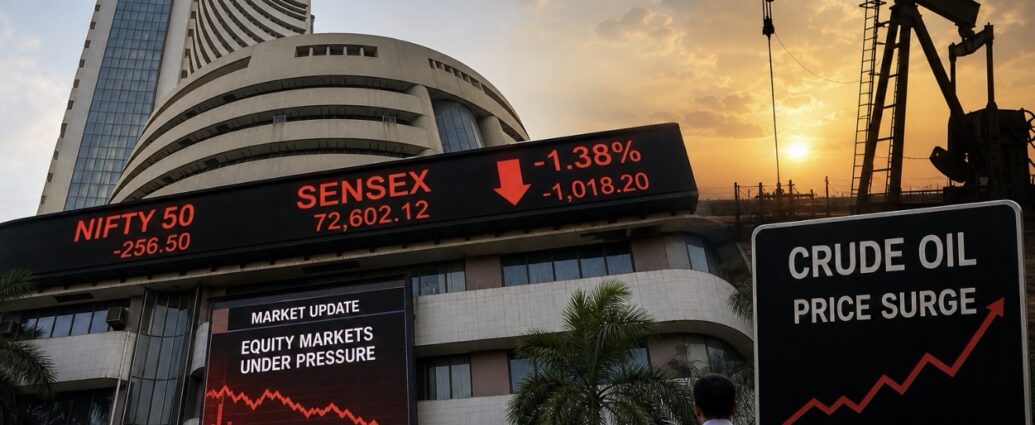
Foreign Investors Have Already Pulled $20 Billion Out of Indian Equities in 2026. Another Oil Spike Could Make Things Considerably Worse — Unless Domestic Buyers, Strong Earnings, and Modi’s Election Wins Hold the Line.
By JBizNews Desk | Mumbai — May 6, 2026
India’s stock market is under renewed pressure as surging oil prices threaten to reverse recent gains, underscoring the country’s deep vulnerability to global energy shocks.
After both the Nifty 50 and BSE Sensex fell sharply in March amid the U.S.-Iran conflict, markets have attempted to stabilize. But the same force that triggered the selloff — rising crude — is once again weighing heavily on the outlook.
The Oil Problem
India imports more than 90% of its crude oil, making it highly exposed to global price swings.
When oil prices rise, the impact spreads quickly across the economy: the import bill increases, the rupee weakens, inflation pressures build, and corporate profit margins shrink. The combined effect often leads foreign investors to pull capital from equities.
The rupee recently hit a record low of 95.33 against the U.S. dollar as crude surged, increasing import costs and dampening investor confidence. Concerns around inflation and the current account deficit have intensified, making India’s equity valuations appear stretched in a volatile global environment.
The Strait of Hormuz, which carries about 20% of the world’s oil supply, remains a key risk. Ongoing geopolitical tensions continue to keep prices elevated and prone to sudden spikes.
The Foreign Investor Exodus
Foreign investors have accelerated their exit from Indian equities.
More than $20 billion has been withdrawn in the first four months of 2026, already exceeding the total outflows for all of 2025. Roughly $19 billion of that selling followed the escalation of the Iran conflict in late February.
In one week alone in April, Foreign Institutional Investors (FIIs) sold ₹13,771 crore in equities, while Domestic Institutional Investors (DIIs) bought ₹11,585 crore — highlighting the ongoing tug-of-war shaping market direction.
What Is Supporting the Market
Despite mounting pressure, several factors are helping prevent a deeper downturn.
Domestic investors have stepped in as a stabilizing force. Local mutual funds and retail investors have purchased approximately ₹1.7 trillion in equities so far this year, providing a critical cushion against foreign outflows.
Corporate earnings have also remained resilient. Analysts project earnings growth of around 16% annually through fiscal 2028, with recent results from companies such as Hindustan Unilever and Maruti Suzuki exceeding expectations and supporting market sentiment.
Political stability has further contributed to confidence. Recent state election victories for Prime Minister Narendra Modi’s ruling coalition have reduced uncertainty and reinforced expectations for continued infrastructure investment and economic growth. Markets responded positively, with the Sensex rising more than 600 points in a single session and adding over ₹5.4 lakh crore in market value.
The Line in the Sand
The direction of India’s markets now hinges largely on oil.
If crude stabilizes and geopolitical tensions ease, foreign capital could begin to return, supported by domestic buying and steady earnings growth. But if oil continues to rise — or if global financial conditions tighten further — renewed selling pressure is likely.
VK Vijayakumar, Chief Investment Strategist at Geojit Investments, said the market’s trajectory will be determined primarily by developments in West Asia. He noted that efforts to secure shipping through the Strait of Hormuz have provided some relief, but risks remain elevated.
For India’s growing base of retail investors, who have helped support markets through sustained domestic inflows, the coming weeks will be critical.
The market’s stability now depends on whether local confidence can withstand a global oil market that remains volatile and highly sensitive to geopolitical shocks.
JBizNews Desk
© JBizNews.com. All rights reserved.