By JBizNews Desk
TEHRAN — May 5, 2026
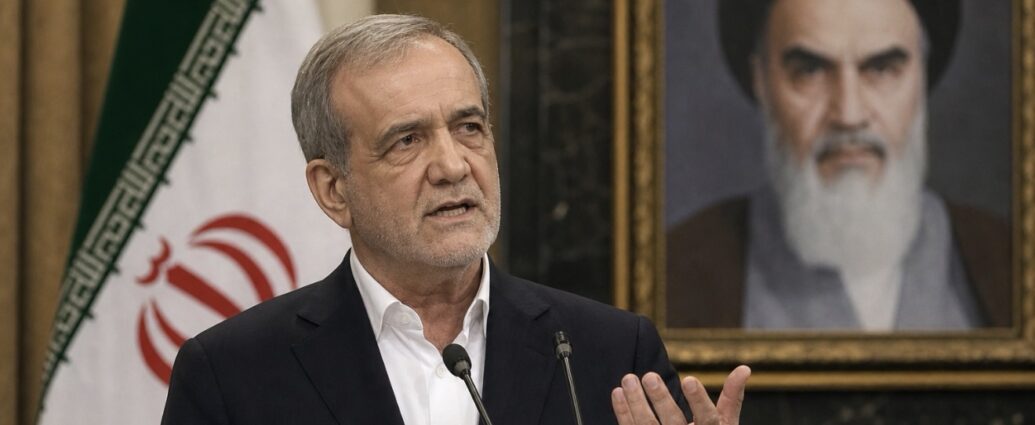
Iran’s President Masoud Pezeshkian has sharply confronted the country’s military leadership over Monday’s renewed missile and drone strikes on the United Arab Emirates, calling the attacks an act of “madness” carried out without the civilian government’s knowledge — and urgently seeking a meeting with Supreme Leader Mojtaba Khamenei to demand an immediate halt, according to a report by Iran International.
The disclosure lays bare a deepening fracture at the top of Iran’s wartime power structure, raising fresh questions about who is actually directing the conflict — and whether any civilian leader retains the authority to stop it.
“Completely Irresponsible”
Exclusive information obtained by Iran International points to a growing clash between Iran’s moderate president and the country’s military leadership over Monday’s escalation in the Persian Gulf. According to sources familiar with Tehran’s deliberations, Pezeshkian expressed strong anger at actions by the Islamic Revolutionary Guard Corps, led by Ahmad Vahidi, describing missile and drone strikes on the United Arab Emirates as “completely irresponsible” and carried out without the government’s knowledge or coordination.
Pezeshkian is said to have described the IRGC’s approach to escalating tensions with regional countries as “madness,” warning of potentially irreversible consequences. Amid a worsening situation and the risk of the country sliding back into full-scale war, Pezeshkian has requested an urgent meeting with Mojtaba Khamenei to press for an immediate halt to IRGC attacks on Gulf states and to prevent further escalation.
Sources close to the presidency say Pezeshkian is deeply concerned about potential international reactions and believes the country cannot withstand a new full-scale war. He has warned that continued unilateral attacks could trigger heavy U.S. retaliation against critical energy and economic infrastructure — an outcome he reportedly said could lead to widespread destruction and an irreversible collapse in livelihoods.
The IRGC’s Growing Grip
The confrontation reflects a structural crisis that has been developing since the killing of Supreme Leader Ali Khamenei on February 28, when U.S. and Israeli strikes launched the current conflict. According to Iran International, the IRGC has effectively assumed control over key state functions, with IRGC commander Ahmad Vahidi reportedly insisting that under wartime conditions, all critical and sensitive positions must be chosen and managed directly by the Revolutionary Guard until further notice.
Pezeshkian has repeatedly sought an urgent meeting with Mojtaba Khamenei but has been unable to establish contact. Instead, a “military council” made up of senior IRGC officers now controls access to the center of power, preventing government reports from reaching Mojtaba and effectively isolating the new Supreme Leader from the elected government.
IRGC commander Ahmad Vahidi is now reportedly making military and political decisions alongside Supreme Leader Mojtaba Khamenei. Parliament Speaker Mohammad Bagher Ghalibaf and Foreign Minister Abbas Araghchi cannot make decisions without the IRGC’s approval, according to reports from the Institute for the Study of War and U.S. intelligence assessments.
This is not the first time Pezeshkian has tried to rein in the military. A week into the war, Pezeshkian apologized for Iran’s attacks on Gulf states, promising to end the attacks unless strikes against Iran originated from those countries. He was swiftly criticized by the IRGC and hardliners, forcing him to walk back his position.
What Sparked the Latest Escalation
The renewed attacks on the United Arab Emirates came as President Trump launched Operation Project Freedom — a U.S. military initiative to escort commercial vessels out of the Persian Gulf through the Strait of Hormuz. Iran’s IRGC warned that any ships attempting to transit the strait “will face serious risks, and violating vessels will be stopped with force.”
The UAE reported missile and drone strikes originating from Iran, following IRGC claims it had blocked U.S. naval access to the strait. A large fire broke out at the Fujairah Petroleum Industries Zone after an Iranian drone strike, with three Indian nationals reported injured. The UAE Ministry of Education ordered nationwide remote learning through Friday as a precaution.
According to Iran International, Pezeshkian is expected to emphasize — if he can secure the meeting — the need for immediate diplomatic engagement, arguing there remains a narrow window to prevent further escalation and return to negotiations.
A Government in Name Only
Reuters reports that Iran’s traditional centralized leadership model has fractured, with authority increasingly concentrated among senior IRGC figures and security bodies. Mojtaba Khamenei, who assumed leadership after his father’s death, is said to play a more limited role, largely endorsing decisions made by military leadership.
Sources cited by Reuters indicate that this shift has already affected Iran’s diplomatic responsiveness, with delays in negotiations attributed to the new power structure.
For the outside world trying to negotiate an end to the conflict, the picture emerging is stark: Iran’s elected president is calling the military’s actions madness — and cannot get a meeting to say so.
JBizNews Desk