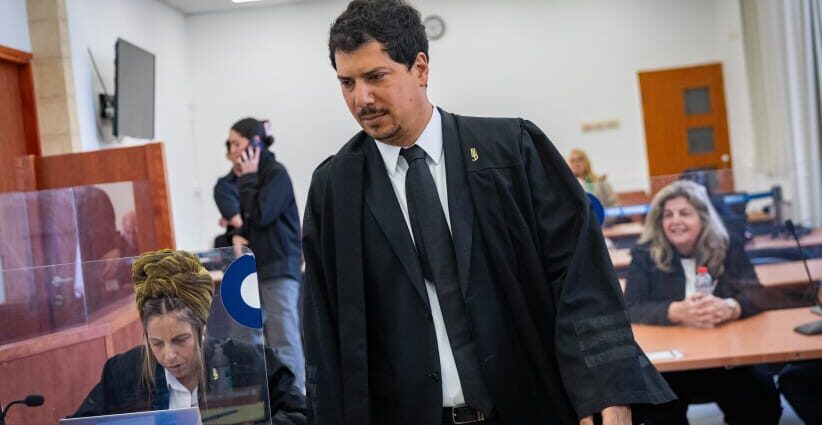
Prime Minister Benjamin Netanyahu’s criminal trial is expected to resume on Tuesday afternoon, after another round of last-minute requests regarding the timing of his testimony, this time again tied to what his defense described as an urgent security-diplomatic schedule.
The Jerusalem District Court panel hearing the case – Judges Rivka Friedman-Feldman, Moshe Bar-Am, and Oded Shaham – was first asked to change the timing of Tuesday’s hearing after Netanyahu’s defense submitted sealed material to the court regarding the prime minister’s schedule.
In a filing submitted by Netanyahu’s attorney Amit Hadad, the defense asked that the hearing begin at 4 p.m., citing an urgent security-diplomatic matter detailed in a sealed envelope.
The defense said that although Netanyahu had scheduled commitments throughout the day, his schedule could be adjusted to hold the hearing until 6 p.m., subject to security and diplomatic developments. The prosecution said it would agree to a 4 p.m. start, provided that the court could still hold at least three hours of testimony.
The court initially granted the request only in part, setting the hearing from 1:30 p.m. to 5 p.m., according to a court decision. The Courts Administration later updated reporters that the hearing would take place between 4 p.m. and 7 p.m.
Tuesday’s testimony comes after Monday’s scheduled hearing was canceled early in the morning, following a defense request citing Netanyahu’s security schedule and accompanied by sealed details submitted to the court and the prosecution. Netanyahu had been scheduled to testify on Monday, Tuesday, and Wednesday this week.
The current questioning is taking place in Case 4000, the Bezeq-Walla affair, the central case in Netanyahu’s criminal trial, and the only one in which he is charged with bribery.
Netanyahu denies charges, claims political motivation
Prosecutors allege that Netanyahu, while serving as communications minister, advanced regulatory decisions beneficial to Bezeq, then controlled by Shaul Elovitch, in exchange for favorable coverage on Walla, which Elovitch also owned at the time. Netanyahu denies all charges and has repeatedly argued that the cases against him are politically motivated.
At the last substantive hearing, Netanyahu again denied that he held a “guidance meeting” with former Communications Ministry director-general Shlomo Filber regarding Bezeq, as prosecutors pressed him on what they say is supporting evidence for Filber’s original account. The hearing was itself shortened and fragmented after Netanyahu left for a security call at the Kirya military headquarters.
The testimony has repeatedly been affected by the prime minister’s security and diplomatic schedule, particularly since the trial resumed after a lengthy wartime pause. In recent weeks, the court and the parties have dealt with multiple requests to cancel, postpone, or shorten testimony days, including disputes over sealed security material and whether the prosecution was given sufficient access to the basis for the requests.
Netanyahu began testifying in December 2024, becoming the first sitting Israeli prime minister to take the stand as a criminal defendant. Cross-examination began in June 2025, after months of direct examination by the defense.
Beyond Case 4000, Netanyahu is charged in Case 1000 with fraud and breach of trust over allegations that he received gifts from wealthy businessmen, and in Case 2000 with fraud and breach of trust over alleged discussions with the publisher of Yediot Aharonot, Arnon “Noni” Mozes, concerning favorable coverage. He denies wrongdoing in all three cases.
The renewed courtroom scheduling dispute also comes amid a broader legal and political moment for Netanyahu. His legal team and the prosecution were recently invited by President Isaac Herzog’s legal team to begin preliminary discussions over a possible plea arrangement, and the Attorney-General’s Office has said the prosecution is prepared to hold talks with the defense, provided there are no preconditions, and the trial continues to advance.
At the same time, Netanyahu remains at the center of Israel’s security and diplomatic agenda, with developments tied to Gaza and Iran, regional diplomacy, and the continuing fallout from the war repeatedly colliding with the fixed schedule of his testimony.