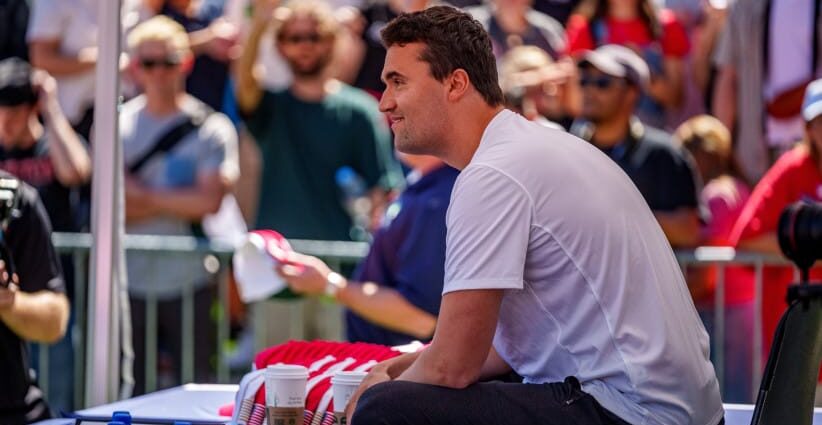
When Charlie Kirk was alive, almost no Modern Orthodox rabbi would publicly stand near him. Most of organized American Jewry treated Kirk as a liability. At best, an embarrassment, at worst, an antisemite. His rallies were seen as too close to the Christian nationalism that Jews are taught from childhood to keep at arm’s length.
One Orthodox rabbi, however, had Kirk’s number. And Kirk had his.
“Charlie said to me, you know, shockingly, people say about him that he’s anti-Israel, antisemitic, or a missionary or whatever,” Rabbi Dr. Ari Berman, the fifth president of Yeshiva University, told me in our Jerusalem Post studio this week. “We had a relationship. He was very appreciative.”
Kirk’s view of higher education was scathing. “College is a scam,” he told one of Berman’s sons. Then, realizing whose son he was talking to, he added: “Except Yeshiva.”
That exchange captures a doctrine almost no one in Israeli media has named, but one that has reshaped Modern Orthodoxy’s posture toward the non-Jewish world more than any theological move in the past 40 years.
Berman calls it Ger Toshav, the resident alien of classical Halachic terminology.
It is not a metaphor. It is a medieval Halachic category that Berman spent years mastering.
Berman: Noahide-following gentiles deserve our kindness
In 2016, he completed a PhD at Hebrew University of Jerusalem under Professor Moshe Halbertal on this exact subject: the gentile in pre-modern Jewish law who accepts the Noahide commandments, shares the foundational moral commitments of Torah, and toward whom Jews carry obligations of chesed, loving-kindness, that fall short of those owed to a fellow Jew but exceed those owed to a stranger.
Most Jews split the world into two columns: Jew and non-Jew. “They don’t realize in Halacha there’s a third dimension,” Berman told me. “The non-Jew who we share values with.”
That sounds like an academic distinction. Until you watch what Berman does with it.
Within hours of the October 7 attacks, Berman picked up the phone. He was calling university presidents to sign a letter standing with Israel against Hamas. Some refused. Others, he told me, asked him to take the word “Israel” out and leave the safer “against terrorism.” He did not.
The first president to commit was the head of the Council for Christian Colleges and Universities, an evangelical consortium of more than 150 schools. “She said to me, Ari, whatever you sign, I’m signing. You don’t have to send it to me. I’m with you.”
The president of a historically Black faith-based university gave him a different answer, in biblical idiom: “The Jews win when Moses holds his hands up. Let us be your Aaron and Hur.”
These were not strangers. They were his Ger Toshav network, built over years of partnership with Notre Dame, BYU, Baylor, and Pepperdine, with the Council for Christian Colleges, and with the American Council on Education’s Commission on Faith-Based Colleges, of which Berman is a founding member. The infrastructure was already in place on October 7. He simply activated it.
In February, the doctrine was tested in public. Berman testified before President Donald Trump’s Religious Liberty Commission. On the same panel sat Catholic commentator Carrie Bowler, who declared on the record that she, as a Catholic, was an anti-Zionist. Berman did not let it pass.
“There are 28 Muslim countries and 13 Christian countries,” he told the commission. “The only people you have a problem with having their own country are the Jews. That’s a double standard. That’s discrimination. That’s antisemitism.”
Congresswoman Elise Stefanik, watching, texted him afterward. “I’m Catholic,” she wrote, telling Berman that Bowler did not speak for Catholics like her. Secretary of State Marco Rubio is Catholic. There are Catholic Zionists. Bowler was not the voice of any of them.
Berman refuses the term most Israelis reach for when describing this kind of alliance: Judeo-Christian. He prefers “foundational biblical values.” Why? Because in much of Christian usage, Judeo-Christian carries a faint odor of supersessionism, the theological claim that Christianity completes and replaces Judaism.
Berman wants a partnership without a merger. Ger Toshav again, in operational form: shared values, separate identities, mutual respect, no theological compromise.
This is not a new question. Half a century ago, Rabbi Joseph Soloveitchik wrote Confrontation, the foundational Modern Orthodox essay on Jewish-Christian dialogue. His answer was that Jews could engage with Christians on the universal moral plane, but not on the theological one.
The line had to be drawn somewhere, and he drew it there. Berman’s Ger Toshav doctrine is the contemporary operationalization of that boundary. Soloveitchik defined the line. Berman is staffing it.
Berman is running a foreign policy that is separate from Israel’s official one. While the Israeli government cultivates the evangelical alliance through political channels, Berman has been building the academic and institutional spine of the Christian Zionist relationship one university president at a time.
The Kirk friendship was one node in that network. The Trump benediction was another, with Berman becoming the first American-Israeli to deliver remarks at a presidential swearing-in. So was the visit by Argentinian President Javier Milei to YU. Berman told me that on the inauguration stage in Washington, before the ceremony began, Milei pulled out his wallet and showed him a picture of the Lubavitcher Rebbe he carries every day.
Israelis are missing this, Berman said.
“Every time I speak to people from Israel who are talking about diaspora, they first go to antisemitism. And then they want to hear that all the Jews from New York are packing their bags. So what they miss is opportunity.”
The Israeli reading of American Jewish life has been organized for three-quarters of a century around two questions: how bad is the antisemitism, and when will they make aliyah? Berman is asking a third question that classical Zionism was not built to answer.
What if American Judaism is producing its own vital expression, fully Jewish and fully Zionist, that does not require relocation to be authentic? Cultural Zionists from Ahad Ha’am onward have circled some version of this question. Berman’s contribution is that he runs the flagship institution from which a serious contemporary answer might emerge.
Berman’s argument is that the assumption is wrong. Authentic Judaism, fully Zionist and fully observant, is a draw in America right now, not a liability. Faith-based universities educate 10% of American undergraduates and are growing fast. Christian students enroll in YU’s Jewish studies tracks. Application numbers climb.
Berman’s wager, with his PhD as the operating manual, is that Modern Orthodoxy is best positioned to lead this moment, not by softening its particularism but by sharpening it. The Ger Toshav framework gives him both: a deeper engagement with non-Jewish allies than most rabbis would countenance, and clearer red lines than most diplomats would draw.
“It’s not about validation,” he told me. “It’s about mutual respect and utility, and what are the areas that we work together, especially in America, to help American society.”
Charlie Kirk understood that. Most of his Jewish critics did not. The question for Israel and for organized American Jewry is whether they want to learn the doctrine before the next moment of crisis, or after it.