By JBizNews Desk
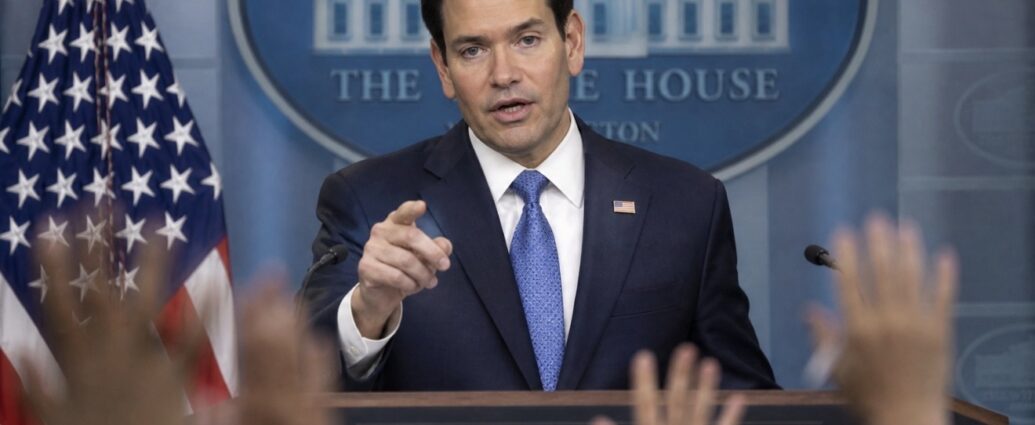
Secretary of State Marco Rubio stepped into unfamiliar political territory Tuesday, taking the podium inside the White House briefing room for a high-profile press session that quickly evolved into something larger than a routine policy update — fueling renewed speculation about the Republican Party’s emerging 2028 presidential landscape.
Rubio, who currently serves as both Secretary of State and National Security Adviser under President Donald Trump, is already occupying one of the most powerful dual roles in modern American government. He is the first official to simultaneously hold both positions since Henry Kissinger during the Nixon administration. Tuesday’s appearance effectively added another role to the list: temporary White House spokesperson.
The briefing marked the beginning of what officials described as a rotating lineup of senior administration figures filling in while White House Press Secretary Karoline Leavitt remains on maternity leave. But inside Washington, the optics carried unmistakable political implications.
Rubio and Vice President J.D. Vance are widely viewed as the two leading contenders to inherit Trump’s political coalition heading into the 2028 presidential cycle, making every public appearance, policy defense, and media performance subject to heightened scrutiny.
Tuesday’s briefing only intensified that conversation.
Rubio handled questions across foreign policy, national security, energy markets, immigration, and international diplomacy while moving fluidly between English and Spanish. At one point, as reporters shouted competing questions across the room, Rubio smiled and remarked: “This is chaos, guys,” drawing laughter while maintaining control of the briefing.
The session contrasted sharply with the often combative tone that has defined recent White House press briefings and gave Rubio an opportunity to project a more measured and conversational public persona — one that political observers immediately noted.
At the same time Rubio stood behind the White House podium, Vice President Vance was appearing in Des Moines, Iowa, the state that traditionally opens the Republican presidential primary calendar. Vance’s event alongside a Republican congressman immediately fueled speculation about early positioning for 2028, even as administration officials dismissed suggestions of coordinated political maneuvering.
Foreign policy remained the dominant substance of Rubio’s appearance.
He defended the administration’s hardline posture toward Iran, warning that a nuclear-armed Tehran would pose a direct threat not only to regional stability but also to global energy markets and American consumers. Rubio pointed specifically to rising instability in the Strait of Hormuz and the impact disruptions could have on oil shipping and gasoline prices.
“The consequences would not stay in the Middle East,” Rubio said, arguing that global energy markets remain deeply vulnerable to escalation in the region.
Rubio also discussed President Trump’s planned trip to China and confirmed his own upcoming visit to Vatican City, where he is expected to meet with Pope Leo XIV to discuss humanitarian aid efforts, international conflict zones, and religious freedom concerns.
Throughout the session, Rubio repeatedly framed his comments around the president’s priorities, underscoring Trump’s continued dominance inside the administration and within Republican politics more broadly. Political analysts noted that the briefing offered Rubio an opportunity to demonstrate loyalty while simultaneously showcasing his own executive-level communication skills.
The appearance also marked a notable shift in Rubio’s media posture. The secretary had maintained a relatively low public profile through much of April, reportedly participating in only one television interview during the month. Tuesday’s briefing abruptly ended that quiet stretch in the most visible media setting available in Washington.
President Trump has repeatedly praised Rubio publicly in recent months, particularly on foreign policy and national security matters, further elevating his profile within the administration. Rubio, for his part, has largely avoided direct engagement with 2028 speculation and has publicly deferred to Vance’s standing within the Republican base.
Still, the comparison between the two men has become increasingly unavoidable.
Vance continues to dominate among populist conservatives closely aligned with Trump’s America First movement, while Rubio has steadily expanded his appeal among establishment Republicans, foreign policy hawks, and donors seeking a candidate capable of blending Trump-era politics with broader international credibility.
Tuesday’s briefing provided a vivid split-screen moment between the two potential successors: one campaigning in Iowa, the other commanding the White House briefing room while speaking on behalf of the administration during a period of rising global tensions.
For now, Rubio returns to the State Department — and soon to Rome. But his appearance behind the White House podium offered something increasingly rare in Washington: a glimpse of what a post-Trump Republican leadership contest may actually look like.
And in a city where every moment is political, Tuesday gave the 2028 conversation fresh momentum.
JBizNews Desk
© JBizNews.com. All rights reserved.