By JBizNews Desk
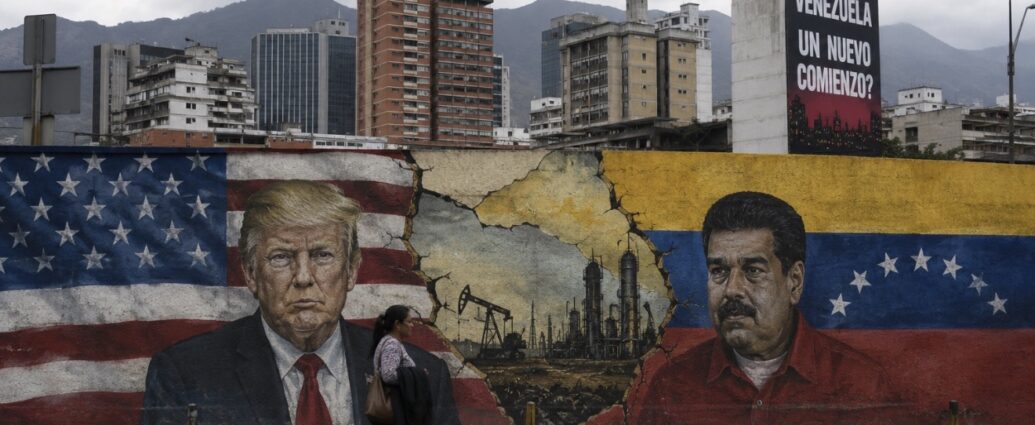
Four months after U.S. forces captured Venezuelan leader Nicolás Maduro and removed him from power, Venezuela has entered one of the most extraordinary political transitions in modern Latin American history — one increasingly directed not from Caracas, but from Washington.
The dramatic shift has transformed relations between the United States and its longtime geopolitical adversary from sanctions and isolation into direct political management, economic supervision, and strategic engagement under President Donald Trump’s administration.
The result is a country now operating in a political gray zone:
formally sovereign, yet heavily dependent on U.S. approval for everything from banking access and oil production to diplomatic recognition and economic survival.
How the Maduro Era Ended
On January 3, 2026, President Trump announced that U.S. military operations inside Venezuela had culminated in the capture of Maduro and his wife, Cilia Flores, during a coordinated strike campaign that Washington said encountered minimal American casualties.
Both were transferred to New York to face federal charges tied to narco-terrorism, drug trafficking, and weapons offenses.
The operation instantly altered the geopolitical landscape across Latin America and triggered one of the most significant regime collapses in the region in decades.
Shortly afterward, Trump declared that U.S. forces were effectively “running Venezuela” during the transition period and confirmed negotiations involving Venezuelan oil assets and future energy cooperation with the United States.
The administration also secured agreements tied to sanctioned Venezuelan oil revenues reportedly worth billions of dollars.
Washington Chooses an Unlikely Partner
One of the administration’s most controversial decisions was its choice to work with interim Venezuelan President Delcy Rodríguez — Maduro’s former vice president — rather than immediately transfer authority to the democratic opposition.
The move stunned many Venezuelan opposition figures, particularly supporters of longtime anti-Maduro activist María Corina Machado, who spent years leading resistance efforts against the socialist government.
Critics accused Washington of prioritizing stability and energy interests over democratic transition.
The White House defended the strategy as pragmatic.
Administration officials argued that Rodríguez controlled enough of the state apparatus to maintain order and oversee a managed transition while negotiations over elections, sanctions relief, and institutional reforms continued.
The U.S. Controls the Economic Lifeline
The Trump administration is now exercising influence over Venezuela primarily through economic leverage.
Washington has selectively eased some sanctions, allowing limited transactions involving Venezuela’s central bank and partially reopening pathways for state-owned oil company Petróleos de Venezuela (PDVSA) to operate internationally.
But nearly all relief measures remain temporary and heavily conditional.
Access to:
- International banking systems
- Foreign investment
- Oil export markets
- Frozen overseas assets
- Global financing mechanisms
still depends on licenses issued by the U.S. Treasury Department.
That arrangement effectively gives Washington extraordinary influence over Venezuela’s economic future.
Trump made the administration’s posture unmistakably clear early in the transition.
“If she doesn’t do what’s right, she is going to pay a very big price, probably bigger than Maduro,” the president said in January, referring to Rodríguez.
U.S. Officials Flood Into Caracas
Since Maduro’s removal, senior Trump administration officials have made repeated trips to Caracas as part of what appears to be a phased stabilization and restructuring effort.
In February, Energy Secretary Chris Wright visited Venezuela to discuss rebuilding the country’s oil infrastructure and expanding future production capacity.
In March, Interior Secretary Doug Burgum traveled to Caracas for talks focused on mining and natural resources. The visit concluded with the formal restoration of diplomatic relations between the United States and Venezuela.
The administration’s intense focus on energy is unsurprising.
Venezuela possesses the world’s largest proven oil reserves, yet years of corruption, sanctions, underinvestment, and political collapse devastated production under Maduro’s rule.
Oil output fell roughly 65% compared with 2013 levels.
Industry analysts say any meaningful recovery would require years of infrastructure rebuilding, legal restructuring, and political stability — conditions Venezuela still lacks.
Democracy Deferred?
Secretary of State Marco Rubio has repeatedly stated that restoring democratic governance remains a long-term objective, but administration officials have privately emphasized that immediate priorities center on:
- Security stabilization
- Migration control
- Energy production
- Regional counter-narcotics operations
That sequencing has frustrated many Venezuelan opposition activists.
Trump himself added fuel to the controversy by publicly claiming opposition leader María Corina Machado, recipient of the 2025 Nobel Peace Prize, lacked sufficient support to govern effectively.
Still, Machado is expected to return to Venezuela in coming weeks and has stated publicly that national elections will eventually be held — a possibility that would have seemed unimaginable only months earlier.
Whether those elections materialize freely and fairly remains one of the central unanswered questions surrounding Venezuela’s transition.
Life for Venezuelans Has Barely Changed
For ordinary Venezuelans, daily life remains difficult despite the geopolitical transformation unfolding around them.
Inflation, weak wages, unreliable infrastructure, and economic hardship continue across much of the country.
Some early indicators suggest limited improvement:
- Meat and poultry prices have declined modestly
- Real estate values have risen approximately 22%
- American Airlines has resumed service to Venezuela
But much of the population has yet to experience meaningful economic recovery.
The United States also continues to maintain partial visa restrictions on Venezuelan nationals, while deportations of migrants continue under broader immigration enforcement policies.
Meanwhile, U.S. military operations targeting suspected narcotics trafficking networks across the Caribbean and Eastern Pacific have continued even after Maduro’s capture.
Since operations began in late 2025, dozens of strikes have reportedly been carried out, with total deaths exceeding 180.
A Political Experiment Without Precedent
Foreign policy analysts say Venezuela has effectively become a geopolitical experiment with few modern parallels.
Experts at RAND have cautioned that removing a leader does not automatically dismantle the underlying power structure.
Although Maduro is gone, much of the broader political and institutional system that sustained his government remains in place.
What exists today is neither a full democratic transition nor a traditional occupation.
Instead, Venezuela appears to be entering a new hybrid phase:
a country formally governed by Venezuelans, yet economically dependent on U.S. licenses, politically influenced by Washington, and strategically shaped through American leverage.
Whether that produces long-term stability, democratic reform, or a new form of dependency remains deeply uncertain.
What is already clear is that Venezuela’s future is no longer being determined solely in Caracas.
For now, the decisive power sits in Washington.
JBizNews Desk
© JBizNews.com. All rights reserved.