JBizNews Desk | Thursday, May 7, 2026
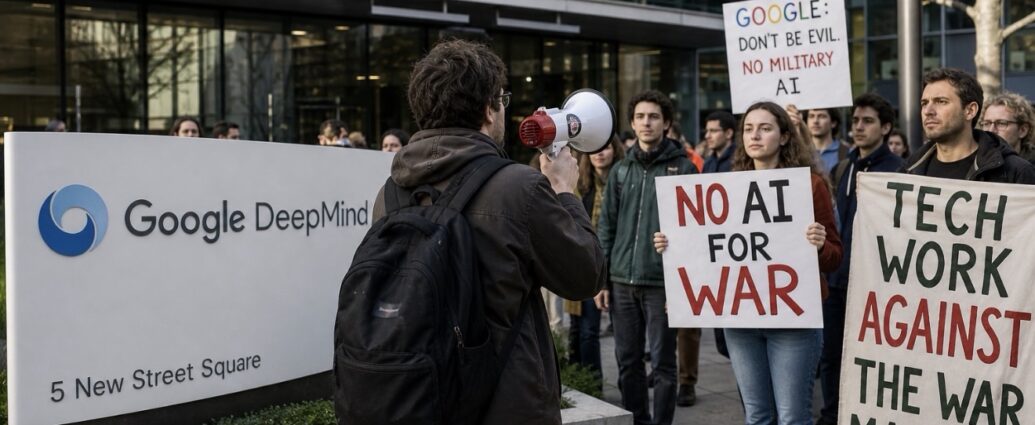
Google DeepMind’s UK-based employees have launched a formal effort to unionize, escalating tensions inside one of the world’s most influential artificial intelligence labs and mounting a direct challenge to Google’s growing involvement in military AI contracts.
Workers formally submitted a request Tuesday asking management to recognize the Communication Workers Union and Unite the Union as their official representatives. The move could make Google DeepMind the world’s first unionized frontier AI laboratory if successful.
According to organizers, 98% of Communication Workers Union members inside DeepMind voted in favor of the unionization effort. However, Google pushed back on suggestions of broad employee consensus, with a company spokesperson telling Fortune that no companywide vote among DeepMind staff had taken place.
“Google has always valued constructive dialogue with employees,” the spokesperson said.
If management voluntarily recognizes the unions, the effort would represent roughly 1,000 workers connected to DeepMind’s London operations.
What Triggered the Union Push
The organizing campaign accelerated after the Pentagon announced a new series of classified AI contracts involving Google and six other major technology companies.
According to statements from the Communication Workers Union, employees are demanding that Google prohibit its AI systems and research from being used by the U.S. military or the Israeli Defense Forces.
Many workers fear the company’s growing defense ties could eventually contribute to autonomous weapons systems, mass surveillance technologies, and advanced military targeting applications.
The unrest has already spread well beyond a small activist group inside the company.
More than 580 Google employees — including senior researchers, directors, and vice presidents — previously signed a letter urging CEO Sundar Pichai to reject the classified Pentagon contracts.
Separately, more than 100 DeepMind employees signed an internal appeal demanding that no DeepMind models or research be used for weapons development or autonomous targeting systems.
The Workers’ Demands
The unionization effort is about more than opposing a single military contract.
Workers are also demanding that Google restore a previously published company pledge stating it would not develop AI technologies for weapons or surveillance purposes.
That commitment was first introduced after widespread employee protests against Project Maven in 2018 — a Pentagon drone surveillance initiative that sparked one of the largest worker uprisings in Silicon Valley history.
But employees say Google quietly removed the pledge from its public AI principles in February 2025, eliminating a key ethical safeguard workers had previously relied upon to challenge controversial projects.
The organizing workers are also calling for the creation of an independent ethics oversight body and protections allowing employees to refuse participation in projects they believe violate moral or humanitarian principles.
A 10-Day Deadline
The employees’ letter gave Google management 10 working days to either voluntarily recognize the unions or agree to mediated negotiations before organizers pursue formal legal recognition proceedings.
Organizers have also warned that the campaign could escalate significantly if talks fail.
Plans under discussion reportedly include public demonstrations and “research strikes,” in which employees would temporarily halt work on core products and research initiatives, including the Gemini AI assistant platform.
Such actions could create operational disruptions inside one of Alphabet’s most strategically important divisions at a time when competition in generative AI is intensifying globally.
Why This Fight Is Different From 2018
The confrontation inevitably recalls Google’s 2018 employee revolt over Project Maven, when internal protests successfully pressured management to withdraw from a Pentagon drone-analysis contract.
But employees and analysts alike say the environment has fundamentally changed.
In 2026, military AI contracts represent a multibillion-dollar strategic market tied directly to national security priorities, defense modernization, and geopolitical competition with China and other rivals.
At the same time, major technology companies including Microsoft, Amazon, OpenAI partners, and other AI firms have increasingly embraced government and military partnerships rather than avoiding them.
Workers involved in the campaign argue that unionization is now necessary because internal protest alone may no longer be enough to influence corporate decision-making.
One DeepMind employee familiar with the effort told Fortune the campaign aims to force leadership to “grow a spine when it comes to standing up to what they have preached and publicly endorsed as our values and principles for the last two decades.”
The Bigger Risk for Alphabet
For Alphabet investors, the dispute creates both ethical and financial questions.
Google DeepMind is considered one of the company’s crown jewels and remains central to Alphabet’s long-term AI strategy.
Any sustained labor unrest — particularly involving elite AI researchers and engineers — could create risks extending beyond public relations damage.
Analysts say the possibility of employee walkouts, slowed research output, or talent departures could eventually become more costly than the defense contracts themselves.
The standoff also highlights a growing divide across the AI industry between commercial opportunity and ethical resistance, as frontier AI systems increasingly move from consumer tools into military, intelligence, and national security applications.
For now, Google faces a rapidly approaching deadline — and one of the most consequential labor battles the artificial intelligence industry has seen to date.
— JBizNews Desk
**© JBizNews.com. All rights reserved. This article is original reporting by JBizNews Desk. Unauthorized reproduction or redistribution is strictly prohibited.