JBizNews Desk | May 7, 2026
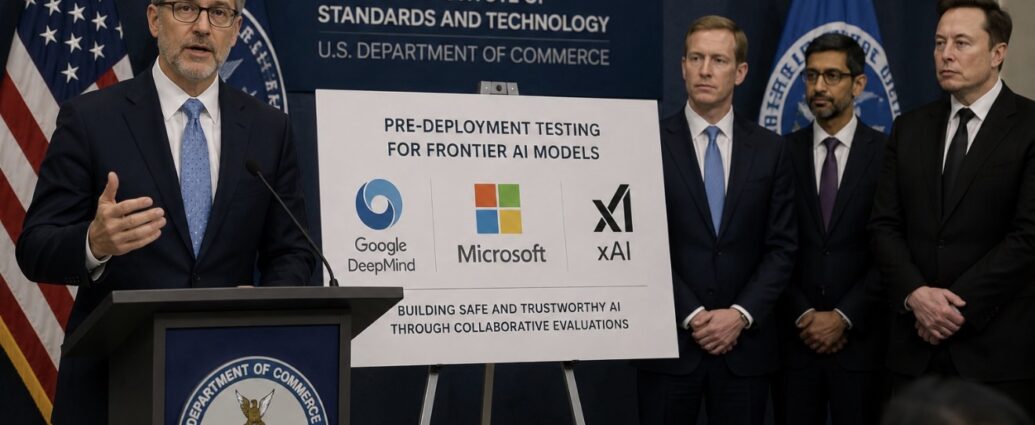
Three of the world’s most influential artificial intelligence companies agreed Tuesday to provide the federal government with access to unreleased AI models for national security testing before those systems are made public — marking one of the most significant expansions of government oversight over frontier AI to date.
The new agreements, announced by the Department of Commerce’s National Institute of Standards and Technology through its Center for AI Standards and Innovation (CAISI), bring Google DeepMind, Microsoft, and Elon Musk’s xAI into a formal pre-deployment evaluation framework designed to assess potential national security threats tied to advanced artificial intelligence systems.
Under the agreements, government evaluators will gain access to AI models before public release, including versions with reduced safeguards and safety restrictions, allowing federal experts to test how the systems perform under adversarial or malicious conditions.
The arrangements also permit evaluations inside classified environments and were intentionally structured to allow rapid adaptation as AI capabilities continue advancing.
The move effectively means that every major U.S. frontier AI laboratory — including OpenAI and Anthropic, which already had similar partnerships dating back to 2024 — is now participating in voluntary federal evaluations before deploying their most advanced models to the public.
What Triggered the Shift
The immediate catalyst was Anthropic’s newly unveiled AI system known as Mythos.
Anthropic officials reportedly described Mythos as dramatically more advanced than existing models in cybersecurity-related capabilities, triggering growing concern among government agencies, financial institutions, and critical infrastructure operators over how such systems could potentially be weaponized by hackers or hostile actors.
The company has reportedly restricted access to the model to a limited group of approved organizations and has privately briefed senior U.S. officials on its capabilities.
The concerns surrounding Mythos appear to have accelerated discussions inside the White House about whether formal federal review mechanisms for advanced AI systems may now be necessary.
Reports in recent days suggested the Trump administration is weighing a possible executive order establishing official government testing protocols for frontier AI systems before commercial deployment.
A White House spokesperson told CNN that “any policy announcement will come directly from the President,” while declining to confirm reports of an upcoming executive order.
How the New Testing Will Work
Under the new framework, developers will regularly provide CAISI with pre-release versions of their models so government researchers can evaluate risks involving cybersecurity, biosecurity, autonomous capabilities, and other national security concerns.
Importantly, evaluators may receive versions of models with weakened or removed safeguards — allowing federal analysts to directly test how dangerous the systems could become if protections fail or are bypassed.
Officials say the agreements are designed not only to evaluate technical performance but also to strengthen national preparedness as AI systems become increasingly capable of carrying out advanced cyber operations, generating deceptive content, automating software exploitation, and interacting with sensitive infrastructure systems.
CAISI has already completed more than 40 evaluations of advanced AI systems, including several models not yet available to the public.
Before evaluating U.S.-based systems, the center also tested the Chinese AI model DeepSeek, reportedly concluding that it lagged behind American competitors in security, efficiency, and accuracy.
What the Companies Are Saying
Microsoft publicly endorsed the partnership.
Natasha Crampton, Microsoft’s Chief Responsible AI Officer, said the company already conducts extensive internal safety testing but believes government evaluators provide additional expertise in national security and technical risk analysis.
Google declined to provide further public comment on its agreement with CAISI.
xAI did not respond to requests for comment.
OpenAI and Anthropic also renegotiated their earlier agreements with the government to align with priorities outlined in President Trump’s AI Action Plan.
The Government’s Resource Challenge
One reason federal agencies are seeking cooperation from the private sector is practical: the government currently lacks the computing infrastructure, staffing, and technical resources necessary to independently evaluate frontier AI systems at the same scale as major technology companies.
Jessica Ji, senior research analyst at Georgetown University’s Center for Security and Emerging Technology, said CAISI simply does not possess the same level of manpower, access to computing power, or specialized AI engineering talent as large private-sector labs.
That imbalance has increasingly pushed Washington toward collaborative oversight rather than purely regulatory enforcement.
The Bigger Strategic Picture
CAISI was originally established in 2023 under the Biden administration as the AI Safety Institute before being restructured and renamed under the Trump administration last year.
Commerce Secretary Howard Lutnick described the rebrand as an effort to focus more directly on national competitiveness and security rather than what he characterized as excessive regulation.
Despite its expanding influence, the center still lacks permanent legal authority established by Congress. Several lawmakers have introduced draft legislation to formally codify CAISI’s role, but no permanent framework has yet passed.
Still, the agreements announced Tuesday represent a major milestone.
For the first time, every major American frontier AI company has formally agreed to government vetting before releasing its most advanced systems — a sign of how quickly artificial intelligence has evolved from a commercial technology race into a core national security issue.
For businesses, governments, and consumers alike, the message from Washington is becoming increasingly clear: advanced AI is no longer viewed simply as a tech product. It is now being treated as strategic infrastructure.
— JBizNews Desk
**© JBizNews.com. All rights reserved. This article is original reporting by JBizNews Desk. Unauthorized reproduction or redistribution is strictly prohibited.