The company behind the world’s most in-demand AI chips keeps posting record revenues — yet its stock has gone almost nowhere. A major earnings report on May 20 may be the moment that changes that.
Nvidia has a paradox problem.
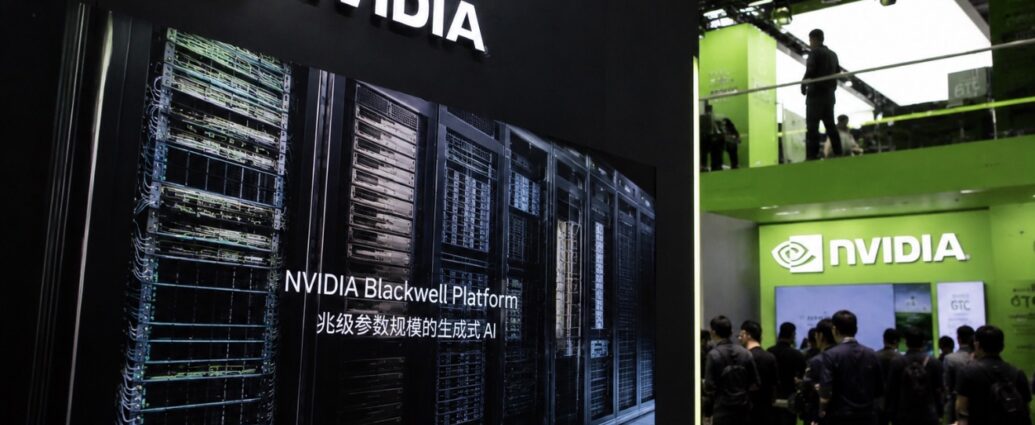
The Santa Clara chipmaker is generating more revenue than ever, shipping its Blackwell graphics processors as fast as factories can produce them, and watching the biggest companies in the world pour hundreds of billions of dollars into infrastructure that runs almost entirely on Nvidia hardware.
And yet the stock has barely moved.
After reaching an all-time closing high of $207.03 in October 2025, NVDA pulled back sharply, weighed down by export restrictions on China, margin pressure during the Blackwell ramp, a post-earnings selloff in late February, rising geopolitical tensions tied to the U.S.–Iran conflict, and broader market volatility.
The underlying numbers tell a very different story.
Nvidia’s data center revenue surged to $62.3 billion in its most recent quarter, fueled primarily by explosive demand for Blackwell AI chips. For the full fiscal year, the company generated $215.9 billion in revenue — up 65% year over year.
For most companies, that kind of growth would ignite a stock frenzy.
For Nvidia, it has barely been enough to hold investor enthusiasm in place.
The Weight of Expectations
Part of Nvidia’s challenge is that expectations have become almost impossibly high.
Investors increasingly worry that the AI spending boom may eventually slow or become financially unsustainable, even as hyperscalers continue pouring unprecedented sums into infrastructure.
Amazon, Alphabet, Microsoft, and Meta Platforms have all announced massive capital expenditure increases aimed directly at AI expansion. Those investments overwhelmingly benefit Nvidia today — but they also raise concerns about how long this spending cycle can continue at its current pace.
Amazon, for example, recently indicated it expects to spend roughly $200 billion in 2026, despite generating only about $11.2 billion in trailing twelve-month free cash flow. That imbalance has become a growing talking point among institutional investors questioning the long-term economics of the AI arms race.
There’s also a second concern quietly building inside Wall Street models: Nvidia’s biggest customers are increasingly trying to become competitors.
Alphabet and Microsoft both continue investing aggressively in their own in-house AI chips and custom silicon platforms. While Nvidia still dominates high-end AI training, the rise of proprietary cloud chips could eventually pressure Nvidia’s margins and pricing power over time.
Analysts also point to three broader risks weighing on sentiment:
• Nvidia’s CUDA software moat may matter less in an inference-heavy AI world
• Custom silicon is steadily gaining share
• The transition to the next generation of chips creates uncertainty during a critical period
China Remains the Biggest Wild Card
No issue looms larger over Nvidia’s stock than China.
Management’s current guidance effectively excludes China data center revenue entirely after tighter U.S. export controls severely restricted shipments of Nvidia’s most advanced AI processors.
That matters enormously because China previously represented roughly 20% to 25% of Nvidia’s data center revenue.
Even a partial loss of that business creates a meaningful hole in future growth expectations.
Washington has allowed limited sales of some lower-tier Nvidia chips into China under strict conditions, but exports of the company’s most advanced Blackwell systems remain heavily restricted.
Any shift in policy — whether looser or tighter — could trigger major volatility in Nvidia shares almost immediately.
What’s Still Working
Despite the concerns, Nvidia’s core business momentum remains exceptionally strong.
Demand from hyperscalers including Microsoft, Amazon, Google, and Meta continues to exceed available supply for Blackwell-based systems. Nvidia management has repeatedly indicated that supply constraints are likely to persist through at least the first half of 2026 as global data center construction accelerates.
The company also disclosed that Blackwell-based systems are now deployed across every major cloud provider.
Supply commitments have nearly doubled to $95.2 billion, while Nvidia says it now has visibility into approximately $500 billion in combined Blackwell and Rubin revenue opportunities stretching from 2025 through the end of 2026.
The next platform transition is already underway.
CEO Jensen Huang recently confirmed that Nvidia’s Vera Rubin architecture — the successor to Blackwell — is expected to begin shipping commercially during the second half of 2026.
According to Nvidia, the Rubin platform could allow AI models to train using 75% fewer GPUs while reducing inference token costs by roughly 90%.
If achieved, those numbers would represent another major leap in AI economics and further cement Nvidia’s role at the center of the industry.
The May 20 Catalyst
For investors, the next major moment arrives on May 20.
Nvidia’s upcoming earnings report is widely viewed as one of the most important events of the quarter for the entire technology sector, with Wall Street closely focused on Blackwell demand, margins, and forward guidance.
Historically, Nvidia earnings reports have produced sharp stock moves, and options markets are already pricing in the potential for a swing of 5% or more in either direction.
The backdrop may favor upside.
Meta recently raised the upper end of its capital expenditure forecast to $145 billion, while Microsoft announced plans to spend roughly $190 billion in calendar year 2026 — far above previous Wall Street expectations.
That spending wave directly feeds Nvidia’s ecosystem.
Wall Street currently expects Nvidia to generate adjusted earnings of $8.34 per share in fiscal 2027, compared with $4.77 in fiscal 2026.
At current levels, that places NVDA at roughly 24 times forward earnings — a valuation many investors view as surprisingly modest for a company still growing revenue at a 65% annual pace.
The AI boom is no longer theoretical.
Nvidia remains its central engine.
The question now is whether Wall Street is finally ready to reward the company for it again.
— JBizNews Desk