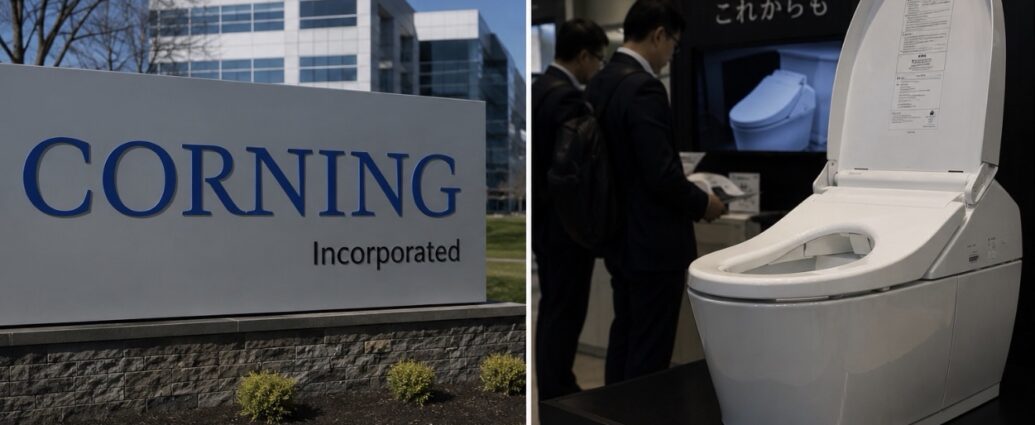
A 175-year-old American glass company and a Japanese toilet manufacturer suddenly became two of the hottest AI stocks in global markets this week — highlighting how the artificial intelligence boom is rapidly spreading far beyond Silicon Valley chipmakers and into the hidden industrial backbone powering the next generation of computing.
Shares of Corning Incorporated surged nearly 20% after Nvidia unveiled a sweeping long-term partnership that could see the AI giant invest up to $3.2 billion into the company’s optical fiber and connectivity expansion plans across the United States. Hours later, investors piled into Japan’s Toto Ltd., sending the stock up 18% to a five-year high after markets realized the company’s advanced ceramics business — originally rooted in bathroom manufacturing — has quietly become a critical supplier to semiconductor factories fueling the global AI race.
The AI Supply Chain Is Expanding Far Beyond Chips
Together, the two companies became symbols of a broader market realization now reshaping Wall Street and Asia alike: the AI infrastructure boom is no longer just about chips. It is increasingly about the industrial supply chain underneath them.
For Nvidia, the Corning deal reflects a growing bottleneck inside the AI economy. As hyperscalers including Microsoft, Amazon, Meta Platforms, and Alphabet continue constructing massive AI data centers packed with tens of thousands of GPUs, moving data efficiently between those systems has become one of the industry’s biggest engineering challenges. Traditional copper connections consume too much electricity, generate excessive heat, and lose signal strength as AI server clusters grow larger. Fiber optics solve that problem by transmitting data with light.
That suddenly places Corning — long known to consumers primarily for Gorilla Glass smartphone screens — at the center of one of the most important infrastructure races in technology.
Under the agreement, Corning plans to increase domestic optical connectivity manufacturing capacity tenfold, expand U.S. fiber production by more than 50%, and build three advanced manufacturing facilities in North Carolina and Texas. The project is expected to create at least 3,000 jobs.
Nvidia CEO Jensen Huang called artificial intelligence “the largest infrastructure buildout of our time,” while Corning CEO Wendell Weeks said the partnership demonstrates that AI is now becoming “a manufacturing story.”
Investors responded immediately.
Corning’s optical communications division already posted 36% year-over-year sales growth during the first quarter of 2026, helping lift total company revenue 18% to $4.35 billion. Management now expects Corning to reach a $20 billion annualized revenue run rate by the end of next year and sees a path toward $40 billion annually by 2030.
The stock has climbed more than 300% over the past year.
A Japanese Toilet Company Quietly Became an AI Powerhouse
Halfway around the world, Toto’s transformation may be even more surprising.
The Japanese company is globally famous for high-end smart toilets with heated seats, built-in bidets, and advanced hygiene systems. But buried inside the company is a highly specialized advanced ceramics division that has quietly become one of the most profitable semiconductor suppliers in Asia.
The business produces electrostatic chucks — precision ceramic components used to hold silicon wafers in place during the semiconductor manufacturing process. Those parts are essential for advanced chip production, including the AI processors now driving explosive demand across global technology markets.
Toto’s expertise in precision ceramics dates back more than a century, originally developed for durable and hygienic bathroom fixtures. That same materials science capability unexpectedly positioned the company to become a major beneficiary of the AI semiconductor buildout decades later.
The company’s advanced ceramics business generated approximately ¥67.4 billion, or about $429 million, in revenue during the fiscal year ended in March — up 34% from the prior year. Operating margins within the segment are expected to surpass 40%, compared with less than 9% just five years ago.
Today, the ceramics division contributes roughly 55% of Toto’s total operating profit.
The shift has attracted global investors.
UK-based activist firm Palliser Capital, now one of Toto’s largest shareholders, recently described the company as “the most undervalued and overlooked AI memory beneficiary” in the market. Palliser has pushed management to aggressively expand semiconductor ceramics investment, viewing the business as a multi-year AI infrastructure growth platform.
Toto plans to invest approximately ¥30 billion through fiscal year 2028 into expanding semiconductor ceramics manufacturing and research capacity.
The Next Phase of the AI Boom
What makes the Corning and Toto stories so significant is not simply their sudden stock rallies. It is what they reveal about where the AI boom is heading next.
For the past several years, investors focused almost exclusively on companies directly building AI chips, including Nvidia, AMD, Taiwan Semiconductor Manufacturing Co., and Broadcom. But as the industry matures, attention is rapidly shifting toward the deeper infrastructure ecosystem required to support AI at global scale.
That includes fiber optics, networking systems, cooling technologies, advanced manufacturing materials, power infrastructure, and precision industrial components.
In other words, the next AI winners may not look like traditional tech companies at all.
Nvidia’s shares have risen roughly fourteenfold over the past five years, but even as the chipmaker remains the centerpiece of the AI trade, investors are increasingly branching outward into the companies supplying the invisible machinery behind the revolution.
The AI race is no longer only about who designs the fastest processor.
It is increasingly about who builds the rails, wiring, optics, ceramics, and industrial systems that allow those processors to operate at scale.
And this week, a glassmaker and a toilet company unexpectedly became two of the most important names in that story.
— JBizNews Desk