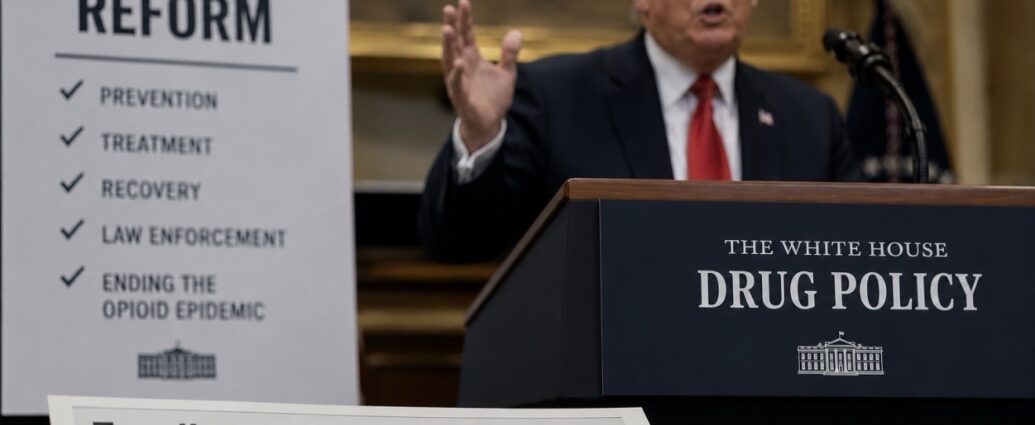
The Trump administration unveiled a sweeping new national drug control strategy this week that promises broader addiction treatment access, stronger overdose prevention efforts, and a more aggressive response to fentanyl trafficking. But across the addiction treatment industry, public health agencies, and Medicaid-funded care systems, the reaction has been dominated by one question:
How can the federal government expand treatment while simultaneously cutting the infrastructure that delivers it?
The administration’s 2026 National Drug Control Strategy describes itself as a roadmap to “dismantle the drug supply and defeat the scourge of illicit drugs,” outlining a series of public health and law enforcement goals aimed at reducing overdose deaths and improving access to recovery services.
Many addiction specialists say the goals themselves are widely supported.
The controversy is over whether the administration’s own funding cuts, staffing reductions, and policy reversals are making those goals harder — not easier — to achieve.
The Strategy’s Core Promise
One of the most repeated themes throughout the strategy is the administration’s pledge to make addiction treatment easier to access than illegal drugs.
The White House argues that expanding treatment availability, supporting recovery programs, and disrupting fentanyl trafficking are central pillars of its effort to combat the nation’s overdose crisis.
The urgency is real.
Federal health data shows that more than 80% of Americans who need substance-use treatment currently do not receive it. The U.S. continues facing record overdose deaths tied largely to fentanyl and synthetic opioids, which remain deeply embedded in the illegal drug supply nationwide.
The strategy endorses several policies long backed by addiction clinicians and recovery advocates, including medication-assisted treatment and fentanyl test strips — tools designed to help detect deadly fentanyl contamination in drugs before use.
The White House Office of National Drug Control Policy described the document as a comprehensive framework that will continue “dismantling the drug supply and defeating the scourge of illicit drugs in our country.”
Critics Say the Funding Reality Contradicts the Strategy
The backlash centers on the growing disconnect between the administration’s rhetoric and its budgetary and operational decisions.
One of the clearest examples involves fentanyl test strips.
While the new strategy endorses their use, the administration issued federal guidance in April 2026 stating that fentanyl test strips would no longer qualify for federal funding support — reversing earlier federal guidance that explicitly allowed funding for the devices.
Public health experts say fentanyl test strips reduce overdose risk by helping users identify fentanyl contamination and make safer decisions, including avoiding use altogether, slowing consumption, or ensuring another person is present.
Critics argue it is difficult to publicly support overdose prevention tools while simultaneously cutting funding access for those same tools.
“It is the height of rhetoric over reality to champion a tool while simultaneously cutting off the funding used to acquire it,” said Regina LaBelle, a Georgetown University professor who previously served as acting director of the Office of National Drug Control Policy.
Grant Cuts and Agency Layoffs Shocked the Industry
The administration also triggered major alarm earlier this year when it abruptly moved to terminate hundreds of federal grants supporting addiction and mental health services.
The January 2026 cuts, which treatment providers estimated could have totaled nearly $2 billion, were reversed within 24 hours following public backlash. But treatment organizations say the episode exposed deep instability inside the federal funding system supporting addiction care nationwide.
At the same time, key federal agencies responsible for addiction treatment oversight have experienced major staffing reductions.
The Substance Abuse and Mental Health Services Administration — known as SAMHSA — has reportedly lost roughly half its workforce since the administration change earlier this year. The Centers for Disease Control and Prevention has also seen workforce reductions estimated at approximately 25%.
The administration is now proposing an additional $753 million in cuts affecting SAMHSA while considering folding the agency into a newly proposed entity called the Administration for a Healthy America under Health and Human Services Secretary Robert F. Kennedy Jr.
The White House has also proposed consolidating two major National Institutes of Health addiction research divisions — the National Institute on Drug Abuse and the National Institute on Alcohol Abuse and Alcoholism — into a single center with approximately $165 million less in funding.
That proposal has alarmed researchers because the National Institute on Drug Abuse currently funds an estimated 85% of addiction research globally.
Marijuana Policy Adds Another Contradiction
The administration’s cannabis policy has created additional confusion within addiction and public health circles.
The strategy itself warns that marijuana use contributes to rising substance-use disorders and cites evidence linking cannabis use to increased psychosis risk. The document also calls for improved treatment options targeting marijuana withdrawal and dependency.
Yet only weeks before releasing the strategy, the administration advanced efforts to reclassify medical marijuana to a lower schedule under federal drug laws while moving toward broader cannabis rescheduling hearings.
Critics say the administration is simultaneously warning about marijuana-related addiction risks while easing federal restrictions on cannabis use.
Medicaid and Treatment Providers Face Financial Pressure
Beyond the policy debate, the financial consequences could prove substantial for the addiction treatment industry itself.
Medicaid remains the single largest payer for addiction and mental health services in the United States, supporting treatment centers, recovery clinics, counseling providers, rehabilitation facilities, and behavioral health systems nationwide.
The administration’s broader Medicaid reduction proposals are now creating additional financial strain for treatment providers already facing uncertainty over federal grants, staffing, and regulatory policy.
Industry leaders warn that treatment facilities — particularly smaller nonprofit and rural providers — could struggle to maintain services if both federal grants and Medicaid reimbursements come under sustained pressure simultaneously.
Libby Jones, who leads overdose prevention initiatives at the Global Health Advocacy Incubator, said many elements of the strategy itself are reasonable and broadly supported.
But she said “disconnects” between policy language and funding decisions are becoming increasingly difficult for providers to navigate.
“Those inconsistencies feel particularly loud in this strategy,” Jones said.
Yngvild Olsen, a former SAMHSA treatment policy official who now advises Manatt Health, said the current environment has created “instability and uncertainty in the field.”
“It’s not clear to me that they’re really going to have the funds or the people to carry that out,” Olsen said.
A Growing Clash Between Messaging and Infrastructure
The broader debate reflects a growing tension inside Washington over how the federal government should approach addiction policy during a period of fiscal tightening and political polarization.
The White House continues emphasizing treatment expansion, recovery support, and overdose prevention as core goals.
But addiction clinicians, researchers, and public health advocates increasingly argue that achieving those goals requires stable agencies, sustained funding, research support, and predictable reimbursement systems — precisely the areas now facing cuts or restructuring.
The result is an addiction treatment system caught between ambitious federal promises and mounting operational uncertainty.
And for providers, researchers, pharmaceutical companies, Medicaid systems, and millions of Americans seeking treatment, the outcome of that conflict may determine whether the nation’s addiction infrastructure expands — or contracts — during one of the most severe overdose crises in U.S. history.
— JBizNews Desk