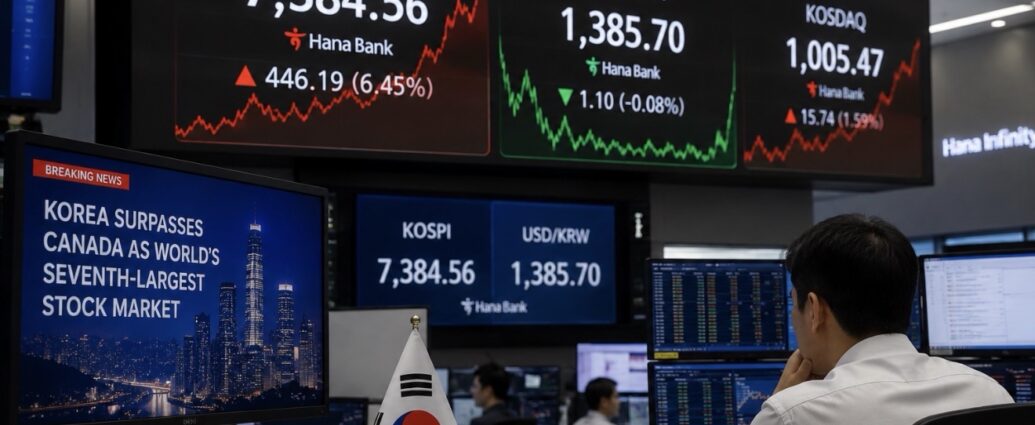
South Korea’s stock market has vaulted past Canada to become the seventh-largest equity market in the world, completing one of the fastest financial ascents in modern market history as investors pour money into artificial intelligence infrastructure plays led by Samsung Electronics and SK Hynix.
The surge has transformed South Korea from a mid-tier global market into one of the world’s hottest investment destinations in less than five months — powered overwhelmingly by global demand for AI memory chips, data-center infrastructure, and semiconductor manufacturing capacity.
The total market capitalization of Korean-listed companies has surged approximately 71% this year to roughly $4.59 trillion, overtaking Canada’s market value of approximately $4.5 trillion.
The rally has been so explosive that South Korea has not only passed Canada, but also rapidly narrowed a gap with larger global markets that once appeared unreachable.
As recently as the end of 2024, the United Kingdom’s equity market was roughly twice the size of South Korea’s.
Now the gap has nearly vanished.
Samsung and SK Hynix Are Driving Nearly Everything
The market’s extraordinary rise has been driven primarily by two corporate giants: Samsung Electronics and SK Hynix.
Samsung Group’s total market capitalization has climbed to roughly $1.44 trillion, representing approximately 38.5% of South Korea’s entire listed equity market.
SK Group — led by memory-chip powerhouse SK Hynix — accounts for another 27.3%.
Together, the two conglomerates now represent nearly two-thirds of Korea’s entire stock market value.
The concentration is staggering by global standards.
Samsung Electronics surged more than 14% in a single trading session this week, becoming only the second Asian company after Taiwan Semiconductor Manufacturing Co. to surpass a $1 trillion market capitalization.
SK Hynix climbed more than 10% in the same session, pushing its own valuation above 1,000 trillion won.
Meanwhile, South Korea’s benchmark KOSPI index closed at a record 7,384.56, rising 6.45% in one day alone.
The index has now surged more than 75% year-to-date — the strongest performance among G20 equity markets.
AI Is Rewiring Global Capital Flows
The driving force behind the rally is simple: artificial intelligence infrastructure.
Modern AI systems require enormous amounts of high-bandwidth memory, advanced semiconductors, data-center hardware, servers, and chip packaging capacity — areas where Samsung and SK Hynix hold dominant global positions.
Investors increasingly view South Korea as one of the cleanest public-market plays on the global AI buildout.
Every major AI expansion — from cloud infrastructure to advanced language models — increases demand for memory chips, particularly high-bandwidth memory used in Nvidia-powered AI systems.
Samsung and SK Hynix sit near the center of that supply chain.
As a result, global capital is flooding into Korean semiconductor stocks at a pace rarely seen in developed markets.
Analysts have sharply revised earnings expectations upward for the country’s semiconductor industry, with operating profit forecasts for Korean chipmakers reportedly rising roughly 66% in just the past month.
Lee Jung-min, head of investment strategy at Korea Investment Management, said the rally may still have room to continue because valuations remain relatively modest compared to the scale of projected earnings growth.
The KOSPI’s 12-month forward price-to-earnings ratio remains around 7.1 times — well below many U.S. technology peers.
“Valuation normalization alone could sustain this record rally,” Lee said.
Wall Street Is Raising Korea Targets Aggressively
Major global investment banks are now rapidly increasing their targets for Korean equities.
Goldman Sachs raised its year-end 2026 KOSPI target to 7,000 and boosted its earnings-growth forecast for Korean companies to approximately 130%, citing stronger semiconductor pricing and accelerating AI-related demand.
J.P. Morgan increased its KOSPI target to roughly 7,500 points.
Nomura analysts argued that investors are increasingly rotating capital away from what they called a “pure U.S. AI trade” toward a broader “global AI supply-chain allocation,” making Korea one of the biggest beneficiaries.
The shift reflects a broader evolution inside global financial markets.
Rather than investing only in American AI software companies, investors are increasingly targeting the hardware, semiconductors, packaging firms, memory suppliers, and industrial infrastructure supporting the AI ecosystem globally.
That transition is dramatically benefiting Korea.
Korea Is Following Taiwan’s Playbook
South Korea’s rise mirrors a similar transformation already seen in Taiwan.
Taiwan’s stock market surged earlier this year as Taiwan Semiconductor Manufacturing Co. became one of the world’s most important AI infrastructure companies.
Taiwan’s market capitalization now stands around $4.48 trillion, with TSMC alone accounting for roughly 45% of the country’s benchmark index.
Like Taiwan, South Korea is increasingly becoming a concentrated AI-driven market where a handful of semiconductor giants exert outsized influence over national equity performance.
That concentration creates enormous upside during AI booms.
It also creates major risks.
The Biggest Risk Is Concentration
The same dynamic powering Korea’s historic rally may also represent its greatest vulnerability.
Market analysts increasingly warn that the country’s equity market has become dangerously dependent on the continued performance of Samsung and SK Hynix.
Even during the latest record-setting KOSPI rally, market breadth remained surprisingly weak.
On the day the index surged more than 6%, only about 200 stocks advanced while nearly 680 declined — meaning most Korean companies actually fell even as the broader index exploded higher.
The discrepancy highlights how heavily the market now depends on semiconductor momentum.
If Samsung or SK Hynix disappoint investors on earnings, AI chip demand, memory pricing, supply constraints, or margins, the impact on Korea’s broader market could be severe.
For retail investors buying Korean ETFs or broad Korean equity funds, the exposure may be more concentrated than it initially appears.
Many are effectively making a leveraged bet on the AI semiconductor cycle itself.
For now, however, the momentum remains overwhelming.
In less than five months, South Korea has transformed itself from a secondary global market into one of the world’s most important AI investment hubs — powered largely by two companies making the chips the modern economy increasingly cannot function without.
— JBizNews Desk