
For more than half a century, American corporate life has operated on a fixed quarterly rhythm. Every three months, public companies open their books to investors, revealing revenue, profits, costs, risks, and forward guidance in filings that can move billions of dollars in market value within minutes.
Now the Securities and Exchange Commission wants to make that system optional.
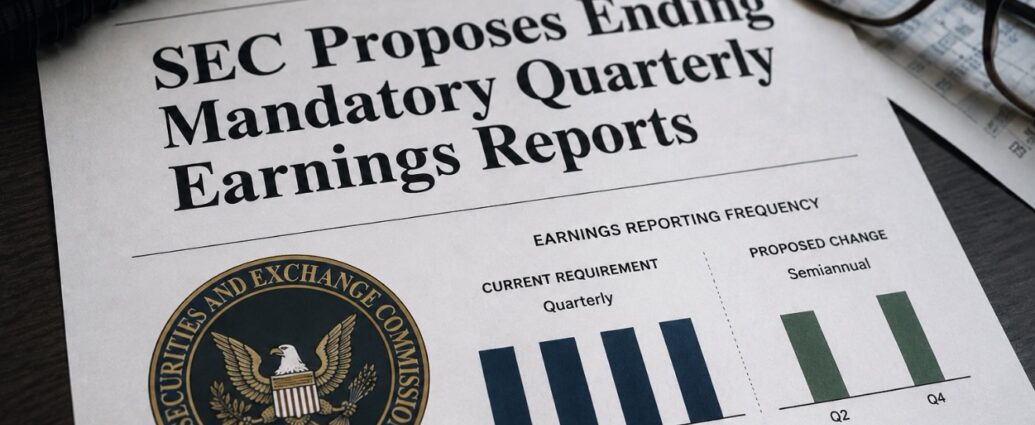
The SEC formally proposed rule changes this week that would allow public companies to file semiannual reports instead of mandatory quarterly reports, marking the biggest potential overhaul to U.S. corporate disclosure requirements in 55 years.
The proposal would allow companies to replace traditional quarterly Form 10-Q filings with a new semiannual filing known as Form 10-S. Public firms would still file annual reports, but instead of reporting four times per year, companies choosing the new framework would only be required to report twice.
The move represents a major victory for long-running efforts — strongly backed by President Donald Trump and many corporate executives — arguing that mandatory quarterly reporting encourages short-term thinking and distracts management teams from long-term growth strategies.
SEC Chairman Paul Atkins framed the proposal as part of a broader effort to revitalize U.S. public markets.
“Make IPOs Great Again,” Atkins said while unveiling the proposal.
A System That Has Defined Wall Street Since 1970
Quarterly reporting has been a defining feature of American financial markets since 1970.
Every earnings season, investors, analysts, traders, pension funds, and retirement savers dissect corporate filings for signs of growth, weakness, changing consumer behavior, operational risks, and management performance.
Entire industries have formed around the reporting cycle — from Wall Street research departments and financial television programming to earnings-call analysis platforms and algorithmic trading systems.
Under the SEC’s proposal, that cadence would fundamentally change.
Companies electing semiannual reporting would only need to indicate the choice once per year through a checkbox on their annual Form 10-K filing. The election would remain fixed for the fiscal year and could not be reversed midyear.
Importantly, companies would still be allowed to voluntarily release quarterly earnings updates if they choose.
Many large corporations are expected to continue quarterly reporting because institutional investors, analysts, and index providers rely heavily on consistent financial updates.
Still, the proposal could significantly reduce mandatory disclosures across large parts of corporate America.
Corporate America Has Wanted This for Years
Supporters of the proposal argue the current quarterly system has become expensive, burdensome, and harmful to long-term corporate planning.
Preparing quarterly filings often requires massive internal coordination involving finance departments, outside auditors, legal teams, investor-relations staff, executive management, and regulatory compliance systems.
Proponents say the process consumes enormous time and money — particularly for smaller public companies.
Kunal Kapoor, CEO of Morningstar, argued that reducing mandatory reporting frequency could make public markets more attractive again, especially for smaller firms hesitant to go public.
“The largest companies would likely maintain quarterly updates voluntarily because their investor base expects it,” Kapoor wrote. “Smaller, less-covered companies — exactly the ones we need in public markets — would gain meaningful cost relief and management bandwidth.”
Advocates also argue quarterly reporting pressures executives into prioritizing short-term earnings targets over long-term investments in research, hiring, infrastructure, product development, and innovation.
The concern over “quarterly capitalism” has existed for decades.
The SEC proposal even cites remarks from former SEC Chairman Arthur Levitt, who once warned that excessive focus on quarterly earnings was damaging the long-term health of American companies.
International Markets Already Moved Away From It
Supporters of the change also note that other major global markets have already reduced quarterly reporting requirements.
Australia and the European Union moved away from mandatory quarterly reporting more than a decade ago.
Research examining companies in markets using semiannual systems has generally shown little long-term difference in valuation levels or return-on-equity performance compared with firms reporting quarterly.
Still, those same studies also identified important tradeoffs involving liquidity, analyst coverage, disclosure quality, and pricing efficiency.
And that is precisely where the backlash is forming.
Critics Warn Investors Could Be Left in the Dark
Investor advocates, academics, and many asset managers argue that reducing reporting frequency would weaken transparency and hurt ordinary investors the most.
The CFA Institute warned in a recent analysis that less frequent financial reporting could impair market efficiency and make it harder for investors to accurately value companies.
“It is nearly axiomatic that, in most applications, more data is preferable to less,” the organization wrote.
Critics argue that large institutional investors already possess significant informational advantages through analyst networks, proprietary research, management access, and alternative data systems.
Retail investors, by contrast, rely much more heavily on public SEC filings.
Reducing disclosure frequency could therefore widen the information gap between Wall Street and Main Street.
Academic research cited in the debate also suggests less frequent reporting can create “information vacuums” where investors overreact to industry news in the absence of company-specific disclosures.
One study published in The Accounting Review found that European companies reporting semiannually often saw their stock prices move sharply based on U.S. peer-company earnings announcements because investors lacked current information about the firms themselves.
The SEC’s own proposal acknowledges several potential risks.
Among them:
- Delayed release of material financial information
- Increased information asymmetry between investors
- Reduced market liquidity
- Weaker investor confidence
- Greater insider-trading concerns during longer reporting gaps
The agency specifically warned that reduced disclosure frequency could “diminish perceptions of fairness,” potentially discouraging participation in public markets.
The Bigger Question: Who Are Public Markets For?
At its core, the debate goes far beyond paperwork.
The fight over quarterly reporting reflects a larger philosophical conflict about the purpose of public markets themselves.
Supporters of the proposal argue markets should primarily help companies raise capital efficiently while giving management flexibility to focus on long-term strategy rather than constant quarterly scrutiny.
Critics argue public markets exist first and foremost to provide investors — including millions of Americans with retirement savings tied to stocks — timely, transparent information about the companies they own.
The SEC proposal now enters a 60-day public comment period before regulators decide whether to finalize the rules through a commission vote.
The process is expected to trigger fierce lobbying from corporations, investor groups, academics, pension funds, exchanges, and Wall Street firms.
Bryan Corbett, president and CEO of the financial industry trade group MFA, said regulators must carefully balance reducing corporate red tape with protecting investors’ access to timely information.
The outcome could reshape not only earnings season — but the relationship between corporate America and investors for decades to come.
— JBizNews Desk




