JBizNews Desk | May 8, 2026
A Small Township Tried to Stop an AI Megaproject
When residents of Saline Township, Michigan packed a public meeting last September to oppose a massive artificial intelligence data center planned for local farmland, many believed they were exercising democratic control over the future of their community.
The township board voted 4-1 against the rezoning request.
Two days later, the developer sued.
Months later, construction equipment arrived anyway.
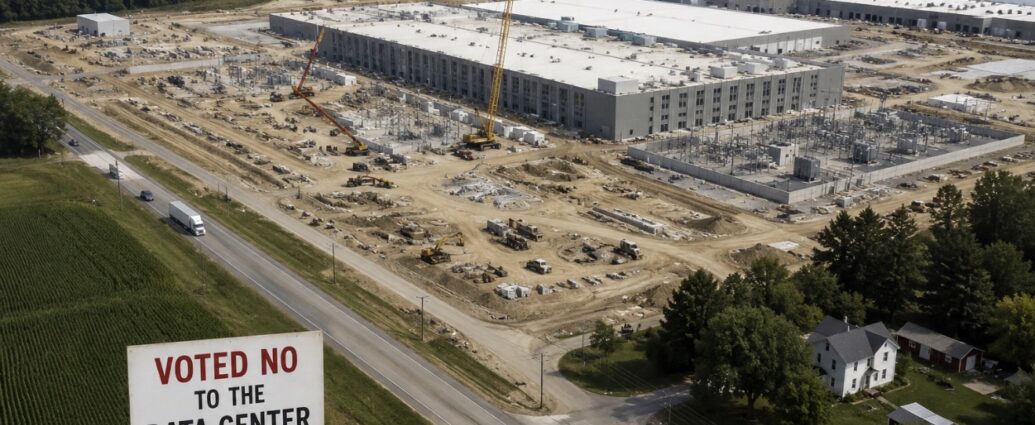
Now, a sprawling AI data center complex is rising from the farmland south of Ann Arbor — and the fight over how it happened is rapidly becoming a national case study in how America’s AI infrastructure boom is colliding with local governments, rural communities, and traditional zoning authority.
The project, internally nicknamed “The Barn,” is being built for Oracle as part of the massive Stargate artificial intelligence infrastructure initiative backed by OpenAI, SoftBank, and other partners targeting roughly $500 billion in AI-related investments nationwide.
The Scale of the Project Is Enormous
The Saline campus covers approximately 575 acres and includes three single-story data center buildings totaling roughly 1.65 million square feet, along with two dedicated electrical substations and support infrastructure.
At full buildout, the facility is expected to consume roughly 1.4 gigawatts of electricity from DTE Energy — more than 10% of the utility’s projected peak grid demand for 2026.
That would make it one of the most power-hungry data centers in the United States.
In April, Related Digital and Blackstone announced approximately $16 billion in financing tied to the project.
Michigan Governor Gretchen Whitmer called it the largest single investment in state history, pointing to projections of roughly 2,500 union construction jobs and an estimated $8 million annually in local school revenue.
For township residents, however, those promises did not outweigh concerns over industrialization, land use, environmental impacts, infrastructure strain, and the loss of farmland.
They voted no.
Construction still moved forward.
How the Developer Overrode Local Opposition
The turning point came almost immediately after the township rejected the rezoning request.
Developer Related Digital filed a lawsuit alleging that Saline Township’s denial constituted “exclusionary zoning” — a legal argument claiming local governments improperly block development opportunities without valid justification.
The lawsuit placed township officials in a nearly impossible financial position.
Saline Township operates with an annual budget reportedly below $750,000, while officials estimated potential legal exposure could exceed $25 million if the case moved forward and the township lost.
Township Clerk Kelly Marion confirmed that the township’s insurance coverage for legal expenses totaled only about $500,000.
Facing overwhelming financial risk, the township ultimately settled the case.
The developer received approvals.
Construction began.
The episode exposed a growing reality facing many smaller communities across the country: local governments often lack the legal and financial resources needed to resist large-scale AI infrastructure projects backed by major technology firms, private equity, and institutional capital.
The AI Boom Is Reshaping Rural America
The Saline dispute reflects a much larger national trend unfolding as technology companies race to build AI infrastructure at unprecedented speed.
Data centers powering artificial intelligence models require massive amounts of land, electricity, cooling systems, fiber connectivity, and water access — resources increasingly found in rural and semi-rural communities rather than major cities.
Industry analysts estimate major hyperscale technology companies — including Microsoft, Google, Meta, and Amazon — could spend between $630 billion and $700 billion on AI-related infrastructure and data centers in 2026 alone.
By 2030, projected global AI infrastructure spending could reach approximately $5.2 trillion.
Much of that expansion is happening outside urban centers.
Roughly 67% of new data centers are now being built in rural or semi-rural areas where land is cheaper, power access is more available, and permitting processes are often less restrictive.
Critics argue those same factors also leave smaller communities vulnerable.
Developers backed by enormous financial resources and legal teams frequently negotiate against townships with limited budgets, part-time officials, and zoning rules originally written for small-scale local development — not gigawatt-scale industrial AI campuses.
Backlash Is Growing Across Michigan
The fallout from the Saline project has triggered a growing political backlash throughout Michigan.
Since construction began, at least 19 Michigan municipalities have reportedly enacted temporary moratoriums or restrictions on future data center development while reviewing zoning policies and infrastructure rules.
Lawmakers in Lansing are now advancing bipartisan legislation aimed at giving local governments clearer authority to reject or heavily condition large-scale AI infrastructure proposals.
A regional water authority has also reportedly refused service for additional proposed facilities in the area amid concerns over long-term infrastructure strain.
Residents near the project continue reporting concerns tied to noise, truck traffic, dust, and environmental disruption.
Nearby farmer Kathryn Haushalter, a former U.S. Marine who planted more than 150 native trees on her property, attempted to intervene legally in permit approvals earlier this year, though a judge denied the request in February.
A National Playbook Is Emerging
The conflict unfolding in Michigan is increasingly being repeated across the country.
Similar disputes tied to AI infrastructure projects are emerging in Texas, Ohio, Wisconsin, and other states where local communities have attempted to resist large-scale data center development only to face lawsuits, state-level permitting overrides, or financial pressure.
The pattern has become increasingly familiar:
Proposal. Local rejection. Legal challenge. Settlement. Construction.
For many rural communities, the concern is no longer simply whether AI infrastructure will arrive — but whether local governments retain meaningful authority to decide how, where, and under what conditions it gets built.
For technology companies and investors, meanwhile, the race is driven by urgency.
Artificial intelligence models require exponentially growing computing power, and companies across Silicon Valley are competing to secure the infrastructure necessary to train and operate next-generation AI systems before rivals do.
That urgency is reshaping the physical landscape of rural America in real time.
And in places like Saline Township, residents are learning that even a local vote may no longer be enough to stop it.
— JBizNews Desk
© JBizNews.com. All rights reserved. This article is original reporting by JBizNews Desk. Unauthorized reproduction or redistribution is strictly prohibited.