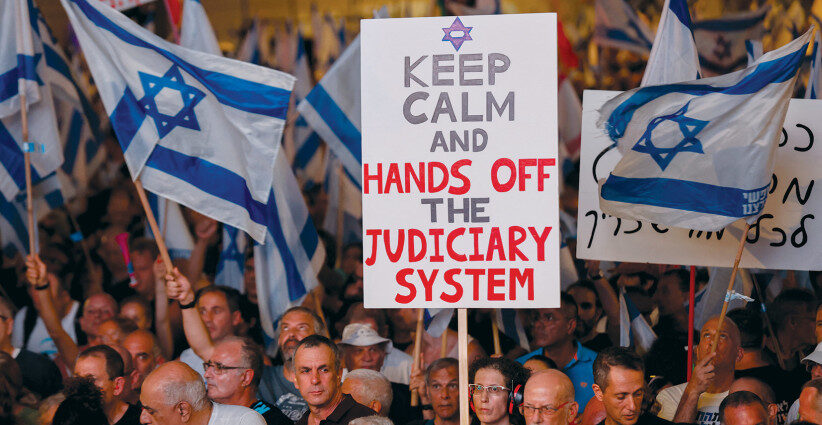
I remember distinctly my mother, a Polish-Israeli, calling me to say that she heard Paweł Jabłoński, Poland’s then-deputy foreign affairs minister, say on the radio that Israeli officials have consulted with their Polish counterparts on “curbing the judiciary” and “managing its judicial issues.”
Seeing her two homelands bond publicly over authoritarianism and disdain for political liberties caused her great embarrassment. Israelis, to their credit, came to the right place for advice: since 2015 and the electoral win of the Law and Justice Party (pol. Prawo i Sprawiedliwość or PiS) till their removal from power in 2023, Poland’s government has been pursuing an overhaul of the Constitutional Tribunal, the Supreme Court, and the National Council of Judiciary, as well as lower courts.
Even with two years of a new government behind us, the fight for free judiciary is far from over. All three of the bodies mentioned above, although to a varied extent, are still captured by partisan appointees who continue to rule in favor of their de facto masters and ultra-conservative policies. Elected in August with PiS’s support, President Karol Nawrocki has also blocked attempts at removing unlawfully instated judges.
“How tragic that the only thing Poland can offer now, is advice on weakening the courts” – said my mother – “and how tragic that Israel is willing to listen.”
Put aside the controversial law nearly criminalizing discussion of the participation of Poles in the Holocaust; when it had come to the judiciary, Poland and Israel became unexpected allies. I remember protesting against the overhaul in Tel Aviv and feeling profound deja vu as just a few years earlier we yelled out the same chants on the streets of Polish cities.
However, it’s not only the democratic backsliding that the two countries have in common. When I was dealt my own SLAPP, for a climate protest I organized, it was only the remnants of free judiciary that struck it down.
Similar news comes out of Israel too: often, it is the courts that continue to serve as the last bulwark against the repression of the civil society. I then realized that Polish and Israeli cases can serve each other as an inspiration not only in fighting democracy, but, more importantly, in fighting for it.
Independent courts are not bohemians’ pastime. They are essential to the state’s survival.
Autocrats around the world have long been positioning themselves as fighting the corrupt elites in the name of the people. PiS have done that using a two-fold strategy: one narrative said that the judicial “reform” was crucial because the judiciary itself is. They claimed that “endless talking” and “sounding the alarm” on the overhaul is a hobby and concern only for the wealthiest, university educated and leftist Poles. This is an important distinction: PiS have managed to convince the public for a long time that the act itself is of utmost importance, but discussing and opposing it, is a sign of privilege and boredom. In a system, where PiS governed by itself, it was the only political party which could act. The rest of us, who wouldn’t stop talking about it, got the branding of spoiled big-towners.
Talking about the character of the law is not enough. The conversation about “Polish democracy” as an idea hasn’t resonated with many Poles, because they viewed the question itself as sort of elitist. I suppose that talking in abstract about the “Israeli democracy” can only get you so far too; ultimately, it’s not only the democratic basis we fight for, but also the material effects which independent courts bring. I wish the pro-democracy movement in Israel would talk more about the tangible benefits of due-process and protecting all of us from tyranny.
Defend judges as people.
History shows us that democracy doesn’t die by this or that law. Those who want to kill it, win rather by intimidation, ostracizing, and fatigue. The former Polish government struck gold when it framed the judicial overhaul as the last step of the decommunization of the political system. It was an effective trick because most Poles support such policies. And it’s also true that many high-level judges in Poland were either educated in the Polish People’s Republic or somehow associated with its former officials. Judges were branded then as a caste; people who haven’t been served justice yet and who must be replaced. Importantly, this anti-communist schtick did not stop PiS from nominating to high offices its own members with a communist past.
But when the government attacked judges as a group, the society stood behind them as people. Judges such as Paweł Juszczyszyn or Igor Tuleya, have gone from being unknown experts to national symbols of the struggle for independent courts. The Poles understood that in defending the system, one doesn’t only defend laws or institutions, but also individuals who face threats and intimidation. Uplifting the voices of judges, lawyers, clerks and students allows for the fight to become more concrete and personal. It also lets new voices emerge who are unbound by the partisan divisions. With a little luck, they can become exactly what’s needed in convincing the unconvinced.

Reach out for help abroad.
What saved us many times in Poland was the fact that our country is a member of the European Union. This meant that there were extra international institutions in place to safeguard the democratic institutions at home. Independent judges and law associations made use of that fact early on: the EU has not only supported the movement vocally, shared know-how and grants and released legal opinions, but also put direct pressure on the Polish government by making the flow of funds dependent on pro-democratic reform.
Moreover, the free-courts movement managed to convince the people that the overhaul boils down to a question of belonging in the European Union as well as the broadly-defined West. Poles, even though many take issue with the EU, are at large a euroenthusiast society and the rift between Warsaw and Brussels seriously scared them.
Israel isn’t in the same position but it is, in many ways, dependent on the international community when it comes to military aid and trade, most notably on the United States. It might sound naïve to believe that after President Donald Trump publicly called for pardoning Benjamin Netanyahu, the American administration could push in favor of the pro-democracy movement. But it doesn’t mean that Israeli activists should not strive to externalize the struggle towards liberal politicians in US and Europe.
Concrete and precise sanctions, such as linking the flow of military aid on giving up the overhaul, is necessary. This is not the case of “meddling in internal politics,” if the majority of Israelis oppose the overhaul and which threatens their basic rights. Americans and others need to realize that Israel, which has independent courts, is in their interests, as it allows democracy to bloom, political overreach to be curtailed and internal disputes to be adjudicated. It goes without saying that the region does not need yet another full-on autocratic regime.
Remember that the real fight begins after the overhaul is stopped.
When PiS lost its parliamentary majority in 2023, the civic society in Poland was jubilant. As the government seemed invincible, we really thought that Poland was becoming the next Belarus. More than two years into the rule of a new government, those who abused the Polish judiciary have not been held to account. PiS have used clever lawyerly tricks to entrench their appointees in the Constitutional Tribunal, the Supreme Court and the National Council of Judiciary. They made it so that their removal is not possible without breaking some laws in the process. Some politicians have also defected to Hungary, most notably former justice minister and the face of the assault on courts, Zbigniew Ziobro, and his deputy, Marcin Romanowski (the latter has even, quite grotesquely, received a political asylum). Even now, after Viktor Orban’s electoral defeat, it might take months for Ziobro and Romanowski to be extradited to Poland; if they won’t find another hideout in the meantime, that is.
The new government got trapped between two forces: some of its supporters demand, to put it blandly, to see PiS apparatchiks behind the bars. The ineffectiveness in restoring the highest courts to their legal function angers them greatly. On the other hand, Donald Tusk, Poland’s Prime Minister since 2023 and one of Poland’s most iconic politicians, has a reputation amongst its opponents of a cruel man. He’s worried that harsh action would in turn make him appear without remorse for democratic norms. He’s also afraid that serious consequences for PiS figures would scare the public, as jail-time sentences for politicians have been a line that even the previous government did not dare to cross.
In Israel, the fight against the judicial overhaul is still in an earlier stage, but the possibility of a new government is not far from reality. Israelis will need to figure out how to restore trust in the institution of the Supreme Court and judiciary in general while satisfying the need of the people to see those responsible for the attempt at its dismantling punished. The Polish example shows that once the overhaul is completed, it is extremely hard to undo it without crossing some societal, political or legal red lines.
The crisis around the judiciary sparks some valid discussion around its role too: does it really serve the interests of all citizens? Who is being left out of the conversation? What breeds indifference? Those are the type of questions that a new Israeli prime minister, whoever it will be, will need to confront themselves with.
The writer, based between Berlin, Tel Aviv and Warsaw, is a freelance journalist covering the Israeli-Palestinian conflict for several Polish newspapers. He also works for the Shipyard Foundation, one of the largest democracy-safeguarding NGOs in Poland and pursues a history and sociology degree at the Humboldt University. He’s the author of a mini-reportage “Smolanim. Voices of the Israeli Left in a post-October 7th world” and in 2019, he co-created the Fridays For Future movement in Poland, which mobilized hundreds of thousands of students to skip school in demand for a worldwide implementation of scientifically accurate climate policy.