JBizNews Desk | Thursday, May 7, 2026
A small farming community outside Ann Arbor, Michigan voted to block one of the largest artificial intelligence infrastructure projects in American history. Weeks later, bulldozers arrived anyway.
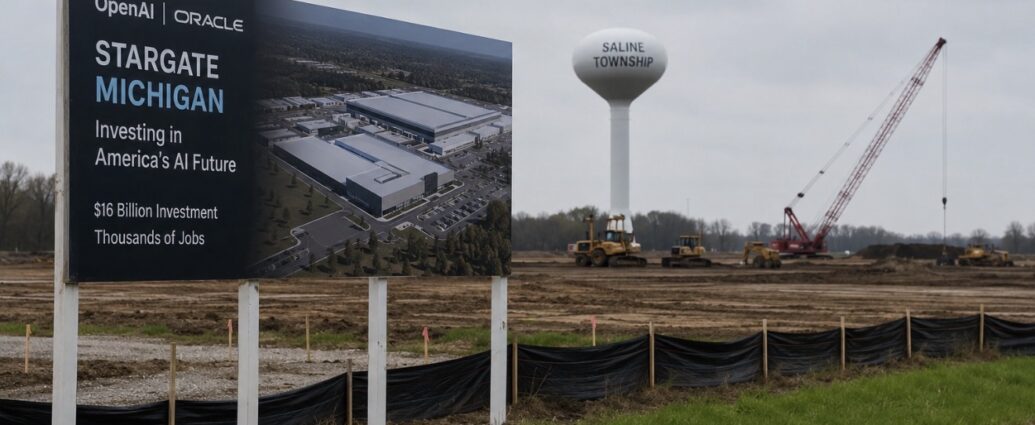
Now the battle over a $16 billion OpenAI-Oracle data center campus being built on Michigan farmland is becoming a national flashpoint in the growing clash between local communities and the exploding demand for AI infrastructure powering ChatGPT, cloud computing, and next-generation artificial intelligence systems.
The controversy centers on Saline Township, a rural community near Ann Arbor where local officials voted 4-1 in September 2025 against rezoning agricultural land for the massive development backed by OpenAI, Oracle, and developer Related Digital.
Just two days later, the developers and participating landowners sued the township, arguing the denial constituted exclusionary zoning under Michigan law. Within weeks, the township reached a consent agreement allowing the project to move forward despite the board’s overwhelming rejection.
Construction equipment began arriving by November.
“I think the plan was to move as fast as possible — so by the time anyone challenged it, they could say it was too far along to stop,” local resident Joshua LeBaron, part of an opposition group fighting the project, said during ongoing community disputes over the development.
Part of OpenAI’s $500 Billion Stargate Expansion
The Michigan project is one of the anchor facilities in OpenAI’s massive Stargate initiative — a reported $500 billion national AI infrastructure buildout spanning six states and designed to dramatically expand computing power for ChatGPT and advanced AI systems.
Oracle is expected to serve as the primary cloud infrastructure tenant for the Michigan site.
Michigan Governor Gretchen Whitmer has called the development “the largest one-time investment in state history.”
The economic numbers are enormous.
Developers project the facility will generate approximately:
- 2,500 union construction jobs
- 450 permanent on-site positions
- 1,500 indirect local jobs
That brings the projected regional economic impact to roughly 4,450 total jobs across Washtenaw County.
The Energy Demand Is Staggering
The scale of the AI facility itself highlights how dramatically artificial intelligence is reshaping America’s physical infrastructure needs.
The campus will consume approximately 1.4 gigawatts of electricity — equal to roughly one-quarter of DTE Energy’s peak electrical output.
The site spans 250 acres and includes three massive 550,000-square-foot buildings dedicated largely to powering AI computing systems, cloud infrastructure, and large-scale data processing.
For local governments, the financial incentives are difficult to ignore.
The township is expected to receive:
- Roughly $8 million annually for local schools
- At least $1.6 million per year in direct tax revenue
- More than $14 million in community benefits for emergency services, parks, farmland preservation, and municipal infrastructure improvements
Residents Continue Fighting the Project
Still, opposition inside the community remains intense.
Nearby farmer Kathryn Haushalter, a former U.S. Marine who returned from Afghanistan in 2012 and rebuilt her family’s 60-acre farm, has become one of the project’s most visible critics.
Haushalter filed legal challenges seeking to overturn the township’s consent agreement, arguing officials violated Michigan’s Open Meetings Act during settlement discussions with developers.
A judge denied that request earlier this year.
Residents have also appealed zoning approvals, arguing construction permits were improperly issued because the property technically remains zoned for agriculture. Under Michigan law, those appeals can potentially trigger automatic pauses on development, though residents say construction has continued while hearings remain unresolved.
Political Fallout Spreads Across Michigan
The project has now escalated into a statewide political issue.
Michigan Secretary of State Jocelyn Benson, a leading Democratic gubernatorial candidate, faced scrutiny after reports highlighted that her husband, Ryan Friedrichs, served as a vice president at Related Companies — the parent company of Related Digital — during the project’s rollout. Friedrichs has since reportedly moved to another role within the company and stepped away from Michigan-related projects.
The broader backlash is rapidly spreading.
Since the Saline approval battle, at least 19 Michigan municipalities have enacted temporary moratoriums or restrictions on new data center developments amid growing concerns over land use, water consumption, energy demand, and local control.
Regional water authorities, local governments, and bipartisan state lawmakers are now debating how much authority communities should have to block large-scale AI infrastructure projects.
A National Battle Over AI Infrastructure
What is unfolding in Michigan may become a preview of similar conflicts nationwide.
The AI boom has created an unprecedented rush for land, electricity, water access, and industrial-scale computing infrastructure. Rural communities with inexpensive land and strong electrical grid connections are increasingly becoming prime targets for major AI and cloud computing facilities.
But the Saline dispute is exposing the growing imbalance between small local governments and trillion-dollar technology ecosystems backed by some of the most powerful corporations in the world.
The township voted no.
The developers sued within 48 hours.
The settlement followed within weeks.
And now one of the largest AI campuses in America is rising from farmland that, until recently, was producing crops.
© JBizNews.com. All rights reserved. This article is original reporting by JBizNews Desk. Unauthorized reproduction or redistribution is strictly prohibited.