JBizNews Desk | Friday, May 8, 2026
The U.S. government is borrowing money at a pace once associated only with major wars and economic crises — and new federal data released this week shows the scale of the problem is accelerating.
According to the latest estimates from the Executive Office of the President and Treasury Department refinancing documents released under Treasury Secretary Scott Bessent, the federal government is on track to run a deficit of approximately $2.06 trillion during the current fiscal year alone.
That works out to roughly:
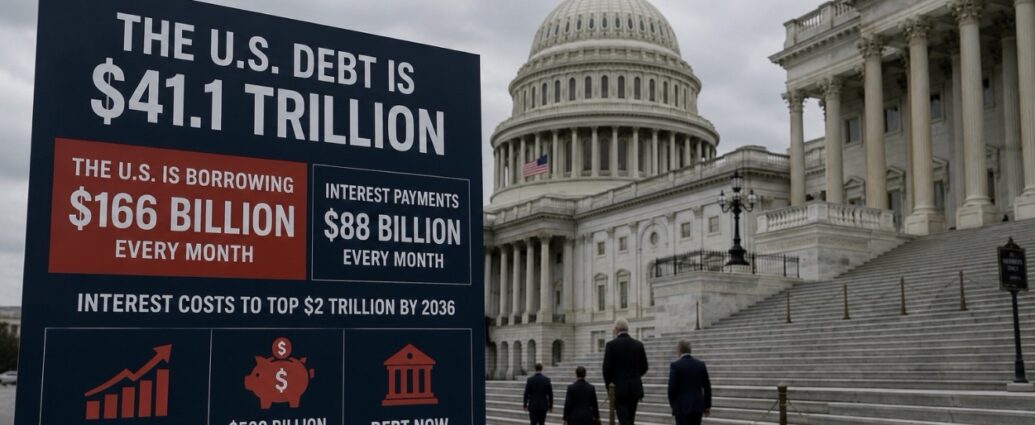
- $166 billion borrowed every month
- More than $5.4 billion every day
- About $225 million every hour
The administration is already projecting the deficit will rise further to approximately $2.17 trillion by fiscal year 2027, continuing a borrowing trend that many economists and fiscal watchdogs increasingly warn may become structurally unsustainable.
America’s Interest Bill Is Exploding
Even more alarming to budget analysts is the cost of servicing the debt itself.
The Congressional Budget Office’s preliminary estimates show the Treasury paid nearly $530 billion in interest payments during just the first six months of the fiscal year between October 2025 and March 2026.
That translates to:
- More than $88 billion per month
- Roughly $22 billion every week
- Nearly $3 billion every single day simply to pay interest on existing debt
Interest costs are now among the fastest-growing categories in the federal budget and are increasingly approaching the scale of major government spending programs.
The CBO projects net interest expenses will total approximately $16.2 trillion over the next decade, climbing from around $1 trillion annually in 2026 to more than $2.1 trillion per year by 2036 if current fiscal policies remain largely unchanged.
Debt Has Officially Surpassed the Economy
The U.S. national debt officially surpassed 100% of gross domestic product earlier this year, crossing a threshold historically associated with periods of severe fiscal strain.
Federal debt held by the public is projected to rise from roughly 101% of GDP in 2026 to approximately 120% by 2036, according to Congressional Budget Office projections — exceeding the prior post-World War II record set in 1946.
The current debt ceiling now stands at $41.1 trillion, following legislation signed into law on July 4, 2025.
Federal spending this year is projected to total approximately $7.4 trillion, or 23.3% of the economy — well above the long-term historical average.
Fiscal Watchdogs Warn of Growing Risk
Budget experts across the political spectrum are increasingly warning that trillion-dollar deficits are no longer temporary emergency measures — they are becoming permanent features of the federal budget.
“$2 trillion deficits used to be unheard of, and then they only occurred during major recessions,” said Maya MacGuineas, president of the Committee for a Responsible Federal Budget. “It’s beyond scary that $2 trillion deficits are now the norm.”
MacGuineas warned that financial markets may eventually lose patience with America’s borrowing trajectory.
“Markets will only tolerate our unsustainable borrowing for so long. The risk of a fiscal crisis gets higher as the days pass,” she said.
Why This Matters to Everyday Americans
The consequences extend far beyond Washington.
Large-scale government borrowing competes directly with consumers and businesses for available capital in financial markets, putting upward pressure on interest rates across the economy.
That means:
- Higher mortgage rates
- More expensive auto loans
- Higher credit card interest
- Increased borrowing costs for small businesses
- Reduced private-sector investment
For millions of Americans already struggling with elevated housing costs and financing expenses, the federal deficit increasingly affects daily life in tangible ways.
War Spending Adds New Pressure
The ongoing Iran conflict has introduced an additional layer of fiscal strain.
Military deployments, weapons production increases, naval operations in the Strait of Hormuz, and expanded defense requests are being financed almost entirely through additional borrowing rather than offsetting revenue measures or spending cuts elsewhere in the budget.
That means wartime costs are now being layered onto an already deteriorating long-term fiscal picture.
For investors and businesses, the implications are significant.
The longer deficits remain near or above $2 trillion annually, the greater the pressure on the Federal Reserve to maintain elevated interest rates, potentially slowing economic growth while increasing financing costs throughout the economy.
What once sounded like an abstract debate over federal debt is increasingly becoming a direct economic reality for households, borrowers, investors, and businesses across the country.
And according to the government’s own projections, the numbers are only getting larger.
© JBizNews.com. All rights reserved. This article is original reporting by JBizNews Desk. Unauthorized reproduction or redistribution is strictly prohibited.