JBizNews Desk | Friday, May 8, 2026
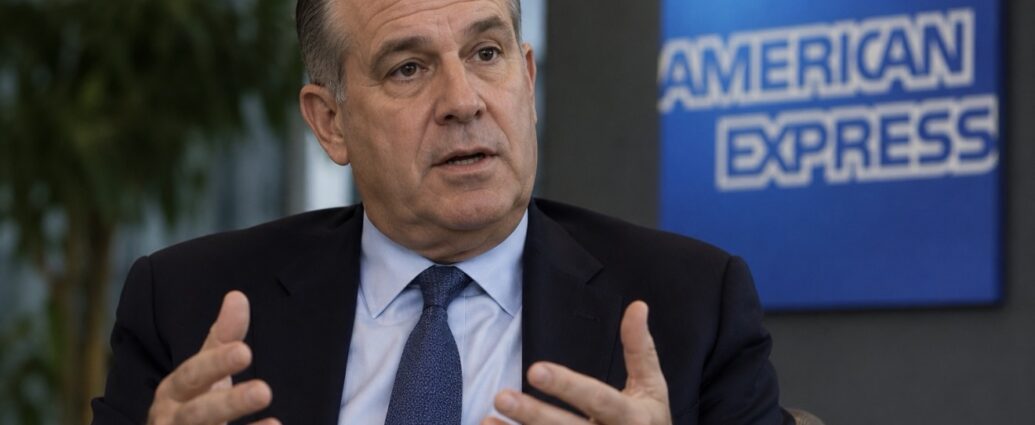
When Stephen Squeri began his career at American Express more than three decades ago, some colleagues privately told him he would never become CEO.
He got there anyway.
And since taking over in early 2018, Squeri has quietly transformed American Express into one of the strongest-performing major financial companies in America — outperforming JPMorgan, Visa, and even the broader S&P 500 by making a bet much of the financial industry initially viewed as risky, if not outright reckless.
He bet that millennials and Gen Z consumers would willingly pay hundreds of dollars per year for premium credit cards — if the experience felt valuable enough.
The gamble worked.
Since Squeri became CEO, American Express stock has delivered average annual total returns of roughly 16.6%, outperforming many of the largest U.S. banks and payment giants during the same period.
Today, American Express has grown into a roughly $200 billion company and remains one of Warren Buffett’s largest investments through Berkshire Hathaway, second only to Apple.
The Strategy Wall Street Thought Was Backwards
For years, the traditional credit card industry playbook followed a predictable formula:
- Attract younger consumers with low-fee or no-fee cards
- Build loyalty gradually
- Upsell premium cards later in life as incomes rise
Squeri rejected that approach.
Instead, he believed younger affluent consumers were already willing to buy premium experiences — if the rewards, status, and lifestyle benefits justified the cost.
“The reality is these Gen Z and millennials love premium,” Squeri said in discussing the company’s strategy. “They love getting something that’s luxe.”
He viewed younger consumers not as financially immature customers needing entry-level products, but as educated buyers willing to pay upfront for experiences they valued.
That insight fundamentally reshaped Amex’s growth strategy.
The $695 Credit Card Bet
One of the clearest examples came when American Express sharply increased the annual fee on its flagship Platinum Consumer Card from $550 to $695.
Many analysts expected younger customers to walk away.
Instead:
- Platinum accounts reportedly grew 60% by 2023
- Spending per new account rose 18%
- Profit per account climbed 28%
- Customer retention remained near 99%
Millennials and Gen Z consumers now account for roughly 60% of new Amex card acquisitions.
Even more importantly for the company, younger Amex customers tend to spend aggressively on categories tied to experiences — particularly dining, travel, entertainment, and lifestyle purchases.
Cardholders under 35 reportedly conduct about 70% more restaurant transactions than older customer groups.
Why Younger Customers Matter So Much
Squeri’s long-term logic is straightforward.
Younger customers may spend less initially than older wealthy consumers, but they potentially represent decades of future revenue, borrowing activity, travel spending, and loyalty.
“They don’t spend as much right now as a Gen Xer or a boomer,” Squeri said, “but we believe they’ll have 20 more years of relationship with us.”
That lifetime-value strategy has become central to American Express’s competitive positioning.
According to Howard Grosfield, president of U.S. consumer services at Amex, Squeri deliberately focused the company around customer segments where American Express could “truly differentiate and win.”
Amex Turned Credit Cards Into a Lifestyle Brand Again
Competition in premium cards has intensified dramatically.
JPMorgan Chase aggressively expanded Chase Sapphire. Capital One pushed upscale with Venture X. Other banks followed.
But Amex retained a unique advantage by leaning heavily into lifestyle identity and premium experiences.
Airport lounges, dining credits, luxury travel partnerships, concierge services, event access, and social status became central parts of the company’s value proposition.
In effect, American Express successfully repositioned itself not simply as a payment company — but as a luxury membership ecosystem.
And younger affluent consumers embraced it.
What Comes Next
At 67, Squeri remains far less publicly visible than CEOs like Jamie Dimon at JPMorgan or David Solomon at Goldman Sachs.
But Wall Street increasingly views his tenure as one of the strongest leadership performances in modern financial services.
The next challenge will be navigating a far more uncertain economic environment.
Higher interest rates, inflation, geopolitical instability, tariffs, and slowing consumer spending all pose risks for the broader financial sector.
Still, Amex’s affluent customer base has historically proven more resilient during economic downturns than mass-market consumers.
And Squeri appears convinced younger wealthy consumers remain one of the most valuable long-term opportunities in finance.
In an era when many legacy financial brands struggle to remain culturally relevant, American Express accomplished something increasingly rare:
It made younger consumers feel that paying more was actually worth it.
And investors have been rewarded accordingly.
© JBizNews.com. All rights reserved. This article is original reporting by JBizNews Desk. Unauthorized reproduction or redistribution is strictly prohibited.