JBizNews Desk | Friday, May 8, 2026
The Iran war is not hitting all Americans equally at the gas pump — and new research from the Federal Reserve Bank of New York shows the divide is becoming increasingly severe.
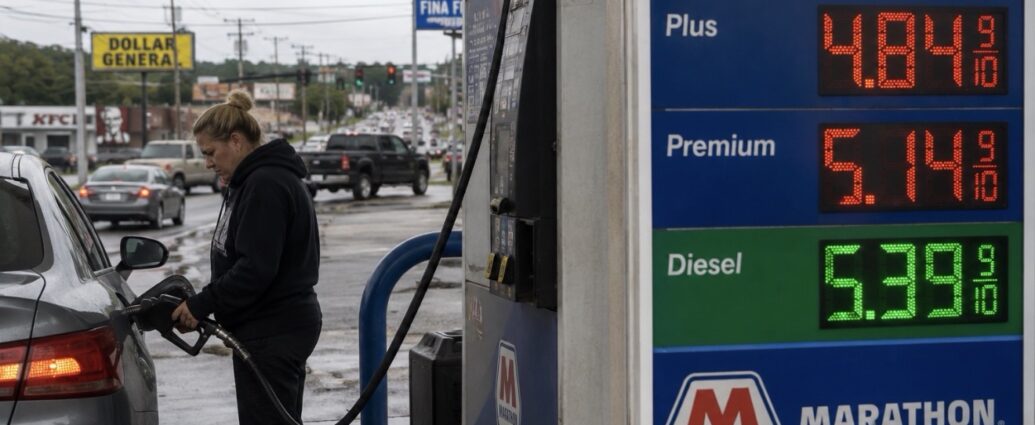
As gasoline prices surge nationwide, lower-income households are being forced to sharply reduce driving while wealthier Americans continue driving almost normally, simply absorbing the higher costs.
The national average price for regular gasoline climbed to $4.54 per gallon this week, according to AAA — up 31 cents in just seven days and roughly 52% higher than before the U.S.-Iran conflict began.
The main driver behind the spike remains the disruption surrounding the Strait of Hormuz, where war-related instability has stranded or rerouted oil shipments through one of the world’s most critical energy corridors.
But behind the headline price increase lies a much deeper economic divide.
The Rich Keep Driving. Everyone Else Cuts Back.
According to new New York Fed research:
- Households earning under $40,000 annually reduced gasoline consumption by roughly 7% in March
- Despite driving less, those households still spent approximately 12% more on fuel due to rising prices
- Meanwhile, households earning $125,000 or more reduced gas usage by only 1% while increasing fuel spending by roughly 19%
In practical terms, wealthier Americans largely continued driving as normal and paid the additional cost without major lifestyle changes.
Lower-income households had no such flexibility.
“With the current energy price shock, a K-shaped pattern in gasoline consumption has opened up much more than before,” the New York Fed researchers wrote.
The report noted that lower-income families appear to be coping by:
- Carpooling
- Driving less frequently
- Delaying nonessential trips
- Using public transportation where available
The disparity is now reportedly even larger than during the 2022 fuel-price surge following Russia’s invasion of Ukraine.
For Many Americans, Driving Is Not Optional
For lower-income workers, the problem is not merely inconvenient — it directly affects economic survival.
For millions of Americans earning under $40,000 annually, a vehicle is often the only reliable way to:
- Get to work
- Bring children to school
- Reach grocery stores
- Attend medical appointments
- Maintain multiple jobs or shift-based work schedules
When gas prices rise sharply, cutting back on driving can mean cutting back on economic participation itself.
Workers increasingly face a painful tradeoff:
Spend money they do not have — or lose income they cannot afford to lose.
The Iran War’s Oil Shock Is Still Rippling
Stanford economists estimate the average American household could pay approximately $857 more for gasoline during the remainder of 2026 because of war-driven energy disruptions.
Oil prices briefly surged as high as $112 per barrel earlier this spring following major disruptions tied to the Iran conflict.
Although crude prices have eased somewhat below $100 after reports of possible diplomatic progress between Washington and Tehran, analysts warn fuel prices may remain elevated for months.
“Even if there was a true and lasting resolution of the conflict … it will still take months to get back to what it was pre-war,” one energy analyst told the Washington Times. “There will still be a risk premium associated with going through that region.”
Some States Are Being Hit Far Harder Than Others
Drivers on the West Coast continue facing the highest prices in the country.
Current statewide averages include:
- California: $6.06
- Hawaii: $5.64
- Washington: $5.61
- Oregon: $5.21
- Nevada: $5.15
Higher state fuel taxes, stricter environmental fuel standards, and distance from refining infrastructure are amplifying the impact in those markets.
Political Pressure Is Rising Fast
The spike in gasoline prices is quickly becoming one of the most politically sensitive domestic consequences of the Iran war.
Democratic lawmakers have increasingly focused on pump prices as a direct measure of how the conflict is affecting ordinary Americans, while the White House faces mounting pressure over inflation, consumer costs, and broader economic anxiety.
Gasoline prices remain one of the most visible economic indicators for voters.
And with national averages still well above pre-war levels — and no immediate path back downward — political pressure surrounding fuel costs is likely to intensify heading into the November midterm elections.
For millions of lower-income Americans already struggling with elevated rent, food prices, and borrowing costs, the gas pump has become one more place where global conflict translates directly into financial stress.
Every commute.
Every fill-up.
Every week.
© JBizNews.com. All rights reserved. This article is original reporting by JBizNews Desk. Unauthorized reproduction or redistribution is strictly prohibited.