JBizNews Desk | May 9, 2026
America’s top finance executives are confronting one of the most difficult business environments in years — balancing war-driven uncertainty, elevated inflation, volatile energy prices, and slowing economic confidence.
But instead of retreating completely into defensive mode, many companies are doing something more complicated: cutting costs while simultaneously looking for acquisitions and growth opportunities.
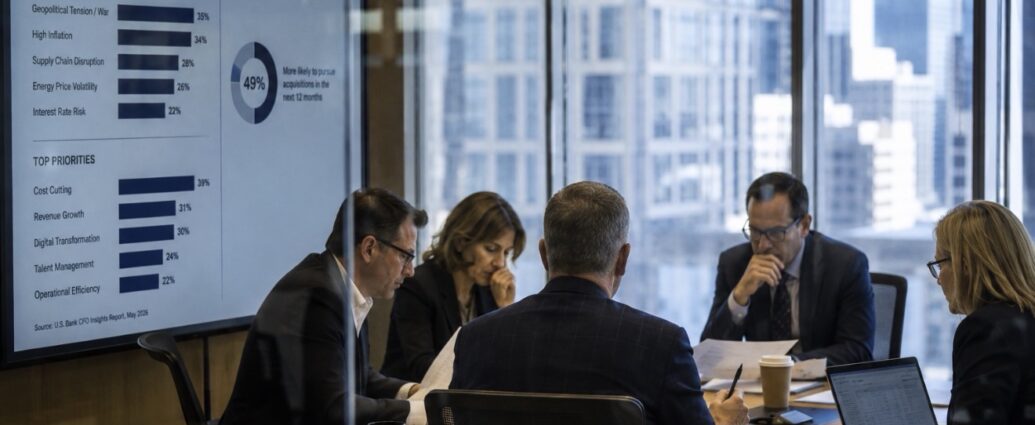
That is the picture emerging from the latest U.S. Bank CFO Insights Report, which surveyed 1,000 senior finance leaders at American companies generating at least $100 million in annual revenue between March 19 and April 14, 2026 — after the start of the Iran conflict.
The findings suggest Corporate America remains cautious, but far from frozen.
War and Inflation Top the List of Corporate Fears
According to the survey:
- 35% of CFOs cited geopolitical tension and war as their biggest business risk
- 34% identified inflation as a top concern
- Many companies also flagged supply chain instability and energy volatility
Those concerns reflect a business environment heavily shaped by the economic fallout from the Iran war.
Since the conflict began:
- National gas prices have surged roughly 52%
- Shipping routes tied to the Strait of Hormuz have faced disruption
- Commodity prices have become increasingly volatile
- Businesses have struggled to forecast costs with confidence
For finance executives responsible for budgeting, forecasting, and capital allocation, the environment has become exceptionally difficult to model.
Yet Many Companies Are Still Looking to Buy
Despite the uncertainty, nearly half of surveyed CFOs — 49% — said they are more likely to pursue acquisitions over the next 12 months than they were during the prior year.
That was one of the survey’s most surprising findings.
At the same time:
- 71% said they had delayed or scaled back at least one major investment project
- Only 12% said they canceled projects outright
The data suggests many companies are responding selectively:
- Cutting discretionary spending
- Preserving cash
- Delaying nonessential expansion
- But remaining aggressive when attractive acquisition opportunities appear
“CFOs are managing through real cross-currents right now,” said Stephen Philipson, Vice Chair and Head of Wealth, Corporate, Commercial and Institutional Banking at U.S. Bank.
“Leaders are still pursuing growth while maintaining cost discipline and sharpening risk management,” he said.
Cost Cutting Is Rising — But Growth Still Matters
Cost reduction remains the top corporate priority.
About 39% of CFOs identified expense management as their primary focus — up significantly from 2024 levels.
But revenue growth has also surged higher on executive agendas, jumping from seventh place in mid-2024 to second place this year.
Digital transformation and AI investment also remained among the top priorities for many companies despite broader economic uncertainty.
The message from executives appears increasingly clear:
This is not viewed as a collapse scenario.
It is viewed as a highly unstable operating environment requiring tighter execution.
Many Companies Are Still Exposed to Oil Shocks
One of the survey’s more concerning findings involved commodity exposure.
Roughly 58% of finance leaders said their businesses remain underhedged against commodity price volatility.
That means many companies still lack sufficient financial protections against swings in:
- Oil prices
- Fuel costs
- plastics
- shipping expenses
- raw materials tied to energy markets
As a result, businesses remain vulnerable to additional escalation in Middle East tensions or further disruptions to global energy markets.
Supply Chains Are Being Permanently Rewired
The survey also shows companies continuing to restructure supply chains in response to tariffs, geopolitical risk, and lessons learned from recent disruptions.
Among companies with overseas manufacturing:
- 62% said they have moved production closer to the U.S.
- 37% reported reshoring some manufacturing directly back to America
- 51% said they diversified suppliers across multiple countries
The long-term trend toward supply chain decentralization appears to be accelerating rather than reversing.
AI Spending Is Becoming More Measured
Artificial intelligence investment remains a major corporate focus — but CFOs are increasingly demanding measurable returns.
Finance leaders said they actively track ROI on roughly 41% of AI-related investments.
Of those being measured:
- 47% were generating positive returns
- The remainder were either underperforming or still unproven
That marks a shift from early-stage experimentation toward greater financial accountability around AI deployment.
Large Companies Feel More Confident Than Smaller Ones
The survey revealed a growing confidence gap between large corporations and smaller businesses.
Finance leaders at companies generating more than $5 billion annually were significantly more optimistic about the economy than executives at firms generating between $100 million and $250 million.
That divide reflects a familiar reality during economic stress:
Larger companies generally have:
- More cash reserves
- Better access to financing
- Greater pricing power
- More flexible supply chains
- Stronger hedging capabilities
Smaller businesses remain far more vulnerable to prolonged inflation and energy shocks.
Corporate America Is Nervous — But Still Moving
Overall, the survey paints a nuanced picture of Corporate America in 2026.
Executives are clearly worried.
Short-term economic confidence has weakened.
War and inflation are dominating strategic discussions.
But companies are not shutting down investment activity altogether.
Instead, many appear to be:
- tightening spending
- reducing risk
- restructuring operations
- repositioning supply chains
- and actively searching for strategic opportunities during volatility
The dominant mindset inside many boardrooms is not panic.
It is cautious opportunism.
And for now, America’s CFOs appear to believe the economy remains strong enough to justify continuing to play offense — even while preparing for more turbulence ahead.
© JBizNews.com. All rights reserved. This article is original reporting by JBizNews Desk. Unauthorized reproduction or redistribution is strictly prohibited.