JBizNews Desk | May 10, 2026
MP Materials, America’s only fully integrated rare earth producer, delivered a striking forecast Thursday that upends conventional thinking about the critical minerals race: the most expensive and geopolitically sensitive rare earth elements — long considered irreplaceable building blocks of modern technology — are heading toward a significant demand decline, not because the world needs fewer magnets, but because engineers are finding ways to build better ones without them.
MP Materials Corp. expects demand for some of the most expensive rare earth materials to drop sharply as magnet makers adopt alternative metals. MP and some of its peers are increasingly finding ways to build high-performance magnets with little or no heavy rare earth content — a shift that could weaken prices for materials like dysprosium and terbium, said Chief Executive Officer James Litinsky.
The announcement came on the same day MP Materials reported its strongest quarterly financial results in company history, underscoring the paradox at the heart of the rare earth industry right now: the company most exposed to heavy rare earth price movements is the one publicly predicting those prices will fall — because it has already positioned itself to thrive without them.
What Heavy Rare Earths Are and Why They Matter
To understand what Litinsky’s forecast means, it helps to understand what heavy rare earths actually do.
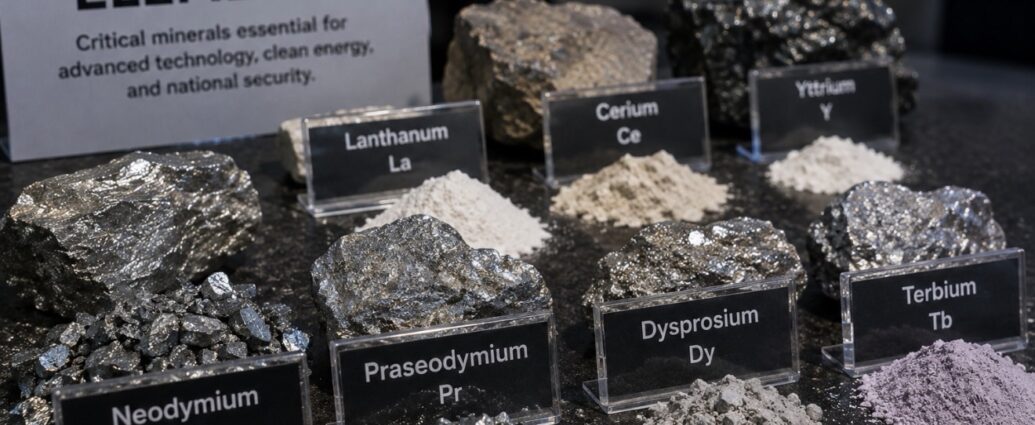
Dysprosium and terbium — the two elements most directly referenced in MP’s outlook — are added to the powerful permanent magnets used in electric vehicle motors, wind turbines, robotics, fighter jets, drones, and countless other high-performance applications. Their primary function is to stabilize the magnet’s performance at high temperatures, preventing it from losing its magnetic strength when it heats up during operation.
The problem has always been that these elements are extraordinarily expensive, concentrated almost entirely in China, and subject to Beijing’s increasingly aggressive export controls.
China controls approximately 90% of global rare earth processing, creating a critical supply chain vulnerability for materials essential to defense, electric vehicles, and renewable energy technologies.
When China tightened export restrictions on dysprosium, terbium, and other heavy rare earths earlier this year, it sent shockwaves through global supply chains and drove prices sharply higher — a reminder of how dependent Western manufacturers had become on a single country for materials with no easy substitutes.
That vulnerability has been the driving force behind the U.S. government’s aggressive investment in domestic rare earth capacity, including a landmark partnership with MP Materials that includes a 10-year price floor agreement for key rare earth products and a Department of Defense offtake commitment for 100% of production from MP’s planned 10X Facility — a new magnet manufacturing plant in Fort Worth, Texas expected to add 10,000 metric tons per year of neodymium-iron-boron magnet production capacity when commissioned in 2028.
The Technology Shift Changing the Equation
What Litinsky is now signaling is that the engineering community has been racing to solve the heavy rare earth dependency problem — and is making meaningful progress.
Magnet manufacturers are developing alloy formulations and manufacturing processes that achieve comparable or superior magnetic performance without requiring the same amounts of dysprosium and terbium. Some formulations eliminate heavy rare earths almost entirely.
This is not a distant theoretical possibility.
MP Materials itself has been targeting mid-2026 for commissioning its heavy rare earth separation facility at Mountain Pass, California, designed to process approximately 3,000 metric tons of feedstock per year with initial focus on dysprosium and terbium production.
The company has been stockpiling heavy rare earth concentrate since late 2023 in preparation. But if demand for those elements is set to fall as technology advances, the strategic calculus around that facility shifts considerably.
The irony is that MP’s own magnet manufacturing ambitions are part of what is driving the demand reduction. As MP and its peers invest in advanced magnet production capabilities, they are simultaneously developing the manufacturing expertise and material science knowledge to reduce their own dependence on the most expensive and geopolitically precarious inputs.
What This Means for American Businesses and Investors
For American manufacturers — particularly automakers, defense contractors, and clean energy companies — the prospect of reduced heavy rare earth dependency is unambiguously positive news.
Lower dependence on dysprosium and terbium means:
- lower exposure to Chinese export controls
- more predictable input costs
- greater supply chain security
MP Materials reported first quarter 2026 revenue of $90.6 million, driven by higher sales of NdPr oxide and metal, reflecting the continued ramp of production of separated products as well as stronger market pricing.
CEO James Litinsky described the results as reflecting “record NdPr production and sales with solid Adjusted EBITDA generation” and cited the company’s progress breaking ground on the 10X facility.
Neodymium-praseodymium — the light rare earth elements central to MP’s core business — is entering its second consecutive year of supply deficit against rising EV and wind turbine demand, with prices consolidating in a $95 to $115 per kilogram range.
Both MP Materials and Australian peer Lynas Rare Earths operate at NdPr prices well above their reported cost bases.
In other words, while heavy rare earth demand may be heading lower, the light rare earths that form the backbone of MP’s business remain in structurally tight supply — a dynamic that supports the company’s long-term revenue picture even as the heavy rare earth outlook softens.
The Department of Defense has committed to a 10-year offtake agreement for 100% of the 10X Facility’s magnet production, with a 10-year price floor for NdPr oxide set at $110 per kilogram — providing MP with predictable revenue even if global prices fall due to a ramp up in China’s output.
A Major Shift in the Critical Minerals Race
For investors and policymakers tracking the critical minerals race, Litinsky’s forecast is a signal worth watching closely.
The rare earth supply chain Washington has spent billions trying to rebuild domestically is maturing faster than many expected — and the technologies it was designed to support are evolving just as quickly.
The next phase of the global rare earth race may no longer center solely on securing supply.
It may increasingly revolve around engineering ways to need less of the most vulnerable materials altogether.
And for American manufacturing, that could ultimately become one of the industry’s biggest strategic advantages.
© JBizNews.com. All rights reserved. This article is original reporting by JBizNews Desk. Unauthorized reproduction or redistribution is strictly prohibited.