JBizNews Desk | May 10 2026
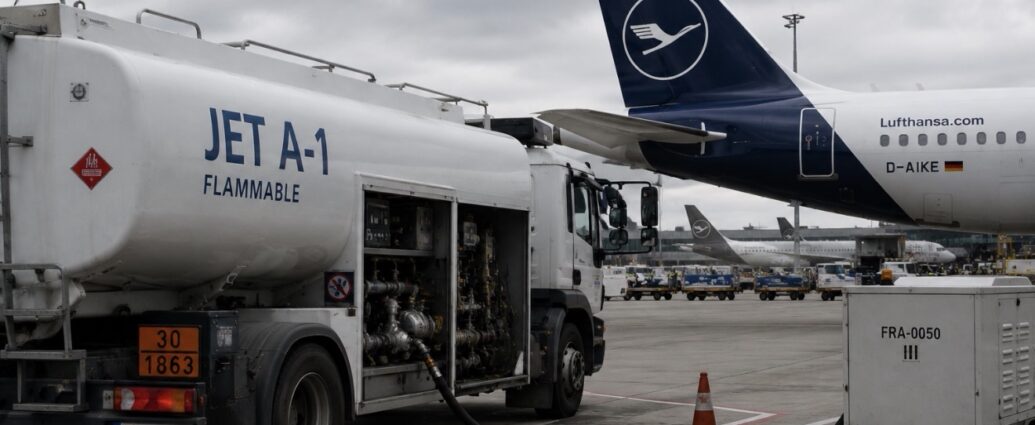
Germany — Europe’s largest economy — quietly asked Israel to ship it jet fuel while its own government was publicly insisting there was no shortage. When Israel announced the deal, Berlin was caught in a contradiction that has since become one of the most revealing moments of the Iran war’s energy crisis.
Israel’s Foreign Ministry announced Wednesday that it will begin supplying jet fuel to Germany following a formal request from Germany’s Federal Ministry for Economic Affairs and Energy. Israeli Foreign Minister Gideon Sa’ar informed German Economic Affairs and Energy Minister Katherina Reiche of the decision during a visit to Berlin.
Israeli Energy Minister Eli Cohen instructed relevant experts to approve the request after the Ministry’s Fuel Administration determined a surplus in jet fuel production. Shipments will be coordinated with domestic refineries and remain contingent on the security situation.
The timing of Israel’s announcement was immediately awkward for Berlin.
German Transport Minister Patrick Schnieder had stated in a series of interviews in recent days that Germany “has no shortage of jet fuel” and that refining capacity in Germany and its neighbors is “sufficient.”
He made those comments specifically to counter reports that Lufthansa Group had canceled tens of thousands of flights this summer, citing an expected shortage of jet fuel.
Once Israel’s announcement made the request public, those assurances collapsed.
The German government subsequently confirmed the offer but stressed that there are “currently no physical energy shortages in Germany” — while in the same statement acknowledging it was in “constructive talks with several countries” over energy supply, including Israel, and that contracts were being drawn up by companies involved.
The two positions — no shortage, but actively sourcing emergency fuel from a wartime ally — were difficult to reconcile simultaneously.
How Germany Got Here
The embarrassment reflects a structural energy vulnerability that has been building in Germany for years and is now being fully exposed by the Iran war.
Europe shut down or converted dozens of refineries over the past decade and became increasingly dependent on imported jet fuel and refining inputs flowing through Middle Eastern supply chains.
The Strait of Hormuz blockade — now in its tenth week — is cutting directly into those flows, hitting European aviation fuel supply, airline operating costs, and government contingency strategies simultaneously.
The price impact has been severe and fast-moving.
The price of jet fuel has more than doubled since the conflict began.
Lufthansa warned this week that fuel costs linked to the crisis have already added roughly €1.7 billion to its expenses this year — and said the company is preparing for possible supply disruptions later in 2026.
Airlines across Europe have already cut approximately two million seats on flights in May 2026 alone.
Lufthansa specifically slashed around 20,000 short-haul flights, attributing the cancellations directly to rising oil prices and fears of a jet fuel shortage in the months ahead.
For American travelers and businesses, the Lufthansa cuts are not an abstraction.
The airline operates one of the largest transatlantic networks in the world, and its flight reductions directly affect routes between U.S. and European cities — pushing up fares, reducing seat availability, and creating ripple effects across codeshare partners including United Airlines.
Why Israel Has Surplus Jet Fuel
The fact that Israel has jet fuel to export surprised even some Israeli energy officials.
Experts in the field could not remember the last time Israel had exported jet fuel to any country.
The refineries in Ashdod and Haifa produce kerosene as part of various fuel refining processes, and officials explained that a surplus has developed because of the freezing of many flight routes due to the war and the fact that only Israeli airlines and a handful of foreign carriers are currently operating flights to and from Israel.
The irony is direct:
The same war that is causing Europe’s jet fuel shortage is also the reason Israel has surplus fuel to export.
Reduced aviation activity inside Israel — a consequence of regional conflict and closed airspace — has left the country’s refineries with output that has nowhere domestic to go.
Some reports have added a defense dimension to the transaction.
Greek publications noted that the fuel types under discussion include JP-5 and JP-8 — military grades of jet fuel — suggesting the deal may extend beyond commercial aviation into emergency military logistics.
Israel’s Foreign Ministry and Energy Ministry confirmed only that coordination of cargoes will be carried out with the refineries, without specifying volumes, grades, or delivery timelines.
The Larger Picture
The Germany-Israel jet fuel transaction is, at its core, a story about what happens when a decade of energy policy assumptions collide with an unexpected geopolitical shock.
Germany spent years closing nuclear plants, reducing domestic refining capacity, and relying on stable global supply chains for critical energy inputs.
The Iran war has disrupted those chains in ways that Berlin was either unprepared for or unwilling to publicly acknowledge — until Jerusalem made the acknowledgment unavoidable.
Israel is also exploring the possibility of exporting natural gas to Germany, with Israel’s Energy and Infrastructure Ministry examining that option as a further extension of the two countries’ existing energy partnership.
If that deal advances, it would represent an even more significant reorientation of European energy sourcing — driven entirely by a war that has redrawn the map of who has energy and who desperately needs it.
For American energy companies, investors tracking European aviation stocks, and businesses with transatlantic supply chains, the Germany-Israel deal is a reminder that the Iran war’s energy disruptions are still finding new corners of the global economy to reshape — and that the countries most caught off guard are often the ones that were most confident they had nothing to worry about.
© JBizNews.com. All rights reserved. This article is original reporting by JBizNews Desk. Unauthorized reproduction or redistribution is strictly prohibited.