For anyone who has driven abroad and then returned to Israel, the experience can feel disorienting. Israeli driving is often described in the same breath as chaos, improvisation, and instinct. It is a system that somehow works, until it doesn’t.
This past Wednesday morning, on a highway in Jerusalem, I encountered a moment that forced me to rethink not only driving norms, but the meaning of patriotism and responsible citizenship in Israel today.
Driving in the middle lane, I was startled when a small Peugeot truck ahead of me came to an abrupt and inexplicable stop. There was no traffic in front of him, no visible obstruction. My immediate instinct was defensive: check the left lane, maneuver around him, avoid what could easily have become a chain-reaction collision.
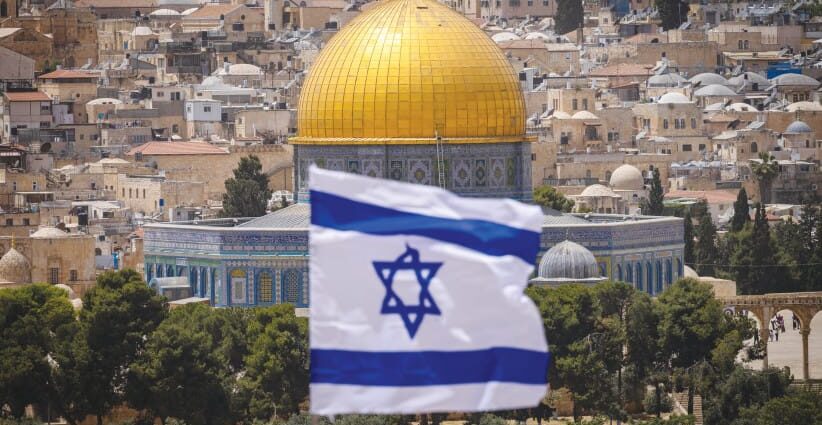
As I passed, I glanced over to understand what had caused such a dangerous and unexpected move. The driver, a man perhaps in his 60’s, was already stepping out of his vehicle. His purpose became clear almost instantly: he was retrieving a large Israeli flag that had fallen onto the highway, partially trapped beneath his front tire.
Like many Israelis, especially after three decades of living here, my initial reaction was not charitable. I cursed him. I judged him. How could someone be so reckless, so self-centered, to endanger others over what appeared, in that split second, to be a piece of cloth?
But as I continued driving, something shifted.
What if he had served in the IDF, risking his life for what that flag represents?
What if he had lost friends, close friends, who died under that same flag?
What if his son or granddaughter is currently deployed in Gaza, Lebanon, or elsewhere, defending the very sovereignty that the flag symbolizes?
The questions came in waves, each one eroding my certainty, replacing anger with discomfort, and then, unexpectedly, with respect.
Because the truth is simple: he refused to run over the flag.
No one would have blamed him if he had. Under those conditions, most drivers would have. It would have been rational. Efficient. Safe.
But he didn’t.
And in that decision, however flawed in execution, there was something deeply revealing about the kind of patriotism that still exists in Israel.
What does patriotism look like today?
That moment stayed with me because it collided with a broader question Israel must confront, especially now: What does patriotism mean in a deeply polarized society, during one of the longest and most complex wars in our history?
Israel today operates under conditions that blur traditional boundaries between war and peace, home front and battlefront, domestic discourse and international perception. This is not theoretical. It is structural.
We are no longer living in an era where what is said in Hebrew stays in Hebrew.
Every statement, every accusation, every political attack made for domestic consumption is instantly translated, amplified, and weaponized globally. The firewall between internal debate and international public diplomacy has collapsed.
This collapse creates a new strategic reality: internal discourse is no longer just internal. It is part of the battlefield.
And yet, our political and media ecosystems continue to behave as if this distinction still exists.
When Israeli politics ‘runs over our flag’
The metaphor from that highway moment is unavoidable.
Today, in Israeli public life, “running over the flag” has taken on a different meaning.
It is not about literal disrespect; it is about rhetorical and strategic behavior that damages Israel’s standing in the world for the sake of short-term political gain.
It occurs when:
• Politicians frame their opponents in ways that are picked up internationally as evidence of systemic failure or illegitimacy.
• Media personalities blur the line between critique and delegitimization.
• Influencers and public figures amplify narratives that serve partisan objectives but weaken Israel’s global position.
This is not a call to suppress criticism. Democracies depend on it.
But there is a profound difference between constructive criticism and destructive amplification, between strengthening the system and eroding it in ways that adversaries can exploit.
In today’s environment, those distinctions matter more than ever.
Because every internal fracture is no longer contained, it is broadcast.
Elections, media, and the incentive to divide
As Israel moves closer to another election cycle, these dynamics intensify.
Campaign messaging is no longer confined to rallies and party broadcasts. It is embedded in algorithm-driven ecosystems, social media feeds, targeted ads, and digital platforms where political messaging often appears indistinguishable from news.
The incentive structure is clear: outrage drives engagement.
And engagement drives visibility.
This creates a dangerous feedback loop where the most extreme, divisive, and delegitimizing messages are rewarded, both domestically and internationally.
In such an environment, “responsible citizenship” risks being redefined not as contributing to the collective good, but as winning at all costs.
Including, metaphorically speaking, running over the flag.
The urgent need to redefine responsible citizenship
Israel cannot afford this trajectory.
If the external and internal arenas are now one continuous space, as they clearly are, then responsible citizenship must be redefined accordingly.
This is not a legal question. It is a societal one.
A modern definition of responsible citizenship in Israel must include:
1. Awareness of consequence: Understanding that domestic rhetoric has global implications. Words spoken for local political gain do not stay local.
2. Red lines in public discourse: Establishing informal but widely respected boundaries that distinguish legitimate critique from narratives that endanger national standing.
3. Collective accountability: Citizens, across the political spectrum, must actively reject and call out behavior that prioritizes division over cohesion.
This means:
• Challenging media narratives that cross into delegitimization.
• Engaging directly, through feedback, calls, and public commentary, when discourse becomes destructive.
• Refusing to normalize rhetoric that undermines Israel’s position globally.
Learning from the road
There is a paradox embedded in Israeli driving culture.
On the one hand, it appears chaotic. On the other, it functions because of an unspoken social contract.
We assume, often without thinking, that the driver next to us will stay in their lane.
Not because it is guaranteed, but because without that assumption, the entire system collapses.
We drive, despite distractions, because we trust, at least minimally, that others will not suddenly swerve into us.
This is not blind faith. It is learned behavior.
A shared understanding of limits.
A collective agreement on what is acceptable and what is not.
From peace to social cohesion
In a traditional sense, we speak of peace as the absence of conflict.
But in today’s Israel, a more relevant definition may be social cohesion, the ability to maintain a shared sense of purpose and truth even amid deep disagreement.
This does not require uniformity of opinion.
It requires agreement on certain fundamentals:
• That the legitimacy of the state is not a political variable.
• That internal disputes should not become external weapons.
• That there are lines we do not cross, even when it is politically advantageous to do so.
Truth, in this context, is not about eliminating disagreement.
It is about preserving a core set of shared realities that hold the society together.
A choice we cannot avoid
The man on the highway made a choice.
It may not have been the safest one.
But it was deliberate.
He refused to run over the flag.
Israel now faces a similar choice, not on the road, but in its public life.
Will we allow our political and media discourse to continue operating without regard for the strategic consequences of a world where domestic and international arenas are fully intertwined?
Or will we redefine the boundaries of responsible citizenship in a way that reflects this new reality?
Because in the end, the question is not whether disagreements will exist. They always will.
The question is whether, in the process of expressing them, we are willing to run over the very symbol and substance of what holds us together.
The author is experienced global strategist and is a strategic adviser and diplomacy fellow at the Jerusalem Center for Security and Foreign Affairs (JCFA). He can be reached at globalstrategist2020@gmail.com.