By JBizNews Desk | May 10, 2026
For generations, Central Valley farmers built their livelihoods around a single, seemingly reliable customer: Del Monte Foods. They signed long-term contracts, planted orchards that would not bear fruit for years, and invested thousands of dollars per acre under the assumption that the nearly 140-year-old food giant would continue purchasing every cling peach they produced. That assumption has now collapsed — and the fallout is spreading across California farmland where thousands of acres of peach orchards are being prepared for destruction.
Del Monte Foods filed for Chapter 11 bankruptcy protection in July 2025 under approximately $1.2 billion in debt after years of declining canned food demand, rising operating costs, and mounting financial pressure tied partly to higher steel prices used in food canning operations. In April 2026, the company permanently closed its major canning facilities in Modesto and Hughson, California, plants that together processed roughly one-third of the state’s entire cling peach crop.
The shutdown instantly destabilized one of America’s most concentrated agricultural supply chains.
A Market Disappears Overnight
The closure of Del Monte’s canneries did not simply eliminate hundreds of jobs. It effectively erased the primary commercial market for California cling peaches.
Pacific Coast Producers, the grower-owned cooperative based in Lodi and now the last major cling peach processor remaining in California, moved to absorb part of the displaced crop by signing temporary one-year contracts for an additional 24,000 tons. But that still left approximately 50,000 tons of peaches — representing nearly 3,000 acres of orchards — without any buyer.
For growers, the economics became impossible almost overnight.
Planting a new cling peach orchard can cost as much as $8,000 per acre, while trees take years before reaching productive maturity. Many farmers had signed contracts with Del Monte extending decades into the future, some running through 2044. Under bankruptcy proceedings, those agreements were canceled, leaving growers exposed to losses they could not realistically recover.
The California Canning Peach Association, representing roughly 70% of the state’s cling peach growers, filed a bankruptcy claim seeking more than $550 million tied to the voided contracts.
Sutter County farmer Ranjit Davit, chairman of the association’s board, planted new orchards in 2023 following direct encouragement from Del Monte under a 20-year contract agreement. Today, those trees have nowhere to send their fruit.
“This is devastating to growers and to this industry,” Davit said.
USDA Emergency Intervention
The Biden administration moved aggressively to prevent even larger losses across California agriculture.
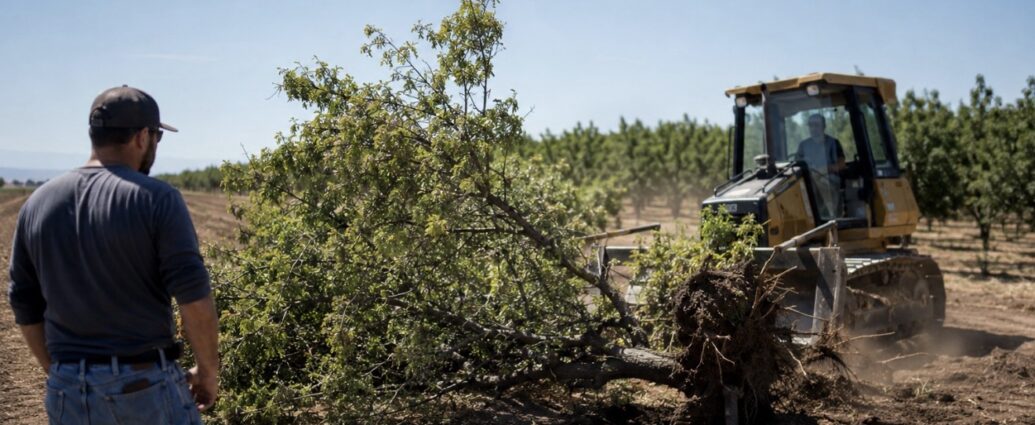
The U.S. Department of Agriculture approved up to $9 million in emergency assistance to help farmers remove approximately 420,000 clingstone peach trees before the 2026 harvest season. Federal officials concluded that allowing growers to harvest fruit with no buyer would only deepen the economic damage.
According to USDA estimates, clearing the orchards now could prevent an additional $30 million in financial losses.
The emergency package received bipartisan support from California lawmakers including Rep. David Valadao, Rep. Mike Thompson, and Sen. Adam Schiff, while nearly 40 state legislators urged Agriculture Secretary Brooke Rollins to intervene earlier this year.
“For generations, Central Valley family farms have relied on Del Monte’s Modesto facility to process their peaches,” Valadao said. “Its sudden closure left growers with thousands of pounds of fruit and no clear path forward.”
The federal funds will help growers remove the unsellable orchards and transition land toward alternative crops — although many farmers still remain uncertain what replacement crops can generate sustainable returns in today’s market environment.
“These guys have decisions to make — they have to get the trees out, they have to decide if they’re going to plant something else, what they’re going to plant,” Thompson said. “Timing is very critical.”
A Warning for American Agriculture
The Del Monte collapse is increasingly being viewed as a warning sign about the vulnerability of America’s vertically integrated food supply chains.
When one processor controls 30% to 35% of a state’s harvest capacity, its bankruptcy does not simply hurt a supplier relationship — it can erase an entire market overnight.
The agricultural sector is already under pressure from multiple fronts simultaneously. Rising fuel costs tied to Middle East instability and disruptions in the Strait of Hormuz have increased transportation and fertilizer expenses. Tariffs have raised manufacturing and packaging costs across the food sector. Meanwhile, long-term consumer shifts away from canned products toward fresh foods have steadily weakened demand for processed fruit.
For heavily indebted processors like Del Monte, the business model became increasingly unsustainable.
Pacific Coast Producers acquired portions of Del Monte’s remaining assets during bankruptcy proceedings, including canned inventory and selected infrastructure. But its existing facilities in Oroville and Lodi are already operating close to capacity, leaving no immediate large-scale replacement for the processing gap Del Monte left behind.
Building new canning infrastructure would require enormous capital investment at a time when few operators are willing to take on additional agricultural processing risk.
Trees Coming Down Across the Valley
Across California’s Central Valley, the impact is becoming visible in real time.
Growers who once planned decades ahead are now bulldozing orchards they expected would support multiple generations of family farming. The removal of 420,000 peach trees is not simply a temporary agricultural correction — it represents the physical unraveling of long-term contracts, investment assumptions, and trust in the stability of America’s food processing system.
For many farmers, the destruction unfolding this summer serves as a harsh reminder that even a 20-year agreement can disappear almost overnight when a major corporate buyer collapses.
And for American agriculture more broadly, the Del Monte bankruptcy may become remembered not just as the failure of a historic food company — but as the moment an entire regional supply chain suddenly discovered how dependent it had become on a single processor.
© JBizNews.com. All rights reserved.