By JBizNews Desk | May 8, 2026
Iran has taken a significant step toward institutionalizing its control over the world’s most critical oil shipping lane. The Iranian government has formally launched a new body called the Persian Gulf Strait Authority — a bureaucratic apparatus designed to vet vessels, issue transit permits, and collect tolls from every ship seeking passage through the Strait of Hormuz. The move transforms what had been an improvised system of payments extracted by the Islamic Revolutionary Guard Corps into a standing government agency with an official email address, a published logo, and a formal application process.
The waterway at the center of this dispute is not peripheral to the global economy. Before the outbreak of the Iran war in February 2026, the Strait of Hormuz carried roughly 20% of the world’s seaborne oil trade — approximately 21 million barrels of crude oil and refined products every day, along with vast quantities of liquefied natural gas and, critically, the fertilizer precursors that feed global agriculture. The strait’s effective closure since late February has already produced the largest oil supply disruption in the history of the global energy market, according to the International Energy Agency.
A Toll Booth at the World’s Gas Pump
The mechanics of the new system are straightforward, even if the geopolitical implications are anything but.
According to shipping intelligence firm Lloyd’s List Intelligence, which first reported the authority’s launch, ships seeking to transit the strait receive an email from the Persian Gulf Strait Authority directing them to submit an application disclosing the vessel’s ownership structure, crew manifest, insurance coverage, and planned route. Upon review, the authority issues — or withholds — a transit permit.
The tax itself is substantial. Iranian officials had publicly confirmed charges in the range of $2 million per vessel for safe passage through the strait. Iranian lawmaker Alaeddin Boroujerdi stated plainly in late March that the practice was intentional.
“Now, because war has costs, naturally, we must do this and take transit fees from ships passing through the Strait of Hormuz,” Boroujerdi said.
For a large tanker carrying roughly 2 million barrels of oil, the fee adds approximately $1 per barrel to shipment costs — a burden analysts say will largely fall on Gulf exporters before eventually filtering into global fuel and commodity prices.
The new agency did not emerge in a vacuum. Since March, a patchwork of informal arrangements had allowed some merchant vessels to navigate the strait’s northern waters near the Iranian coastline, routing around the standard international shipping corridor and past Iran’s Larak Island. Scam operators also reportedly emerged, offering fraudulent transit paperwork in exchange for cryptocurrency payments.
The Persian Gulf Strait Authority effectively consolidates and formalizes that murky system, positioning Tehran as the sole arbiter of commercial movement through one of the world’s most economically vital waterways.
A Challenge to Freedom of Navigation
The diplomatic and legal implications are substantial.
The United Nations Convention on the Law of the Sea, which entered into force in 1994, codifies freedom of navigation through international straits as a foundational principle of global commerce. Iran’s assertion that it can impose taxes and regulate passage directly challenges that framework and has already drawn condemnation from the United Kingdom and organizations representing the majority of the world’s tanker operators.
The United States has not endorsed any arrangement that would recognize Iran’s authority over the strait.
American naval forces operating under U.S. Central Command have intensified escort operations in the region and, according to military officials Friday morning, fired upon and disabled Iran-flagged vessels attempting to breach the U.S. naval blockade of Iranian ports.
President Donald Trump earlier this month launched Project Freedom, a U.S.-led initiative intended to provide commercial naval escorts through the waterway — a direct counter to Iran’s new permitting regime.
The result is an increasingly dangerous dual-blockade environment: the U.S. Navy blockading Iranian ports while Iran effectively blocks Gulf shipping lanes.
Industry estimates now suggest that as many as 1,500 commercial ships are stranded in or around the Strait of Hormuz awaiting safe passage.
The Price Is Already Being Paid
While diplomats negotiate and military forces maneuver, the economic consequences are already spreading across global supply chains.
The Arabian Gulf supplies approximately 38% of the world’s urea fertilizer exports and nearly half of global seaborne sulfur exports, both critical components for modern agriculture. Since the conflict escalated, nitrogen and phosphate fertilizer prices have surged between 20% and 40%.
The U.S. Department of Agriculture now projects overall food inflation of approximately 2.9% for 2026, incorporating rising transportation fuel costs, elevated fertilizer prices, and expected reductions in crop yields.
Agricultural economists warn that consumers have likely not yet experienced the full downstream effect of the supply disruption because food pricing typically lags farm-level input increases by several months.
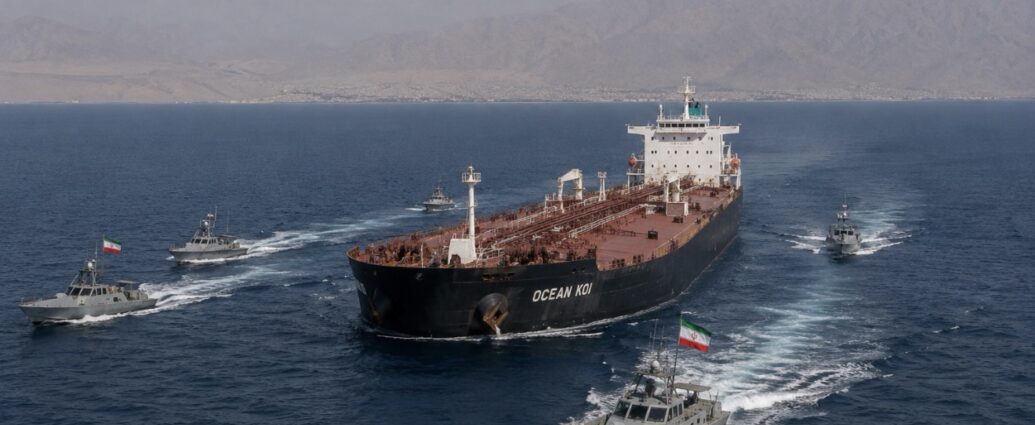
The situation escalated further Friday after Iranian naval forces seized the tanker Ocean Koi, a Barbados-flagged crude vessel operating in the Gulf of Oman. Iranian state broadcaster IRIB reported that the ship, which had been sanctioned by the United States earlier this year, was escorted to Iran’s southern coastline and transferred to judicial authorities.
The seizure reinforced fears that the Strait of Hormuz is no longer merely an economic chokepoint but an active military confrontation zone with global consequences.
What Happens Next
Markets, shipping companies, and governments are now attempting to determine whether the Persian Gulf Strait Authority represents a temporary wartime revenue mechanism or the beginning of a long-term Iranian attempt to institutionalize control over one of the most strategically important waterways on earth.
The answer carries implications far beyond oil markets.
It will shape freight costs, fertilizer availability, global food inflation, shipping insurance rates, and the stability of international trade flows affecting billions of consumers worldwide.
For now, one reality has become increasingly clear: the economic consequences of the Hormuz conflict are no longer confined to the Middle East. They are moving directly into global supply chains, commodity markets, and household budgets around the world.
© JBizNews.com. All rights reserved.