Warren Buffett, no stranger to the residential real estate business and to the incalculable role of homebuilding and development within it, is quoted as saying, “Valuing a business is part art and part science.”
Buffett would appreciate the throughline from his broader mantra to its direct applicability to land valuation, a bulwark of any-sized homebuilding operation.
Land – the literal alpha and omega of homebuilding’s beginning-to-end-to-beginning-to-end value-generating lifecycle – and homebuilding are interlocked, and art and science bind to sustain a present and future for any homebuilding operator.
The “science” of homebuilding land acquisition and development has always involved assembling and interrogating a dizzying matrix of variables: parcel geography and topography, zoning and entitlement constraints, utility access, environmental risk, demographic migration patterns, competitive positioning, finished-lot pricing, homebuyer affordability thresholds, projected sales pace, and, ultimately, whether a community will “pencil” financially once every direct and indirect cost is factored into the final home price.
Mixing and matching that science-stack matrix with people and the homes they’ll want to live in, the “art” part, unfolds in a concurrent lifecycle. It’s the land acquisition and development executive’s instinct, woven helically and uncannily through the routines and data fields of land buying science.
The trusted relationship with a seller, leading often to an off-market opportunity. The political read on a planning commission. The understanding of which floor plans will resonate in a submarket three years from now. The local knowledge that comes only from walking the dirt, driving the roads, and talking with officials, builders, brokers, engineers, and residents.
For decades, successful homebuilding enterprises have hinged on trust, gut, lessons learned, sparks of creativity, and lots and lots of behavioral, physical, regulatory and financial data.
One day it’s a tool; the next, it’s a teammate
Now, Acres.com is betting that artificial intelligence can radically compress the science and calculus side of that equation – freeing land and development teams to spend more time on the art, where they create the most value, if they’ve got the bandwidth.
This week, the Fayetteville, Ark.-based land intelligence platform introduced Acres Intelligence, which it describes as “the first AI agent designed to work alongside land acquisition and development teams, researching new sites, analyzing constraints, and producing professional-grade reports and dashboards in minutes, all within the platform.”
The launch comes at a moment when the homebuilding industry’s speculative and often risky land calculus has rarely mattered more.
A slower-than-expected spring selling season in May 2026 has intensified scrutiny of land exposure, capital deployment and finished-lot pipelines. At the same time, the structural undersupply of vacant developed lots continues to threaten builders’ 18- to 36-month growth horizons.
Public and private builders alike are navigating a market in which acquisition mistakes can haunt earnings, margins and market-share ambitions for years. Or worse, existential viability.
Against that backdrop, Acres Intelligence isn’t merely a shiny new toy or a tech capability; it’s a way to engage real-time, real-life land acquisition practitioners in a workflow reset and give them a sudden windfall of time.
“We think this is a new teammate you’re experiencing,” Acres founder and CEO Carter Malloy said during an exclusive walkthrough discussion with The Builder’s Daily. “This sits on top of all of that… It is definitely a paradigm shift.”
Ground-breaking
The system combines Acres’ proprietary parcel, ownership, zoning, permitting, environmental and geospatial datasets with natural-language AI workflows capable of performing tasks that traditionally require days or weeks of analyst work.
“Land has always been one of the most fragmented and time-intensive asset classes to understand,” Malloy said in the company’s release. “With Acres Intelligence, we’re introducing a new way of working.”
That “new way of working” touches virtually every major workflow routine within a homebuilding land-and-development operation.
Site selection. Market screening. Zoning analysis. Competitive positioning. Finished-lot pricing. Investment committee preparation. Pipeline visibility. Regulatory risk assessment. Consumer demand analysis.
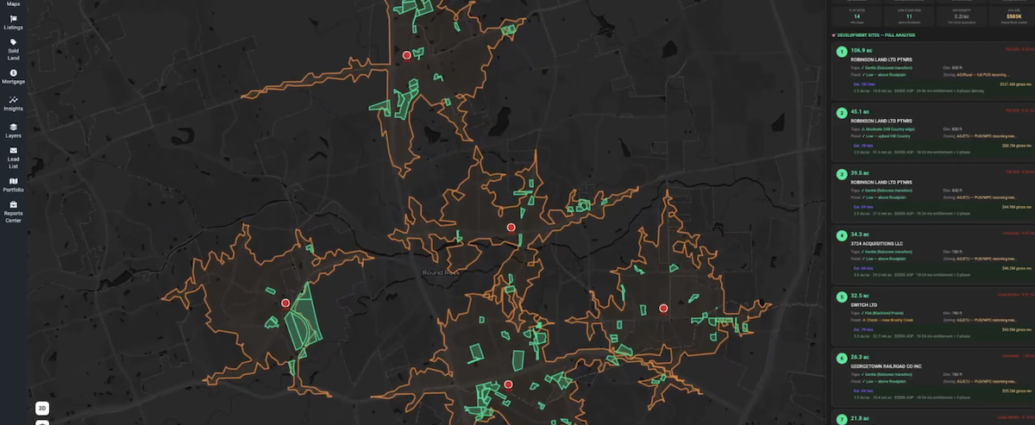
During the demonstration, Malloy showed how Acres Intelligence can search for vacant infill parcels for luxury housing within a five-minute drive of an H-E-B grocery store in Texas, then score parcels based on zoning, flood exposure, slope, and development suitability in real time.
“It didn’t just go and highlight some parcels around the map,” Malloy said. “It’s gone and used Acres’ travel-time isochrone… and then highlighted and scored parcels.”
For land acquisition professionals who typically stitch together spreadsheets, consultant reports, municipal records, and broker intelligence, seeing those separate workflows compress into a single source of truth in seconds of processing time can be transformative.
“Well said, just dramatically speeding up the research and the costs involved with specifying sites,” Malloy said after discussing the traditional workflow burden carried by acquisition teams.
Navigating entitlement risk and opportunity
The implications extend well beyond search efficiency.
One of Acres Intelligence’s most consequential capabilities may be its ability to ladder and prioritize regulatory and entitlement risk in a context rife with local, county, and state jurisdictional stakeholders.
The system can automatically generate zoning and feasibility reports, identify ordinance conflicts, flag drainage and stormwater concerns, surface opportunity-zone incentives and synthesize local planning requirements into decision-ready summaries.
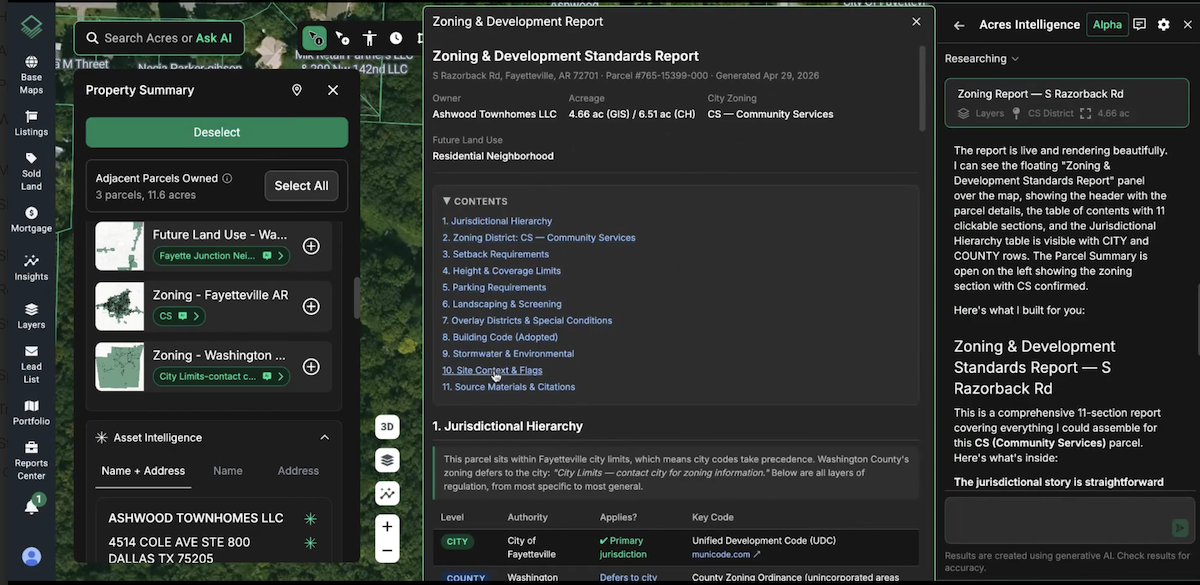
“We’re very excited about the idea that it ladders and it highlights,” Malloy said. “There are a couple of zoning reports available in the market that are 38 pages long, and most of it is gibberish. What this is saying is, ‘here’s all the data,’ but we’re yelling at you, ‘here’s the two things you really need to pay attention to right out the gate.’”
Being able to isolate the two or three variables likely to derail a project could certainly change both the timing arc and the economics of early-stage land pursuit.
Brad Hargreaves, founder of Thesis Driven and a longtime observer of real estate technology and investment strategy, recently wrote that “alpha is created by those who either (a) bring proprietary data to the table or (b) have a unique strategy for using the data at hand.”
Acres Intelligence appears designed around both propositions.
The company’s AI workflows are powered by what Malloy repeatedly characterized as a “monstrous data advantage” built through ownership mapping, courthouse records, MLS integration, building permit data, geospatial layers, and proprietary builder transaction tracking.
One particularly disruptive use case Malloy demonstrated to us is Acres’ Home Builder Index – a real-time tracking system for land transactions, lot sales, inventory positioning, and competitive activity.
“We’re able to watch the actual data on the actual on-the-ground sales,” Malloy said.
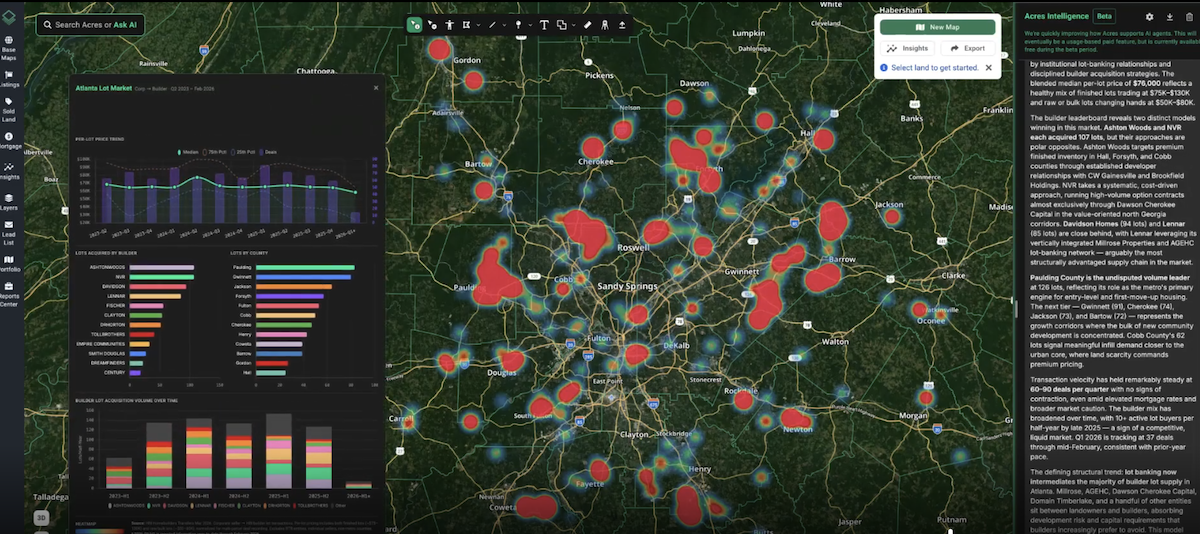
That allows a homebuilding land acquisition director or buyer to visualize where competitors are active, where lot-price corrections are occurring, where inventory pressure is building, and where pricing power remains resilient at both the market and sub-market levels.
The pretty bow on the package was Acres Intelligence’s ability to assemble preliminary “investment committee packets” – including rough underwriting assumptions, development constraints, margin estimates, and risk flags – in minutes.
“I’m not going to make my decision to invest millions of dollars based on this,” Malloy said. “But I can make plenty of decisions not to waste my time based on this.”
That statement may capture the platform’s most immediate value proposition.
In a housing market where builders are recalibrating community pace assumptions, land vintages, product segmentation and incentive structures almost monthly, the ability to eliminate bad pursuits earlier may prove as valuable as finding the next winning tract.
Malloy believes the technology’s competitive implications could become structural.
“In six and 12 months, if you don’t have Acres, you will be at a competitive disadvantage,” he said. “So far it has been… giving folks a competitive advantage by having Acres, but with this new AI, you will be at a meaningful disadvantage relative peers without Acres.”
The potential for this competitive edge also reflects a broader reality unfolding across housing’s operational stack: AI is moving rapidly from experimentation into embedded workflow infrastructure.
The question now facing homebuilding leaders is whether organizations can adapt quickly enough to harness the science side of the equation, without losing the art that still defines great land judgment and the exceptional skill at getting a good deal closed.