By JBizNews Desk
President Donald Trump said Friday that a temporary ceasefire between Russia and Ukraine could mark “the beginning of the end” of the war, as President Vladimir Putin presided over the most restrained Victory Day parade Moscow has staged in years — a visible sign of how a conflict once expected to reinforce Russian power has instead reshaped military strategy, financial priorities and global geopolitical risk calculations.
The three-day ceasefire, running through Monday, pauses military operations between Russian and Ukrainian forces and includes a prisoner exchange involving 1,000 detainees from each side. Both Vladimir Putin and Ukrainian President Volodymyr Zelensky confirmed participation in the agreement after what President Donald Trump described as direct discussions with both leaders.
“And we have a little period of time where they’re not going to be killing people. That’s very good,” President Donald Trump told reporters Friday evening before departing the White House. He later described the arrangement as “the beginning of the end,” framing the temporary halt not as a peace settlement but as a possible opening toward broader negotiations after more than four years of war.
Whether the ceasefire survives beyond the holiday period remains deeply uncertain. Previous attempts at temporary truces collapsed almost immediately, with both Moscow and Kyiv accusing the other of violations. Ukrainian officials continue insisting that any lasting agreement cannot involve recognition of Russian territorial gains, while the Kremlin has repeatedly signaled it views sustained military pressure as central to its negotiating leverage.
Still, the timing of the ceasefire carried unusual symbolic and financial significance because it coincided with Russia’s annual Victory Day celebrations — one of the Kremlin’s most important national events and historically a carefully choreographed projection of military strength.
This year’s parade looked noticeably different.
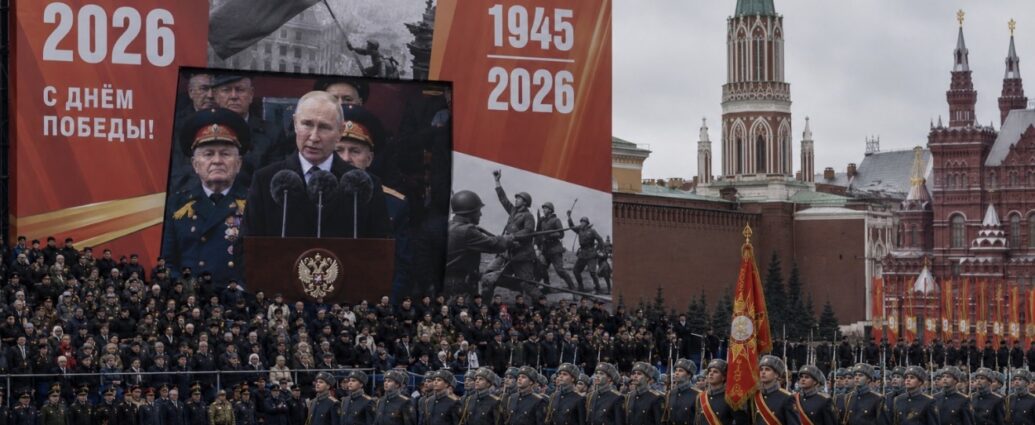
For the first time in years, Moscow’s Red Square ceremony proceeded without the large armored formations, missile launchers and sweeping tank columns that traditionally dominate Victory Day imagery. Instead, the Kremlin relied heavily on marching troops, patriotic staging and tightly controlled symbolism while heightened security concerns overshadowed the event.
Russian officials publicly attributed the scaled-back display to operational demands tied to the Ukraine war. But the broader reality was difficult to ignore: after years of sustained combat, many of the military assets once showcased during the parade are now committed to active battlefield operations, while drone threats deep inside Russian territory have forced Moscow to rethink even the optics of domestic security.
The changing tone of Victory Day also reflected the growing economic burden of a prolonged war that continues reshaping Russia’s fiscal position and broader global markets.
Defense spending now consumes a sharply larger share of Russia’s national budget, while sanctions, export restrictions and capital controls have altered trade flows across energy, commodities and manufacturing sectors. European governments, meanwhile, have accelerated military procurement programs and expanded long-term defense spending commitments at levels not seen since the Cold War.
For investors, even temporary de-escalation between Moscow and Kyiv can influence markets far beyond Eastern Europe.
Energy traders continue monitoring the conflict closely because disruptions tied to Russian oil, natural gas and shipping routes have repeatedly triggered volatility in global commodity markets. Grain exports from the Black Sea region remain critical to food pricing across parts of Europe, Africa and the Middle East, while insurers and freight operators continue pricing elevated geopolitical risk into shipping contracts linked to the region.
European sovereign bonds, defense equities and currency markets also remain highly sensitive to any indication of escalation or diplomatic progress. Analysts say even a limited ceasefire can temporarily ease geopolitical risk premiums if investors believe broader negotiations could eventually emerge.
Still, few market participants appear ready to treat the current pause as a definitive turning point.
The war has repeatedly produced short-lived diplomatic openings followed by renewed fighting, leaving governments and investors cautious about assigning too much significance to temporary agreements. Energy markets in particular have become increasingly conditioned to absorb geopolitical shocks tied to Russia and Ukraine without assuming immediate resolution.
Putin nevertheless used the Victory Day event to reinforce parallels between the Soviet Union’s victory over Nazi Germany and Russia’s current campaign in Ukraine, portraying the war as part of a broader struggle against what the Kremlin describes as Western aggression and NATO expansion.
“The great feat of the victorious generation inspires the soldiers carrying out tasks of the special military operation today,” President Vladimir Putin told assembled troops and dignitaries during his address.
The staging around Putin reflected that message. Veterans from both World War II and the Ukraine campaign were seated prominently during the ceremony, underscoring the Kremlin’s effort to merge historical memory with the current conflict into a single patriotic narrative designed to reinforce domestic unity during a prolonged war.
For President Volodymyr Zelensky, participation in the ceasefire appeared more tactical than transformational. Ukrainian officials framed the agreement narrowly, emphasizing humanitarian considerations and prisoner exchanges while avoiding suggestions that Kyiv views the temporary halt as evidence of a durable diplomatic breakthrough.
That caution reflects the broader reality surrounding the conflict. Despite intermittent negotiations and shifting battlefield dynamics, both Russia and Ukraine continue preparing for the possibility of a prolonged confrontation stretching well beyond 2026.
At the same time, Western governments increasingly face their own strategic and financial pressures tied to sustaining long-term military support, replenishing defense stockpiles and managing voter fatigue surrounding aid commitments.
What became especially clear during this year’s Victory Day observance, however, was how deeply the war has altered the image of strength the Kremlin once projected with confidence.
The tanks that traditionally rolled across Red Square are largely deployed elsewhere. Security around Moscow has intensified dramatically. Foreign attendance appeared thinner than in previous years. And the diplomatic momentum surrounding the ceasefire emerged not from the Kremlin, but from Washington.
For President Donald Trump, the ceasefire offers an opportunity to position himself as a central player in efforts to stabilize one of the world’s most consequential geopolitical conflicts. For President Vladimir Putin, the scaled-down parade highlighted the mounting military and economic costs of sustaining a prolonged war while attempting to preserve the image of national endurance at home.
And for global markets, the combination of symbolic restraint in Moscow and tentative diplomacy between the warring sides offered another reminder that geopolitical risk — much like the war itself — remains unresolved, volatile and deeply intertwined with the outlook for energy prices, defense spending and international economic stability.
JBizNews Desk