By JBizNews Desk | May 10, 2026
The company behind some of America’s fastest-growing sports businesses is now taking control of one of the world’s most recognizable fan traditions.
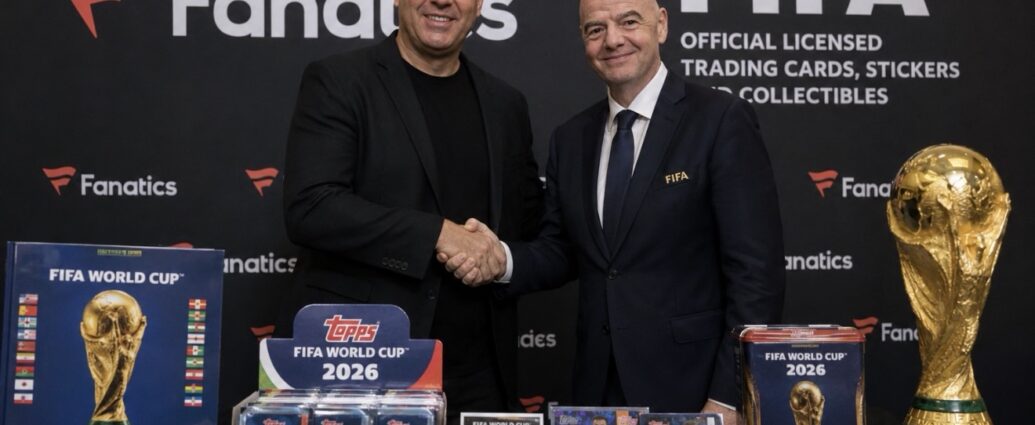
Fanatics has reached a sweeping long-term agreement with FIFA to produce the official trading cards, sticker albums and collectibles tied to the World Cup and other global tournaments, replacing Panini, the Italian company that has defined the World Cup sticker experience for generations.
The transition begins in 2031, ending a relationship between FIFA and Panini that stretches back to the 1970 World Cup in Mexico — a run that transformed sticker collecting into one of the most enduring rituals in global sports culture.
The agreement gives Fanatics and its subsidiary Topps exclusive rights to produce physical and digital trading cards, stickers, collectibles and trading card games tied to FIFA competitions worldwide. The deal also expands Fanatics’ rapidly growing international footprint and cements the company’s dominance across the global sports collectibles industry.
For millions of soccer fans, the change represents far more than a licensing shift.
For decades, peeling open Panini sticker packs, trading duplicates with friends and filling World Cup albums became part of the tournament experience itself — spanning generations across Europe, Latin America, Africa and increasingly the United States. Few products in sports carried the same emotional and nostalgic connection.
Now, that tradition is moving under the control of a company that has spent the past several years aggressively consolidating sports licensing rights across multiple leagues and categories.
“This is the single biggest thing globally we could do to grow our business,” Fanatics founder and Chief Executive Michael Rubin said in announcing the agreement.
Rubin pointed to Fanatics’ expansion in European soccer collectibles following its UEFA partnership, which he said grew from roughly $15 million in annual revenue to more than $200 million, as evidence of the opportunity Fanatics sees in global football.
The FIFA agreement also reflects a broader transformation underway inside the governing body itself.
Under FIFA President Gianni Infantino, the organization has increasingly embraced commercial strategies more commonly associated with major North American sports leagues, focusing heavily on direct fan engagement, licensing monetization, digital expansion and event-driven retail ecosystems.
Infantino described the partnership as a way to modernize how fans interact with the sport while creating new long-term revenue streams that FIFA says will help fund football development globally.
As part of the agreement, Fanatics committed to distributing more than $150 million worth of free collectibles to children and young fans worldwide over the life of the partnership.
Sports-business analysts say the FIFA agreement could significantly increase Fanatics’ long-term valuation by giving the company control over what many consider the single most globally scalable collectibles property in sports. Investment bankers following the sector have increasingly compared Fanatics not to traditional memorabilia companies, but to vertically integrated sports-commerce and media platforms capable of generating recurring revenue through licensing, retail, digital assets and live-event ecosystems.
The company has already been discussed in private-market circles as a potential future IPO candidate at valuations that could rival major publicly traded sports and entertainment businesses if its collectibles and betting divisions continue expanding at current rates.
One of the most significant changes could come through the introduction of premium memorabilia integration into soccer trading cards — something Topps and Fanatics already use extensively across the NFL, NBA, MLB, WWE and Formula 1.
The companies plan to introduce jersey patch cards containing pieces of match-worn player uniforms embedded directly into trading cards, a concept that has become highly lucrative in American sports collectibles but has never been fully commercialized at scale in global soccer.
The move highlights how Fanatics increasingly views collectibles not simply as merchandise, but as a high-margin intersection of sports fandom, media, gaming and alternative assets.
That strategy has turned the company into one of the most aggressive consolidators in sports business.
Over the past several years, Fanatics systematically took major licensing agreements away from Panini across multiple leagues, including the NFL, NBA and Major League Baseball. The company also replaced Panini this season as the official trading card and sticker partner of the English Premier League.
The FIFA agreement now effectively gives Fanatics control over many of the world’s most commercially valuable sports collectibles licenses.
The shift also carries broader business implications because of the sheer scale of the World Cup itself.
The upcoming 2026 FIFA World Cup, hosted across the United States, Canada and Mexico, is expected to become the largest sporting event ever staged in North America, generating massive demand for merchandise, collectibles, sponsorships and fan experiences.
Fanatics will play a central commercial role in that ecosystem, serving as FIFA’s official retail operator for the tournament, including stadium retail operations and FIFA Fan Festival merchandise experiences across host cities.
The company’s collectibles division alone is projected to generate nearly $5 billion in revenue in 2026, according to company estimates, underscoring how sports memorabilia has evolved into a major standalone business category fueled by digital commerce, live events and collector speculation.
For Panini, the agreement marks the end of one of sports licensing’s most iconic partnerships, though not immediately.
The Modena-based company retains FIFA rights through the 2030 World Cup in Saudi Arabia, meaning Panini albums will still accompany both the 2026 and 2030 tournaments before the transition officially takes effect.
But after six decades defining the visual language of the World Cup for generations of fans, the company that made sticker collecting synonymous with soccer’s biggest tournament is preparing to hand over the business to a new global sports powerhouse.
The battle may not end quietly.
Panini has already filed an antitrust lawsuit against Fanatics tied to the company’s growing control over sports licensing rights, and the broader legal fight over consolidation in the sports collectibles industry remains ongoing.
For collectors, however, the message from FIFA’s latest deal is already clear: the economics of global sports fandom are changing rapidly, and the business of trading cards and stickers has become large enough — and profitable enough — to reshape who controls some of the world’s most cherished sports traditions.
JBizNews Desk