By JBizNews Desk | May 10, 2026
Most people have never thought about sulfuric acid.
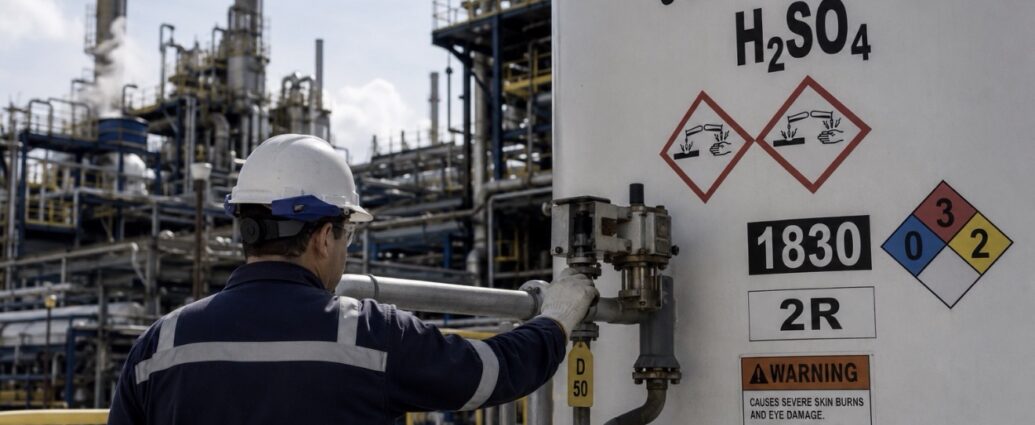
It does not trade like oil. It is not discussed nightly on financial television. Consumers never see it on grocery shelves or at gas stations. Yet sulfuric acid quietly sits inside nearly every major industrial process that powers the global economy — from the fertilizers used to grow food and the copper needed for electrical wiring to semiconductors, batteries, pharmaceuticals, water treatment and modern manufacturing itself.
Chemists have long called it the “king of chemicals.”
Now, the war involving Iran is pushing the world dangerously close to a shortage of it.
The crisis begins with a reality largely invisible outside commodity and industrial circles: the Persian Gulf is not only one of the world’s most important oil-producing regions. It is also the center of global sulfur production.
Countries including Saudi Arabia, Qatar, Kuwait, Iran and the United Arab Emirates collectively account for roughly 44% to 45% of global sulfur exports, according to commodity analysts and industry trade data. Sulfur is primarily produced as a byproduct of refining sour crude oil and natural gas — resources heavily concentrated across the Gulf.
When the Strait of Hormuz effectively shut down following the escalation of the Iran conflict earlier this year, the disruption extended far beyond oil tankers.
It abruptly interrupted nearly half the world’s sulfur supply chain.
Sulfur itself is only the starting point. Once processed and burned, it becomes sulfuric acid — one of the most heavily used industrial chemicals on earth.
Roughly 60% to 70% of global sulfuric acid production goes directly into manufacturing phosphate fertilizers used across the United States, Asia, Africa and South America. Another large share supports mining operations, where sulfuric acid is used to extract copper, cobalt and nickel from ore — metals essential for electric vehicles, renewable-energy storage systems and consumer electronics.
Ultra-pure sulfuric acid also plays a critical role in semiconductor manufacturing, where it is used to clean silicon wafers during chip fabrication.
It is embedded across pharmaceuticals, detergents, plastics, synthetic fibers, industrial cleaning products and municipal water-treatment systems.
“There is virtually no major industrial supply chain that does not touch sulfuric acid somewhere,” said Meena Chauhan, head of sulfur and sulfuric acid research at Argus Media.
Since the conflict began, sulfuric acid prices have surged roughly 30% globally, according to commodity market estimates. In Chile, the world’s largest copper producer, sulfuric acid prices jumped approximately 44% in a single month, sharply increasing operating costs for miners already facing tightening supply conditions.
Across the Democratic Republic of Congo, copper and cobalt producers have begun rationing chemical inventories and reducing acid consumption to preserve existing stockpiles. Analysts warn the restrictions could begin affecting copper production later this year if replacement supplies remain constrained.
Indonesia’s rapidly expanding nickel-processing sector — critical to the electric-vehicle battery market — is also beginning to report industrial slowdowns tied directly to acid shortages.
Then the situation worsened dramatically.
This month, China, which accounts for roughly 20% of global sulfuric acid exports, effectively suspended overseas shipments of the chemical beginning in May 2026, according to analysts at ING.
Beijing’s move is aimed at protecting domestic fertilizer production and food security as global agricultural supply chains tighten under mounting geopolitical pressure.
But the timing could hardly have been worse for international markets.
Global buyers already scrambling to replace Persian Gulf sulfur supply suddenly found the world’s largest alternative exporter effectively exiting the market at the same moment.
“The Iran conflict created a shortage of raw materials. China’s export halt triggers a commercial drought,” said Syed Salman Shaffi, president of Gold Miners Club.
Fred Gordon, head of Acuity Commodities, said the Chinese restrictions have deepened what was already becoming a severe industrial supply imbalance.
Commodity analysts say the crisis illustrates how modern supply chains remain vulnerable not only to oil disruptions, but also to obscure industrial materials most consumers never realize underpin daily life.
Even before the Iran conflict escalated, sulfur markets were operating near multi-year highs due partly to the lingering effects of the Russia-Ukraine war and surging demand from Indonesia’s nickel-processing expansion, according to James Willoughby, research analyst at Wood Mackenzie.
Some high-pressure acid-leaching facilities — particularly those processing nickel ore for battery production — reportedly maintain only one to two months of sulfur inventory, meaning operational disruptions could accelerate rapidly if replacement shipments fail to arrive.
The downstream consequences now stretch well beyond mining and agriculture.
Taiwan, which imports roughly 30% of its liquefied natural gas from Qatar through the Strait of Hormuz, faces growing concerns over energy stability that could eventually affect semiconductor manufacturing.
Taiwan Semiconductor Manufacturing Company (TSMC) — producer of roughly 90% of the world’s most advanced semiconductor chips — consumes nearly 9% of Taiwan’s electricity supply, according to industry estimates. Much of that power system depends heavily on imported Gulf energy flows now vulnerable to prolonged disruption.
Fertilizer prices have already climbed between 10% and 20% across several global trading hubs, raising concerns that the next wave of inflation may emerge not from oil prices directly, but from food production costs tied to shrinking fertilizer availability.
That risk is particularly acute for large agricultural importers including India, Brazil and parts of Southeast Asia, where fertilizer affordability directly influences crop yields and consumer food prices.
Manufacturers across Asia are also beginning to issue force majeure notices — declarations that contractual obligations cannot be fulfilled because of extraordinary external conditions — tied to sulfuric-acid-related supply disruptions.
“Sulfuric is a biggie,” said Eric Byer, president and chief executive of the Alliance for Chemical Distribution. “It’s top of mind for our industry and a variety of different things,” including batteries, industrial products and basic household chemicals.
For investors, the sulfuric acid crisis is becoming another example of how geopolitical conflicts increasingly transmit through global markets in indirect and unpredictable ways.
Commodity traders, shipping firms and industrial manufacturers have spent years focusing primarily on crude oil disruptions tied to the Middle East. But the current crisis is exposing how deeply interconnected the global economy has become around less visible industrial inputs that quietly support nearly every major manufacturing process.
The International Energy Agency has already described the Hormuz shutdown as the largest disruption in the history of the modern oil market.
But the sulfur shortage now unfolding suggests the economic consequences of the Iran war may ultimately extend far beyond gasoline prices or energy exports.
The disruption is reaching into fertilizers used to grow crops, metals needed to electrify economies, semiconductors powering artificial intelligence and consumer electronics, and industrial supply chains that support everything from construction to pharmaceuticals.
The Strait of Hormuz, it turns out, is not simply an oil chokepoint.
It may be one of the world’s most important chokepoints for modern industrial civilization itself.
JBizNews Desk