By JBizNews Desk
May 10, 2026
Target CEO Michael Fiddelke told investors in March that the retailer is undertaking a major redesign of its baby departments as part of a broader strategy to reconnect with young families — a customer group the company increasingly views as central to reversing years of market-share pressure from Walmart and Amazon. The initiative includes the rollout of new in-store “Baby Boutiques,” expanded premium merchandise, personalized shopping services, and thousands of new baby-related products aimed at positioning Target once again as a primary destination for parents.
The strategy marks one of the clearest signs yet that Target is moving away from its longtime “everything store” identity and refocusing more aggressively on what executives repeatedly describe as “busy families” — shoppers who tend to consolidate spending into fewer retail trips once they become parents.
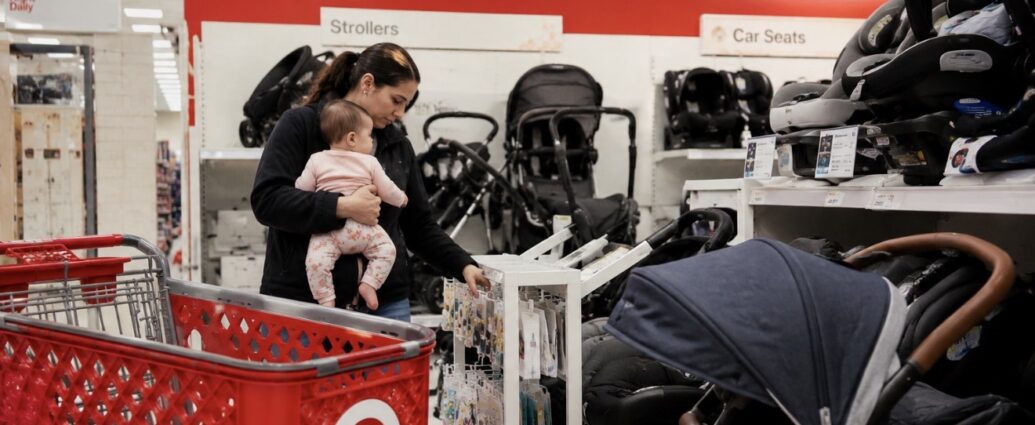
Inside approximately 200 Target stores, representing roughly 10% of the company’s footprint, shoppers can now browse redesigned baby sections featuring assembled strollers, car seats, bassinets, and high chairs displayed outside traditional packaging, allowing parents to physically test products before purchasing.
The upgraded departments feature premium brands including UPPAbaby, Bugaboo, Doona, and Stokke, with some products priced near $1,000, reflecting Target’s effort to compete not simply on price, but on shopping experience and merchandising quality.
Alongside the boutique rollout, Target has added nearly 2,000 new baby products across stores and online platforms.
Executives say the effort is designed around a simple but financially critical retail reality: once consumers become parents, they typically reduce the number of stores where they shop and increasingly prioritize convenience, trust, and familiarity.
That behavior creates an unusually valuable long-term customer opportunity.
Win a parent early, and retailers often capture years of recurring spending not just across diapers and baby supplies, but groceries, apparel, household goods, pharmacy purchases, seasonal shopping, and digital fulfillment services.
Cara Sylvester, Executive Vice President and Chief Merchandising Officer at Target, described baby and grocery as the two most important categories for attracting time-constrained families.
“This is about earning trust early and strengthening relationships that extend well beyond the baby aisle and beyond the baby life stage,” Sylvester said.
She acknowledged that the company’s baby departments had “gone untouched for years” and represented one of the retailer’s largest underdeveloped opportunities.
As part of the initiative, Target is also expanding its Baby Concierge service into physical stores, giving customers access to in-person product guidance and shopping support. The company additionally plans to grow its Cloud Island private-label baby brand, which has become one of its strongest internally developed children’s labels.
The urgency behind the strategy reflects intensifying competitive pressure across the retail sector.
Over the past several years, Target has steadily lost share in key household spending categories as online shopping accelerated and competitors improved pricing, fulfillment speed, and product selection.
At the same time, Walmart has increasingly attracted higher-income shoppers — a demographic once strongly associated with Target’s core customer base — while continuing to expand both grocery dominance and e-commerce capabilities.
Amazon, meanwhile, has deepened its hold over convenience-oriented consumers through increasingly rapid delivery infrastructure, subscription-based shopping behavior, and merchandising strategies aimed at wealthier households traditionally aligned with Target’s more design-focused brand identity.
Retail analysts say Target’s renewed focus on baby categories may be one of the retailer’s most strategically sound initiatives in years.
Carol Spiekerman, a retail strategist and industry speaker, described the baby business as “the definition of low-hanging fruit” for Target’s turnaround efforts.
“The baby business is evergreen and a category in which Target enjoys built-in credibility,” Spiekerman said. “This time, it seems Target has a multi-pronged plan that builds experiences around brands rather than relying solely on having them.”
The broader retail investment behind the initiative is substantial.
Target has committed approximately $5 billion toward store remodels, new store development, and operational upgrades during 2026, alongside hundreds of millions of dollars in additional store-level payroll, staffing, and employee training investments.
The company has also pledged roughly $1 billion in additional spending toward supply chain modernization, technology infrastructure, and operational staffing improvements — even after eliminating approximately 1,800 corporate positions in late 2025 as management shifted resources away from administrative functions and toward customer-facing operations.
Executives have simultaneously emphasized grocery as a critical long-term traffic driver, noting that roughly half of Target shoppers already purchase food items during store visits. That overlap makes baby and grocery categories particularly powerful together, especially for younger families increasingly trying to consolidate shopping trips into fewer destinations.
For investors, the central question is whether Target can meaningfully differentiate itself from Walmart, whose enormous scale and pricing power continue dominating much of mass retail.
Analysts increasingly believe the answer may depend less on price and more on shopping experience.
While Walmart continues focusing heavily on low-cost leadership, Target’s strategy appears increasingly centered on premium presentation, store atmosphere, curated merchandising, and convenience-oriented browsing — positioning stores as environments where shoppers feel comfortable spending time rather than simply completing transactions.
Executives believe that distinction still matters, particularly for younger suburban families.
“We know who we are,” Sylvester said. “We’re a style-led, design-led and forward retailer that delivers value for busy families.”
Whether the baby aisle ultimately becomes the starting point for a broader turnaround remains uncertain. But in a retail environment where customer loyalty increasingly forms around convenience and habit, Target appears to have identified one of the few remaining categories capable of shaping years of long-term household spending behavior.
Now the company must prove it can convert that strategy into sustained traffic growth before competitors tighten their grip even further.
JBizNews Desk