By JBizNews Desk
May 11, 2026
Market royalty is getting a hardware makeover.
Samsung Electronics officially joined the world’s trillion-dollar club on May 6 after shares in the South Korean technology giant surged more than 14% in a single trading session, pushing the company’s market capitalization above $1.15 trillion and reinforcing what has now become one of the defining themes of global financial markets: the companies controlling the infrastructure behind artificial intelligence are rapidly becoming the world’s most valuable businesses.
Samsung became only the second Asian company ever to cross the trillion-dollar threshold, joining Taiwan Semiconductor Manufacturing Co., or TSMC, which entered the club in 2024 during the height of the AI infrastructure rally.
The move also sent South Korea’s benchmark Kospi Index above 7,000 points for the first time in history, while shares of fellow memory-chip producer SK Hynix jumped more than 10% in the same session as investors continued pouring capital into companies tied directly to artificial intelligence hardware demand.
The milestone reflects a dramatic shift in where investors now believe the global economy’s long-term value is concentrating.
The trillion-dollar club was once dominated primarily by consumer platforms, internet ecosystems, and software giants — companies built around apps, advertising, e-commerce, and smartphones.
The newest entrants are different.
Nvidia crossed the $1 trillion mark in May 2023 as demand for AI accelerators and graphics-processing units exploded. TSMC followed as investors recognized the irreplaceable role its advanced semiconductor fabrication plants play in manufacturing cutting-edge AI chips.
Broadcom joined shortly afterward, lifted by surging demand for networking infrastructure and custom AI semiconductors used inside hyperscale data centers.
Now Samsung has added what many analysts describe as the final foundational layer of the AI hardware stack: high-bandwidth memory.
Those advanced memory chips sit inside virtually every modern AI accelerator and are essential for training and operating large language models at commercially viable speeds.
Without them, modern artificial intelligence systems simply cannot process data efficiently enough to function at scale.
The financial performance driving Samsung’s rise has been extraordinary.
During the first quarter of 2026 alone, Samsung’s operating profit increased more than eightfold compared with the same period a year earlier, reaching approximately $39 billion.
Quarterly revenue hit an all-time company record and exceeded Samsung’s entire profit for all of 2025 combined.
Executives said the company’s entire planned 2026 supply of high-bandwidth memory is already effectively sold out, with demand continuing to outpace available production capacity.
Samsung additionally warned that the supply-demand imbalance inside the memory market may become even more severe during 2027 as AI infrastructure spending accelerates globally.
“The memory market is currently undersupplied,” said Sam Konrad, investment manager at Jupiter Asset Management. “With Samsung indicating that supply and demand in 2027 will be even tighter than in 2026, prices for NAND and DRAM are likely to continue rising.”
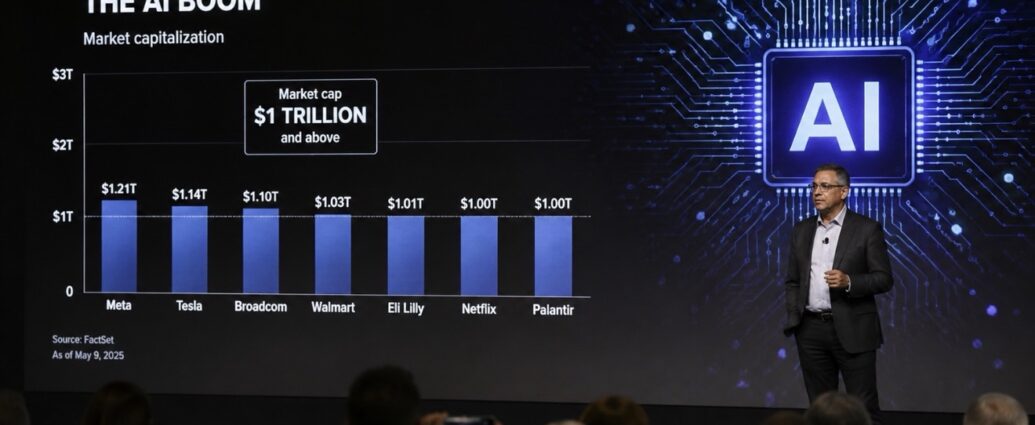
The current trillion-dollar club now consists of 13 companies: Nvidia, Apple, Microsoft, Alphabet, Amazon, Meta Platforms, TSMC, Broadcom, Tesla, Samsung, Berkshire Hathaway, Walmart, and Saudi Aramco.
Ten of those companies are American. Taiwan, South Korea, and Saudi Arabia each contribute one.
The few non-AI entrants help illustrate what scale investors still reward outside the artificial intelligence trade.
Berkshire Hathaway crossed the trillion-dollar threshold in 2024 as the first major U.S. non-technology company ever to do so, reflecting decades of compounded growth across insurance, railroads, utilities, energy, manufacturing, and consumer brands under Warren Buffett.
Walmart became the first retailer to enter the club during 2026, fueled not only by its enormous retail footprint but also by growing investor enthusiasm surrounding its logistics network, advertising business, and expanding digital infrastructure.
Eli Lilly briefly surpassed the trillion-dollar level as demand for its obesity and diabetes treatments surged globally before shares later pulled back.
And Saudi Aramco remains a reminder that control over energy production at sufficient scale still commands enormous market value.
But Wall Street analysts increasingly argue the defining story belongs overwhelmingly to the AI hardware complex.
Nvidia, TSMC, Broadcom, and now Samsung each control a critical chokepoint the artificial intelligence industry cannot bypass.
No frontier AI model gets trained without Nvidia’s processors. No Nvidia processors get manufactured without TSMC’s advanced chip fabrication facilities. No hyperscale AI data center operates efficiently without Broadcom’s networking hardware. And no AI accelerator runs at full performance without the high-bandwidth memory supplied primarily by Samsung and SK Hynix.
The AI boom is no longer simply enriching the companies building chatbots and software applications.
It is elevating the suppliers of the world’s scarcest computing components into the highest ranks of global finance.
That shift is increasingly reshaping the broader market itself.
“Corporate earnings in aggregate keep getting stronger, and it’s mainly coming from one place — from the technology sector,” said Mark Davids, head of emerging markets and Asia Pacific equities at JPMorgan Asset Management.
Samsung’s arrival inside the trillion-dollar club may ultimately serve as another confirmation that the next era of global economic power is being built not only through software and platforms, but deep inside the semiconductor infrastructure powering artificial intelligence itself.
— JBizNews Desk
© JBizNews.com. All rights reserved. This article is original reporting by JBizNews Desk. Unauthorized reproduction or redistribution is strictly prohibited.