By JBizNews Desk
May 11, 2026
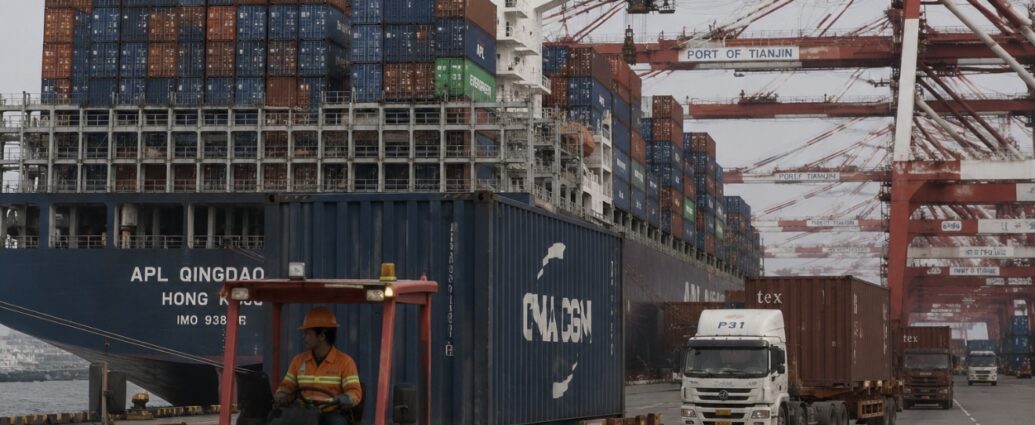
China’s export engine accelerated sharply in April, delivering a trade surplus far larger than economists expected and strengthening Beijing’s leverage just days before President Donald Trump is scheduled to meet President Xi Jinping in a high-stakes summit that could shape the future of the world’s most important trade relationship.
Data released Saturday by the General Administration of Customs of the People’s Republic of China showed Chinese exports reached approximately $359.44 billion in April, while imports totaled roughly $274.62 billion, producing a monthly trade surplus of $84.82 billion.
That marked a dramatic increase from March’s surplus of approximately $51.13 billion.
Total foreign trade for the month climbed to roughly $639.4 billion, with overall trade growing 14.2% year over year in yuan-denominated terms.
Exports rose 9.8% from a year earlier, while imports surged an even stronger 20.6%, reflecting aggressive stockpiling by Chinese manufacturers attempting to secure components and industrial materials before escalating energy costs tied to the Iran war push global input prices even higher.
The rebound arrives at a politically sensitive moment.
Trump is expected to travel to Beijing on May 14-15 for a leaders’ summit with Xi that both governments increasingly view as critical to stabilizing a relationship strained simultaneously by tariffs, technology restrictions, tensions surrounding Taiwan, and diverging positions on the Iran conflict.
The widening trade imbalance will almost certainly become one of the summit’s central issues.
China’s year-to-date trade surplus with the United States has now reached approximately $87.7 billion, according to the latest customs data.
Chinese officials portrayed April’s performance as evidence of continued resilience despite global instability.
Lyu Daliang, director of the customs administration’s Department of Statistics and Analysis, said China’s trade sector maintained strong momentum throughout the early months of 2026, supported by coordinated government policies and expanding overseas demand.
“Foreign trade has performed well since the start of the year, supported by coordinated policy measures and proactive efforts across regions and departments,” Lyu said.
The export growth was broad-based but especially concentrated in high-value technology and industrial categories.
Mechanical and electrical products — China’s single largest export segment — totaled approximately $229.29 billion during the month.
High-technology exports reached roughly $104.01 billion.
Exports of mobile phones climbed to approximately $84.10 billion, while integrated circuits totaled roughly $31.08 billion.
Motor vehicle exports, including engine-equipped chassis, reached approximately $160.96 billion, with automotive components adding another roughly $85.99 billion.
The figures reinforced China’s growing dominance across critical advanced-manufacturing and technology supply chains increasingly tied to the global artificial intelligence boom.
A major driver of April’s export acceleration was surging demand tied directly to AI infrastructure spending.
Global technology companies have been racing to secure chips, industrial components, networking equipment, and manufacturing inputs as the Iran conflict threatens to disrupt global supply chains and increase transportation and energy costs further.
That unusual dynamic — in which geopolitical instability abroad actually boosts Chinese export demand — has become one of the defining characteristics of China’s manufacturing economy during the first half of 2026.
While several export-oriented economies struggled to redirect cargo flows away from the Persian Gulf after the Strait of Hormuz disruption, Chinese manufacturers moved quickly to diversify shipping routes and capitalize on the resulting supply shortages elsewhere.
The strong April performance follows an already historic year for Chinese exports.
After facing U.S. tariffs that briefly climbed to triple-digit levels during 2025, Chinese manufacturers aggressively expanded sales into South America, Africa, Southeast Asia, and the Middle East while lowering prices to preserve market share.
China ultimately finished 2025 with a record annual trade surplus of approximately $1.2 trillion, intensifying criticism from trading partners who argue Chinese industrial overcapacity is distorting global markets.
Now, as Trump prepares to arrive in Beijing, both sides face mounting economic and political pressure to prevent another escalation in trade tensions.
The existing tariff truce reached last year reduced reciprocal tariff rates to approximately 10% through November 2026 following negotiations between Washington and Beijing.
China is expected to push aggressively for an extension of that arrangement.
Trump, meanwhile, faces growing domestic pressure tied to rising gasoline prices, elevated inflation, and weakening consumer confidence ahead of November’s U.S. midterm elections.
Analysts briefed on the expected summit agenda are not anticipating major structural breakthroughs.
But with the current tariff truce set to expire later this year, both governments have strong incentives to avoid renewed confrontation while global markets remain under pressure from the Iran conflict and slowing economic growth.
The April trade figures also reinforce a broader reality increasingly confronting policymakers in both Washington and Beijing.
Despite years of trade tensions, tariffs, and political rhetoric surrounding economic decoupling, China’s manufacturing base remains deeply embedded in global supply chains in ways neither side has yet proven willing — or able — to fully unwind.
Economists increasingly warn, however, that the forces driving China’s export surge during the first half of 2026 may not persist indefinitely.
If the Strait of Hormuz remains disrupted and energy prices continue climbing, the front-loaded demand currently pulling exports higher could eventually fade as global consumers and businesses begin cutting spending more aggressively.
That risk matters especially for Beijing because domestic consumption inside China has remained relatively weak despite repeated rounds of government stimulus.
For now, however, China’s factories continue shipping goods at a near-record pace.
And as Trump and Xi prepare to meet in Beijing this week, the latest trade data ensures both leaders will arrive fully aware that the economic balance between the world’s two largest economies remains as politically sensitive — and strategically consequential — as ever.
— JBizNews Desk
© JBizNews.com. All rights reserved. This article is original reporting by JBizNews Desk. Unauthorized reproduction or redistribution is strictly prohibited.