By JBizNews Desk
May 11, 2026
The U.S. Senate Banking Committee is preparing to hold what could become one of the most consequential cryptocurrency votes in modern American financial history, as lawmakers move closer to establishing the first comprehensive federal regulatory framework governing digital assets in the United States.
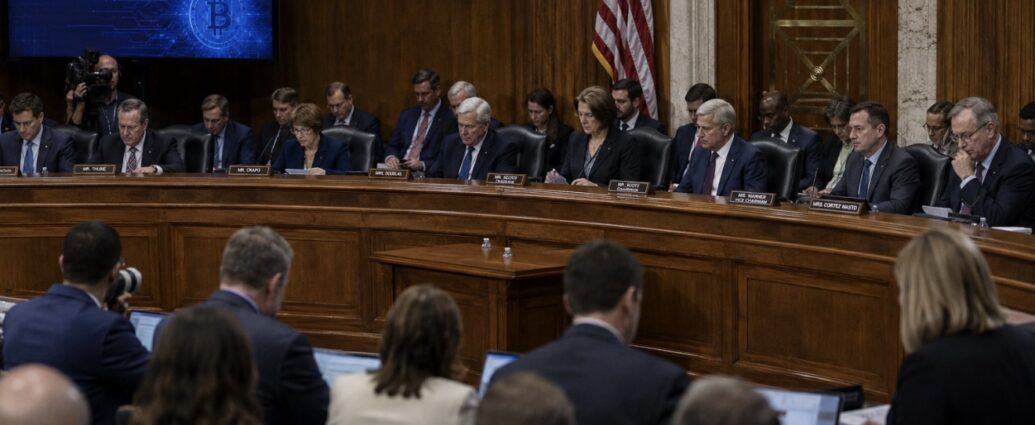
Committee Chairman Senator Tim Scott of South Carolina announced Friday that the panel will convene an executive session on May 14 at the Dirksen Senate Office Building in Washington to consider the Clarity Act — sweeping legislation designed to finally establish clear legal definitions and regulatory boundaries for cryptocurrencies, stablecoins, and blockchain-based financial products.
For the digital asset industry, the vote represents a pivotal moment after years of legal uncertainty, regulatory conflict, and escalating battles between crypto companies and federal agencies.
The legislation seeks to answer one of the most fundamental unresolved questions in the industry: when a digital token qualifies as a security, when it qualifies as a commodity, and when it may fall into a separate digital asset category altogether.
That ambiguity has defined much of the U.S. crypto market for years.
Without formal congressional guidance, companies have faced overlapping and often contradictory oversight from the Securities and Exchange Commission, the Commodity Futures Trading Commission, and other federal regulators, with enforcement actions frequently becoming the government’s primary mechanism for signaling policy expectations.
The Clarity Act would replace much of that uncertainty with a statutory framework assigning regulatory authority based on the structure and function of specific digital assets.
The House of Representatives passed its version of the bill in July of last year, but the legislation stalled in the Senate amid an intense lobbying battle between the cryptocurrency industry and the traditional banking sector.
Now, with the current congressional session entering a politically sensitive stretch ahead of the November midterm elections, pressure is building on both sides.
The Senate must pass the legislation before the end of 2026 if lawmakers hope to deliver the bill to President Donald Trump for signature before the current Congress expires.
For crypto executives, investors, and venture capital firms, the May 14 committee vote is increasingly viewed as a critical inflection point that could determine whether the United States embraces a formalized digital asset framework — or continues operating under the fragmented regulatory environment that has defined the industry for much of the past decade.
At the center of the remaining dispute is a battle over stablecoins and interest-bearing digital deposits.
A separate stablecoin law passed last year established a framework allowing intermediaries, including crypto exchanges, to offer interest-bearing products tied to stablecoin holdings.
Traditional banks are now pushing aggressively to limit or eliminate that provision inside the Clarity Act.
The banking industry argues that allowing crypto exchanges and non-bank financial platforms to pay interest on stablecoins could trigger a major migration of deposits away from federally regulated banks into uninsured digital wallets and exchanges.
Executives warn that such a shift could weaken the traditional banking system’s deposit base — the foundation supporting lending, credit creation, and broader financial stability throughout the economy.
Banks also argue that stablecoin platforms offering deposit-like returns without complying with FDIC insurance requirements, capital standards, and banking regulations would create an uneven competitive landscape carrying systemic financial risks.
The cryptocurrency industry strongly rejects that argument.
Major firms including Coinbase and Kraken have framed the banking industry’s lobbying campaign as an attempt to use regulation to shield incumbent financial institutions from technological competition.
Crypto executives argue that prohibiting exchanges from offering interest-bearing stablecoin products would effectively protect banks while restricting innovation inside digital financial markets.
For many in the industry, the stablecoin debate has become a broader symbolic fight over whether Washington genuinely intends to allow decentralized financial infrastructure to compete with traditional banking systems on equal footing.
The political stakes surrounding the legislation have grown significantly.
The crypto industry is pushing aggressively to finalize the bill before the November midterm elections, where shifts in congressional control could fundamentally alter the legislation’s trajectory.
A change in House leadership could reopen negotiations, delay implementation, or force major revisions to the framework.
After years of failed legislative attempts and regulatory uncertainty, many industry leaders increasingly view the current political window as narrow — and potentially temporary.
The broader environment surrounding cryptocurrency policy has also shifted sharply since Trump returned to office.
Unlike previous administrations that leaned heavily on enforcement actions and regulatory crackdowns, Trump has signaled substantially greater openness toward cryptocurrency innovation and blockchain-based financial infrastructure.
His administration has repeatedly emphasized the importance of keeping digital asset development inside the United States rather than pushing companies and capital overseas.
That shift has fueled optimism across the crypto sector, where executives increasingly view favorable regulation as one of the largest potential catalysts for broader institutional adoption and mainstream financial integration.
The outcome of the Senate Banking Committee’s May 14 vote may ultimately hinge on whether lawmakers can broker a compromise acceptable to both the banking sector and the crypto industry.
If the committee advances a version of the Clarity Act broadly supported by major crypto firms, the legislation moves materially closer to becoming law.
If last-minute banking-industry amendments significantly restrict stablecoin interest provisions or other core components of the framework, however, the deadlock that has paralyzed crypto regulation in Washington for years could continue indefinitely.
For the digital asset industry, the stakes extend far beyond one piece of legislation.
The vote increasingly represents a broader referendum on whether the United States intends to build a formal regulatory framework capable of integrating cryptocurrency into the traditional financial system — or continue leaving one of the fastest-growing sectors in modern finance operating inside legal uncertainty.
— JBizNews Desk
© JBizNews.com. All rights reserved. This article is original reporting by JBizNews Desk. Unauthorized reproduction or redistribution is strictly prohibited.