By JBizNews Desk
May 10, 2026
Flying with checked luggage in the United States has become significantly more expensive almost overnight — and analysts increasingly warn travelers that the higher fees may become permanent even after the global fuel crisis eventually eases.
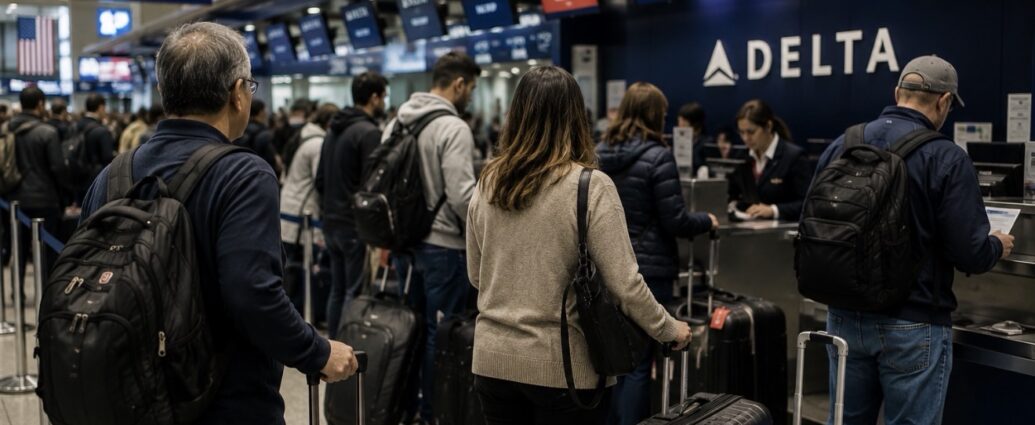
Within a single week in April, every major U.S. airline raised checked baggage fees as carriers scrambled to offset soaring fuel costs tied directly to the ongoing Iran conflict and the disruption in global oil markets.
The coordinated increases across the industry mark the broadest wave of airline baggage fee hikes since U.S. carriers first introduced checked-bag charges during the 2008 oil-price shock.
The underlying economic pressure is severe.
Since late February, the effective closure of the Strait of Hormuz — through which roughly 20% of the world’s seaborne crude oil normally flows — has pushed jet fuel prices sharply higher across global markets.
According to energy intelligence firm Argus Media, jet fuel prices at major U.S. hub airports have surged from approximately $2.50 per gallon before the conflict to roughly $4.69 per gallon.
Fuel remains the airline industry’s second-largest operating expense after labor, meaning the spike immediately translated into higher costs across the sector.
Delta Air Lines Chief Executive Officer Ed Bastian told investors that the fuel surge had already added roughly $400 million in operating expenses since the conflict began on February 28.
Executives at United Airlines and American Airlines described similarly elevated cost pressures during recent earnings calls and investor presentations.
The industry’s response was swift and unusually synchronized.
JetBlue Airways moved first in late March, increasing first checked-bag fees on domestic routes to approximately $39 to $49 depending on travel timing and booking structure.
United Airlines followed on April 3, raising prepaid first-bag fees from $35 to $45 across domestic routes, Mexico, Canada, and Latin America.
Passengers paying within 24 hours of departure now face fees as high as $50 for a first checked bag, while third-bag fees jumped from $150 to $200.
Delta Air Lines matched the new pricing levels on April 8 in what marked the carrier’s first domestic baggage-fee increase in approximately two years.
The same day, Southwest Airlines raised first checked-bag fees from $35 to $45 and second checked-bag fees from $45 to $55 — a particularly symbolic move given Southwest’s decades-long branding around its former “two bags fly free” policy.
That long-standing policy had already been phased out last year as profitability pressures mounted across the industry.
American Airlines subsequently aligned with the emerging industry standard of approximately $45 for a first checked bag.
The cumulative impact on consumers is substantial.
According to travel-industry estimates, a family of four traveling round-trip domestically while checking two bags per person now faces approximately $720 in baggage charges alone — roughly $160 higher than similar trips just several weeks earlier.
Airlines are deliberately choosing to recover fuel costs through ancillary fees rather than aggressively raising base ticket prices.
Industry analysts say the strategy is designed to avoid sticker shock during the booking process itself, where sharply higher fares could reduce overall demand.
“JetBlue initiated, its erstwhile partner United followed within 48 hours, and others are likely to match,” airline industry consultant Robert Mann Jr. told travel publication Afar.
Southwest publicly described its own increases as part of “an ongoing analysis of the business and against the evolving global backdrop.”
For consumers, however, the more important question may not be why fees increased — but whether they will ever come back down.
Many analysts believe the answer is likely no.
“Baggage fees are likely sticky — once they go up, they stay there,” Drew Powers, founder of Powers Financial Group, told Newsweek.
Alex Beene, a financial literacy instructor at the University of Tennessee at Martin, echoed that assessment directly.
“Even if the conflict subsides, it could take weeks to see prices come down,” Beene said. “And, sadly, it might be that baggage fees never come down, as those fees are known to stay at their new levels.”
History supports that concern.
When airlines first introduced checked-bag fees during the oil-price shock of 2008, carriers initially framed the charges as temporary responses to extraordinary fuel costs.
The fees remained even after oil prices later collapsed.
Over time, baggage fees evolved into one of the airline industry’s most profitable revenue streams.
According to federal transportation data, U.S. airlines collectively generated billions annually from baggage charges and other ancillary fees throughout the past decade.
The broader industry response to rising fuel costs extends beyond baggage pricing alone.
United Airlines Chief Executive Officer Scott Kirby warned recently that the company plans to eliminate certain routes over the next several quarters as part of broader cost-control measures tied to the fuel environment.
Other carriers are similarly reevaluating schedules, aircraft utilization, and capacity planning heading into the summer travel season.
That timing matters.
Summer is historically the busiest and most profitable travel period of the year for U.S. airlines.
Instead, carriers are entering the season facing sharply elevated fuel prices, rising operational costs, and little clarity surrounding when — or whether — global energy markets will stabilize.
For travelers, the result is becoming increasingly clear.
The era of inexpensive checked luggage is fading further into history — and once airlines discover consumers will pay higher fees, those charges rarely move in reverse.
— JBizNews Desk
© JBizNews.com. All rights reserved. This article is original reporting by JBizNews Desk. Unauthorized reproduction or redistribution is strictly prohibited.