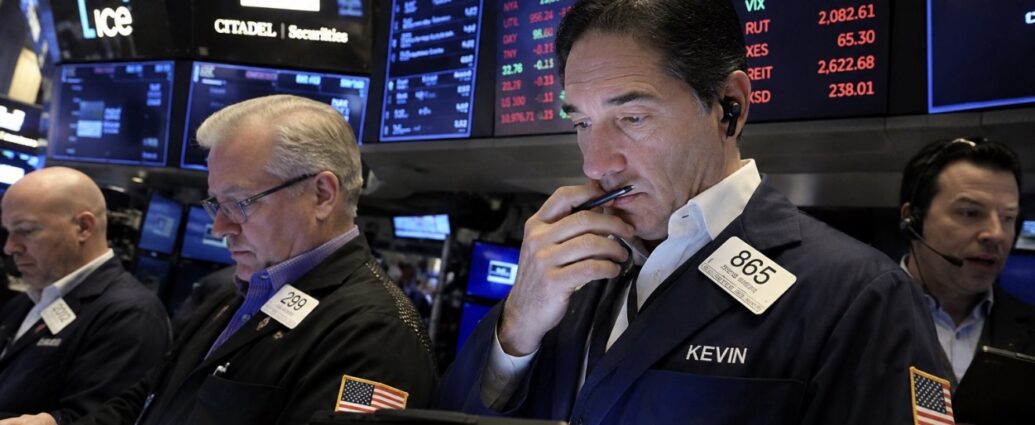
10:52 a.m. ET
Wall Street is struggling to extend its historic six-week rally Monday morning as surging oil prices, renewed geopolitical anxiety surrounding Iran, and a mixed batch of corporate earnings offset optimism from last week’s strong jobs report and record highs in the major indexes.
As of 10:52 a.m. ET, the S&P 500 is hovering near flat, the Dow Jones Industrial Average is little changed, and the Nasdaq Composite is down 0.34% after both the Nasdaq and S&P touched fresh all-time intraday highs earlier in the session. The Russell 2000 is outperforming, up 0.76%, signaling a rotation into smaller-cap stocks as momentum in mega-cap technology shares cools.
Energy markets remain the dominant macro force driving sentiment.
West Texas Intermediate crude has surged more than 3% to above $98 per barrel, while Brent crude is trading north of $104, after President Donald Trump rejected Iran’s latest ceasefire proposal over the weekend and signaled no immediate willingness to ease pressure on Tehran.
Iranian Foreign Ministry spokesman Esmaeil Baghaei said Monday that Tehran’s proposal was “generous and legitimate,” offering an end to the conflict, reopening of the Strait of Hormuz, release of frozen Iranian assets, and the lifting of the U.S. blockade on Iranian shipping.
Trump rejected the proposal Sunday on Truth Social, calling it “TOTALLY UNACCEPTABLE,” immediately reigniting fears that the Gulf conflict — now entering its third month — could drag deeper into the summer and continue disrupting global energy markets.
The Strait of Hormuz remains effectively constrained, keeping roughly 20% of the world’s seaborne oil trade under ongoing threat and maintaining intense pressure across global shipping, aviation fuel, and inflation expectations.
JPMorgan global economics chief Bruce Kasman warned clients last week that operational stress in global supply chains could begin accelerating as early as June if disruptions continue.
Markets are now increasingly focused on the upcoming Trump-Xi summit scheduled for May 14–15 in China, which investors view as an unofficial diplomatic deadline for progress.
“The market has been using this summit as a bit of a deadline,” Scott Ladner of Horizon Investments said Monday, warning that if no progress is made before the summit concludes, investors may begin pricing in a much longer-duration geopolitical conflict.
Despite the uneasy macro backdrop, Wall Street entered Monday with powerful momentum behind it.
Last Friday, the S&P 500 closed at a record 7,398.93, while the Nasdaq finished at an all-time high of 26,247, capping a sixth consecutive winning week fueled by stronger-than-expected payroll growth and another solid earnings season.
Nonfarm payrolls rose 115,000 in April, nearly double consensus expectations, while first-quarter S&P 500 earnings broadly outperformed Wall Street estimates.
Still, some strategists are warning the market may need a pause after the sharp rally.
Sam Stovall of CFRA Research said Monday the S&P 500 “may need to take some time to catch its breath” before attempting another sustained move higher.
Corporate earnings continue driving sharp stock-specific moves beneath the relatively flat index action.
Qualcomm (QCOM) jumped 9.5% after beating second-quarter expectations and confirming plans to begin shipping data-center chips to a major hyperscale customer later this year — an important signal that the company is gaining traction in the AI infrastructure market dominated largely by Nvidia and AMD.
Intel (INTC) rose 5.7% after The Wall Street Journal reported the company reached a preliminary manufacturing agreement involving Apple chips, extending a remarkable rally that has nearly doubled Intel shares since its April earnings report.
Monday.com (MNDY) surged 26% after reporting revenue growth of 24% year over year and unveiling a new AI platform that impressed investors already aggressively chasing enterprise artificial-intelligence software names.
Lumentum Holdings (LITE) climbed 7.7% after Nasdaq announced the company would join the Nasdaq-100 index later this month.
Sony gained 6% following news of a sensor partnership with Taiwan Semiconductor Manufacturing.
Meanwhile, Fox Corporation (FOXA), Constellation Energy (CEG), and Barrick Mining (B) all traded higher after reporting earnings beats before the opening bell.
On the downside, weakness was concentrated in consumer, industrial, and speculative-growth names.
Dollar General (DG) fell 5.8% after issuing softer-than-expected fiscal 2026 guidance amid uncertainty tied to a management transition.
Mosaic (MOS) dropped 5% following disappointing earnings, while industrial supplier W.W. Grainger (GWW) plunged 18% as traders locked in gains after the stock recently reached record highs.
Nintendo shares fell more than 11% after announcing an unexpected price increase for the upcoming Switch 2 gaming console alongside cautious forward guidance.
The Trade Desk (TTD) slid 9% after disappointing second-quarter forecasts, while Palantir Technologies (PLTR) weakened despite strong earnings amid valuation concerns and reports involving NHS England data-access issues.
One of the strongest themes on Wall Street continues to be artificial intelligence.
The Roundhill Memory ETF (DRAM) — heavily tied to AI memory demand — reached $6.5 billion in assets in just 36 days, making it the fastest ETF in history to cross that threshold, according to Bloomberg Intelligence analyst Eric Balchunas.
The housing market, however, continues flashing signs of strain.
The National Association of Realtors reported Monday morning that existing home sales rose just 0.2% in April to a seasonally adjusted annual rate of 4.02 million units, missing expectations for 4.12 million and remaining effectively flat year over year.
NAR Chief Economist Lawrence Yun acknowledged the sluggish trend directly.
“This spring homebuying season, so far all the way through April, we can say we are not predicting any increase compared to one year ago,” Yun said.
Mortgage rates hovering near 6.4%, driven partly by elevated Treasury yields tied to energy-driven inflation fears, continue weighing heavily on affordability and buyer activity.
Investors are now looking ahead to one of the most important economic weeks of the year.
April CPI arrives Tuesday morning, followed by Producer Price Index data Wednesday and Retail Sales Thursday — all of which will heavily influence Federal Reserve expectations and the inflation outlook.
The Trump-Xi summit later this week adds another layer of geopolitical significance.
And looming over everything is Nvidia’s earnings report on May 20 — an event many traders already view as the next major catalyst for the AI-driven bull market that continues powering much of Wall Street’s momentum.
— JBizNews Desk
© JBizNews.com. All rights reserved. This article is original reporting by JBizNews Desk. Unauthorized reproduction or redistribution is strictly prohibited.